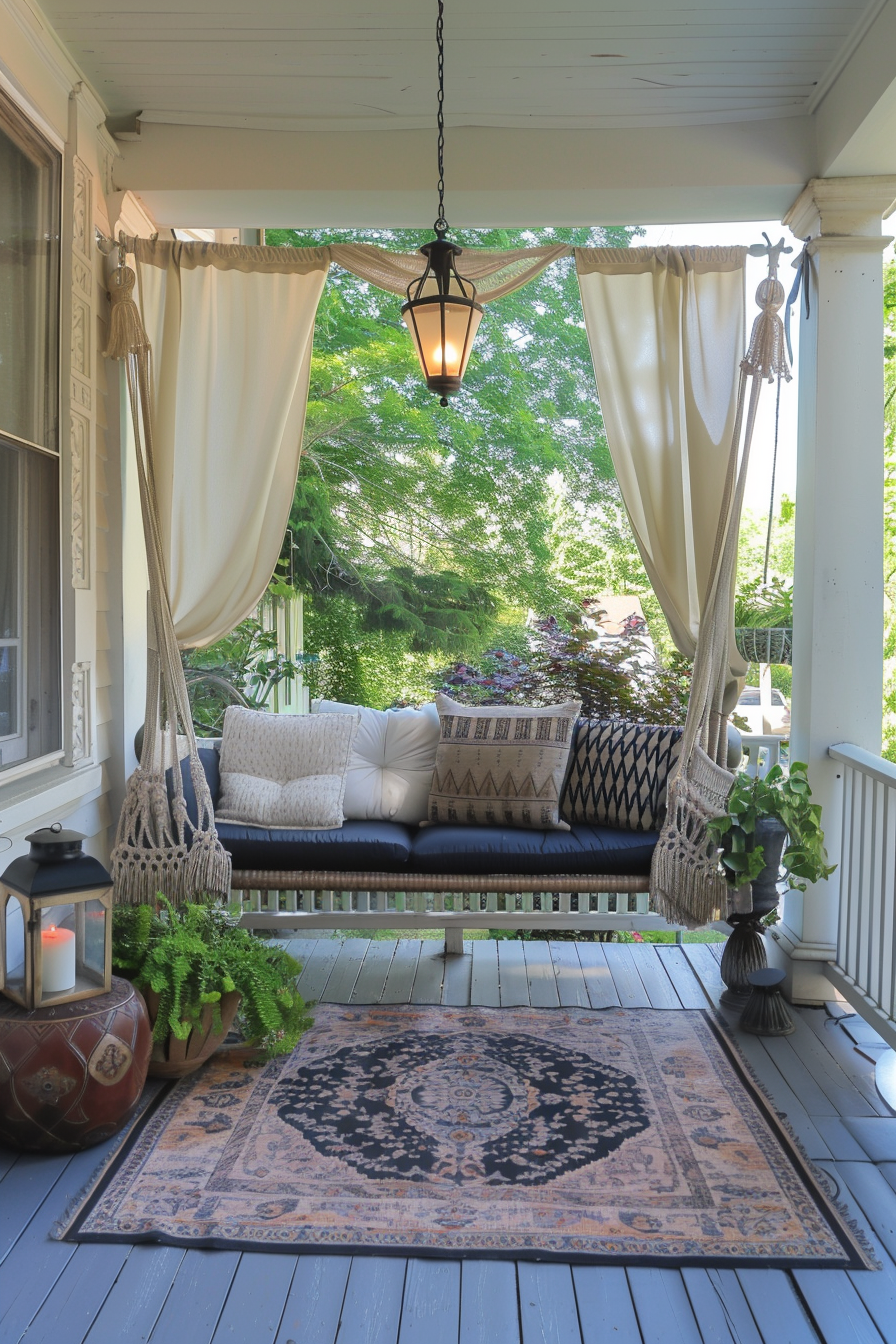
I spent three summers with a bare, glaring porch before I finally hung curtains out there — and honestly, it changed everything. The afternoon sun stopped being an enemy, Biscuit got a shady nap corner, and suddenly the whole space felt like a room instead of just a slab of concrete with a couple of chairs. Curtains are the single fastest way to make a porch feel intentional. And the options are so much more interesting than people think.
Below I’m breaking down 13 curtain styles I’ve researched, tested, or straight-up obsessed over. I’ll tell you which ones are worth the money, which ones I’d skip for an actual outdoor space, and a few tricks I’ve picked up the hard way. The macramé section alone might be enough to make you rearrange your whole front porch. Fair warning.

Sheer Curtains for a Light and Airy Look

Sheer curtains are where most people start, and honestly, they’re a good place to start. They let the light in — that golden, filtered kind of light that makes everything look softer — while still giving you just enough of a visual barrier that you don’t feel completely on display for every passing neighbor.
I hung a pair of white voile panels on my back porch for about $18 total from HomeGoods, and they made the whole space feel like something out of a magazine. Not because they were fancy. Just because they moved. There’s something about fabric that billows in a breeze that makes a porch feel alive in a way no other decor really does.
For color, white and off-white are genuinely the easiest choices and I don’t think that’s boring advice. They go with everything. But if you want to add a little personality, pale sage green or a dusty blush can be really lovely against natural wood or brick. I tried a pale blue once and it read more “pool bathroom” than “dreamy porch,” so I’d test a swatch first before committing to a whole set.
Fabric matters more than people realize. Look specifically for voile, chiffon, or organza if you want that floaty, soft effect. Cheaper polyester sheers exist and they work, but they tend to hang stiffly and bunch weird at the clips. A little bit of natural fiber content (even a cotton-poly blend) makes a noticeable difference in how the curtain drapes.
For hanging, clip rings on a simple rod are the easiest option. If you want something that looks a little more considered, a matte black tension rod with silver rings is under $15 at most hardware stores and looks way more expensive than it is. If your porch gets serious afternoon sun or wind, do a double rod: sheers on the inner rod, a heavier panel on the outer. You can open and close them independently depending on the time of day, which is genuinely useful.
Sheer curtains work in almost every porch style. Pair them with lace trim for something vintage. Keep them plain and solid for a cleaner, more modern look. Either way, they soften the whole space without making it feel closed off.
Outdoor Curtains for Privacy and Protection

My neighbor has the most enthusiastic lawn mowing schedule I’ve ever witnessed. Every single weekend morning. And that’s exactly why I became a convert to proper outdoor curtains.
These are not your regular interior curtains dragged outside. Real outdoor curtains are made from polyester or solution-dyed acrylic — materials that can handle UV exposure, humidity, and rain without fading or going moldy. The difference between using indoor curtains outdoors versus actual outdoor-rated ones is about one summer. Indoor fabric will be bleached and sad by August. Outdoor fabric will still look fine three years later.
When you’re shopping, look for labels that say “solution-dyed” or “UV resistant.” IKEA’s HILDIS panels are a budget-friendly outdoor option. For something sturdier, look at brands like Sun-Zero or Eclipse, which make panels specifically rated for outdoor use. Expect to spend somewhere between and per panel for decent quality.
For full enclosure, you want panels long enough to hit the floor (or close to it) and wide enough that you’re using roughly 1.5 to 2 times the width of your opening. Skimping on width is the number one mistake people make — flat curtains with no gather look cheap and block less light. More fabric equals better coverage and a more luxurious look, even in an inexpensive material.
The rod situation matters too. Don’t hang heavy outdoor curtains on a flimsy tension rod and expect it to hold in a July thunderstorm. A galvanized steel or aluminum rod properly anchored into the wall or ceiling is what you actually need. I learned this after watching a tension rod take out a whole curtain panel mid-thunderstorm and clothesline Biscuit on its way down. He was fine. I was embarrassed.
Style-wise, outdoor curtains are genuinely fun to play with. A wide cabana stripe gives you that easy, coastal-house vibe. Navy or slate gray solid panels look more polished and work with basically any porch furniture. I’ve also seen a natural linen-look outdoor fabric that’s beautiful — it reads as relaxed and warm but holds up surprisingly well.
Blackout Curtains for Better Sleep

Okay, this one might seem like overkill for a porch. But hear me out.
If you have a screened sleeping porch, a porch that doubles as a home office, or you live somewhere that gets blazing early morning sun, blackout curtains are genuinely worth it. My sister converted her side porch into a reading nook slash guest overflow situation, and the blackout curtains she hung there are the reason anyone can actually sleep past 6am in the summer.
The key is looking for panels labeled “100% blackout” specifically, not “room darkening.” Room darkening still lets light bleed through — it’s better than nothing, but it’s not the same. True blackout fabric has a thick foam or thermal coating on the back that blocks light completely and also helps with temperature control. In a porch space that gets a lot of direct sun, that thermal layer can make a real difference in how hot the space gets mid-afternoon.
The one honest caveat: blackout curtains are heavier and they can make a porch feel a little oppressive during the day if they’re closed. The solution most people land on is a double-layer setup — blackout panels for nighttime or nap time, lighter sheers that you can pull closed during the day without losing all your light. It sounds like extra effort but once the rods are up it’s actually really easy to work with.
Hang them as close to the opening as possible, and use a rod that extends at least 4 to 6 inches beyond the frame on each side. Light sneaks in around the edges more than through the fabric, so the wider coverage matters. Velcro tape along the sides to the wall or screen frame can close that last gap if you need it truly dark.
Colors are less of a concern here since the functionality is the point — but blackout curtains do come in nice options now. Deep charcoal, warm ivory, even a dusty mauve. They don’t have to look utilitarian.
Macramé Curtains for a Bohemian Touch

I will not apologize for how much I love macramé. It’s knotted rope and it somehow makes every space look ten times more intentional and collected. My front porch has a macramé panel I got from an Etsy seller for $38 and it gets more compliments than anything else out there.
The thing about macramé curtains specifically is that they do something other curtains can’t: they create texture and visual interest without blocking the light or the breeze. The open weave lets air move through freely, which on a warm afternoon is actually a significant comfort advantage over solid fabric panels. You get privacy (people can’t really see through knotted rope from a distance) without feeling closed in.
For style matching: if your porch is already leaning boho or natural, macramé is an obvious yes. If your space is more clean-lined or modern, look for macramé in a tighter, more geometric knot pattern rather than the big loopy fringe-heavy styles. There’s a whole range between “Stevie Nicks’ porch” and “minimalist wall art” and most of it lives on Etsy.
Bamboo or raw wood rods look great with macramé — they reinforce that natural, handmade feeling. A chunky wooden dowel from the craft store (often under $8 for a 36-inch length) works perfectly. If you want something with a more industrial edge, matte black metal works surprisingly well too.
One real limitation worth knowing: macramé is not weather-proof. If your porch is fully exposed to rain, the rope will absorb moisture and take forever to dry out, and eventually it’ll degrade or mildew. Covered porches are ideal. If yours gets some weather, look for macramé made from cotton-poly blend cord rather than pure cotton — it handles moisture a little better.
Pair it with woven jute rugs, lots of plants, and maybe a rattan chair and you’ll have the porch everyone stops to photograph.
Roll-Up Blinds for Easy Adjustments

Roll-up blinds are the most practical option on this whole list, and I mean that as a compliment. No drama. No finials, no clip rings, no fabric pooling on the floor. You pull a cord, the thing rolls up. You release it, it comes down. It’s fast and it works.
For outdoor porches that get direct afternoon sun, roll-up blinds — especially ones made from solar screen fabric — are genuinely one of the best ways to cut glare without making the space feel dark. Solar screen fabric is woven loosely enough to preserve your view and your airflow, but it blocks a significant amount of UV and heat. On a west-facing porch this is not a small thing. That 3pm light can be brutal.
Bamboo roll-up blinds are the other option I love, and they’re incredibly affordable (often $20-$35 at Target or IKEA for a standard width). They add warmth and texture in a way that plastic or canvas alternatives just don’t, and they pair nicely with almost any porch furniture style. The downside is they’re not fully weatherproof — bamboo warps and splits if it gets soaked repeatedly. Covered porch only, or bring them in during storms.
For installation, measure your opening carefully before you buy. Most roll-up blinds mount inside the frame (inside mount) or outside it, and the measurement approach is slightly different for each. Inside mount tends to look cleaner but requires a specific minimum depth. Outside mount gives you more flexibility and covers gaps around the frame. When in doubt, outside mount is easier to make work.
You can also customize roll-up blinds pretty significantly — cutting bamboo ones down to width isn’t difficult with a handsaw and some sandpaper, and you can add trim or paint the wooden components to match your porch palette. I’ve seen people stencil patterns onto canvas roller shades and they look amazing, honestly.
Cafe Curtains for a Cozy, Intimate Feel

Cafe curtains have a really specific energy that I think is underrated in porch spaces. They’re half curtains — covering the bottom portion of the opening, leaving the top exposed — so you get privacy at sitting height without losing your sky view or your upper light. It’s a clever little trick.
I used cafe curtains on my side porch, which faces the neighbor’s driveway. Hung them at about the midpoint of the railing height and suddenly I can sit out there with my coffee without feeling like I’m performing for an audience. But the porch still feels open, still gets the breeze, still feels like outside. That balance is hard to get with full-length panels.
Fabric choices here are actually pretty wide open. Lightweight cotton or linen in a solid color looks clean and cottage-like. A small gingham or ticking stripe gives you that classic bistro feeling (hence the name “cafe curtains”). I’ve also seen heavyweight canvas or denim used for a more casual, relaxed vibe that works really well on covered porches with outdoor furniture.
The rod goes at roughly the midpoint of your opening — a simple tension rod works fine here and keeps installation super easy. No drilling required if your frame has enough width to tension against. Clip rings or sewn rod pockets both work for hanging. I personally prefer clips because I can adjust the gather and take them down to wash without any hassle.
Pair them with a small bistro table and a couple of mismatched vintage chairs and the whole vibe is extremely charming. Add a potted herb or two and you’ve basically created a French countryside corner in your suburban backyard.
Grommet Curtains for a Modern, Industrial Look

Grommet curtains are what I’d recommend if you want something that looks purposeful and clean without a lot of effort. The metal rings are punched directly into the fabric at even intervals, so when you slide them onto the rod you automatically get those neat, even folds. No clip ring adjusting, no rod pocket wrestling. It just looks tidy.
They’re also genuinely easy to open and close, which matters more than people think. Curtains you have to fiddle with every time tend to stay closed or stay open permanently. Grommets glide. You’ll actually use them.
For a porch with modern, streamlined furniture — think clean metal frames, concrete or composite decking, minimal color palette — grommet curtains in a solid deep color are a natural fit. Charcoal, slate, navy, or even a warm off-white work beautifully. The grommets themselves come in silver, black, and oil-rubbed bronze finishes, and it’s worth picking a finish that coordinates with your other hardware (light fixtures, door handles, furniture frames). It’s a small thing but it makes the whole space look more designed.
Canvas and outdoor-rated polyester are the most practical fabric choices for a porch, and most outdoor grommet panels are made from exactly these. They’re durable, washable, and hold their shape well. If you want a softer, more relaxed feel, a linen-look polyester blend gives you the texture without the maintenance of real linen (which does not love being rained on).
For styling, I’d keep everything else in the space fairly simple if you go with a bold grommet curtain. Let the panels be the statement. A couple of clean-lined chairs, a side table with a lantern, done.
Tab-Top Curtains for a Relaxed, Casual Look

Tab-top curtains are the chill, no-fuss cousin of every other curtain style. The fabric loops sewn into the top slip right over the rod — no rings, no grommets, nothing to thread or clip. You’re done in five minutes.
They have a relaxed, slightly uneven hang that I find really charming for casual porches. Not everything needs to be perfectly tailored. Sometimes a little soft drape is exactly the right energy.
The tab size makes a bigger visual difference than you’d expect. Large, wide tabs create a bold, almost graphic look where the rod is part of the design. Smaller, narrow tabs blend in more and let the fabric take center stage. If you’re going for a bohemian or cottagecore vibe, bigger tabs on a rough wood or bamboo rod look really lovely.
Material-wise, tab-top curtains come in everything from lightweight cotton to heavy canvas to outdoor-rated polyester. For a porch that gets weather, stick with outdoor fabric. For a covered porch with minimal exposure, you have more latitude — even a natural linen or a soft canvas works well and wears beautifully over time.
One thing I’d flag: tab-tops don’t slide open and closed as easily as grommets or clip rings. The tabs grip the rod a bit, so they’re more of a set-it-and-leave-it situation. If you want curtains you’ll be opening and closing multiple times a day, another style might serve you better. But if you just want them pulled to one side as a permanent frame for your porch view, tab-tops are gorgeous for that.
Style them with woven textures, lots of plants, and maybe some rope accents, and you’ve got a porch that looks like you spent a week curating it even if you put it together on a Sunday afternoon.
Tie-Top Curtains for a Romantic, Whimsical Touch

Tie-top curtains are sweet. I don’t know a better word for them. Long ribbons or fabric ties bow around the rod and create these soft, slightly messy loops that feel romantic and effortless in a way that’s hard to replicate with other hardware.
They’re the kind of curtain that looks genuinely beautiful caught in a breeze. Especially in a lightweight fabric like chiffon or voile. That movement is everything.
The ties themselves can be part of the design statement. Long, trailing ties in a contrasting fabric (like navy ties on white curtains) look intentional and interesting. Matching ties that blend into the curtain are softer and more subtle. I’ve also seen satin ribbon used as ties on heavier linen panels, which creates a really unexpected and pretty contrast between formal and rustic.
For a porch, I’d stick with tie-tops on covered or semi-covered spaces where they won’t get soaked. The tying mechanism doesn’t love moisture and repeated wet-dry cycles will fray the fabric at the knot points pretty quickly. If you get some rain but not a full deluge, a cotton-poly blend will hold up better than pure cotton or chiffon.
These pair beautifully with string lights. Honestly almost every curtain on this list looks better with string lights, but tie-tops in particular — the softness of the fabric plays off the warm glow in a really flattering way. Add some vintage-style Edison bulbs draped loosely overhead and some mismatched vintage cushions and it looks like a Pinterest board come to life.
Pair them with floral pillows, a couple of potted gardenias if you can keep them alive (I cannot), and some ambient light and you’ve got one of the most romantic porch setups imaginable.
Sheer Voile Curtains for a Light, Airy Feel

I know I already talked about sheers up top, but voile specifically deserves its own moment because it’s a cut above your average sheer fabric. It has a tighter weave than chiffon, which means it hangs more crisply, it’s less likely to snag, and it holds its shape better over time. It’s also more affordable than you’d expect — a good voile panel is often in the $15-$25 range.
Voile is the fabric I’d reach for if I wanted sheers that actually look intentional rather than like I grabbed whatever was on clearance. There’s a quality to the way it catches light that’s just nicer. It glows a little rather than just being transparent.
White and ivory are the classics and they genuinely work everywhere. But patterned or embroidered voile is worth looking for if you want something with a little more personality. A tonal embroidered leaf pattern or a subtle woven stripe can add texture without reading as busy. I found a white voile with a very fine silver thread woven through it once and I still think about it (I didn’t buy it, which I regret).
For hanging, voile works best with some fullness — use a rod width that’s at least 1.5 to 2 times the opening width for a properly gathered look. A flat voile panel looks cheap regardless of the fabric quality. Give it room to breathe and fold and it’ll look beautiful.
Wicker or rattan furniture, a ceiling fan, some potted ferns — that’s the full picture for this style. It’s classic without being stuffy and it works in a 100-year-old Victorian porch or a 1990s ranch-style overhang equally well.
Lace Curtains for a Vintage, Romantic Touch

Lace curtains have a very specific aesthetic and I respect that they’re not for everyone. But if your porch has any kind of vintage, Victorian, or cottage character, they are absolutely the right call and nothing else comes close to replicating what they do.
Real lace fabric catches the light in this intricate, dappled way that solid or woven fabrics just can’t match. It throws tiny shadow patterns onto the floor and walls around it. It’s genuinely pretty in a way that has nothing to do with trends.
Classic white or ivory is the obvious choice, and it’s obviously a classic for a reason. But blush or pale butter yellow lace can be stunning if you want something a little warmer. Avoid anything too bright or synthetic-looking — cheap lace has a very obvious plastic quality that takes away from the delicate effect you’re going for.
Patterns range from simple geometric mesh to elaborate florals and paisleys. For a front porch with Victorian trim details, an intricate floral lace pattern is going to look like it was made for the house. For something a bit more restrained, a simple scalloped or grid lace keeps the romantic feeling without going full grandmother’s parlor.
Lace needs gentle care. Hand wash or gentle machine cycle, line dry, don’t iron it aggressively or the pattern will flatten and lose its dimensionality. If you hang it on a covered porch and it’s not getting rained on, you probably won’t need to wash it more than once a season anyway.
Pair lace with antique white painted furniture, maybe a porch swing with floral cushions, and some potted roses if you’re going all in. Add a reading lamp and an actual paper book (not a tablet, somehow a tablet ruins the vibe) and it’s perfect.
Striped Curtains for a Classic, Preppy Look

Stripes are one of those patterns that never actually go out of style even though they’re always being declared “in” or “out” on whatever interior design blog is currently being loudly wrong. Navy and white stripes in particular have been working on porches for about 200 years. I feel confident they’ll keep working.
The stripe width is the variable that changes everything. Thin, tightly spaced stripes (classic ticking) look tailored and a little farmhouse-y. Medium cabana stripes (think beach umbrella) have that easy, vacation-porch energy. Oversized bold stripes feel more graphic and contemporary. They’re technically all “striped curtains” but the vibe difference is significant.
For a nautical or coastal porch: navy and white, medium-width stripe, maybe a little bit of a horizontal orientation. For a farmhouse or cottage porch: ticking stripe in neutral tones, vertical, linen or cotton fabric. For something more modern: a wide two-color block stripe in unexpected colors like rust and cream or olive and white.
I’d suggest keeping the rest of your porch relatively solid and simple when you go with stripes. Stripes already have visual energy — they don’t need competition from a floral pillow and a plaid rug. One or two solid-color pillows that pull from the stripe palette and a natural texture element (jute rug, wicker chair) is usually enough.
Outdoor-rated striped panels are really easy to find because stripe is one of the most common patterns for outdoor fabric. Sunbrella makes some beautiful options if budget allows. For something more affordable, IKEA and Target both carry outdoor-rated striped panels that are genuinely decent quality for the price.
Floral Curtains for a Colorful, Cheerful Touch

Floral curtains are a commitment. More than any other pattern on this list, they’re going to be the loudest thing on your porch, so it’s worth thinking through scale and color before you buy.
Large, blowsy floral prints — the kind with big roses or tropical leaves splashed across the fabric — are bold and fun and they work in spaces that can handle some personality. A white-painted porch with natural rattan furniture and simple green plants can absolutely absorb a big floral curtain and look amazing. That same curtain in a porch that already has patterned cushions and a busy rug is going to feel chaotic.
Smaller, more delicate florals (ditsy prints, small calico patterns, sprig designs) are easier to work with because they read more like a textured solid from a distance. They add color and visual interest without dominating the whole space. This is usually the safer choice if you’re not sure how much pattern your porch can take.
Color is important here too. A floral in soft, earthy tones — think muted terracotta and sage on a cream ground — is warm and easy to live with. A floral in bright primary colors is fun for about a season and then tends to feel exhausting. I’ve made this mistake with throw pillows enough times to say it with confidence: the muted version almost always ages better.
For styling, keep the rest of the space grounded. Solid cushions in colors pulled from the floral, a simple natural rug, some real plants (which complement any floral without competing). Painted furniture can be lovely with florals — a sage green or butter yellow chair looks really intentional against a soft floral curtain backdrop.
And if you’re worried about committing to florals for the whole porch, start with just one panel as an accent on one side. Asymmetry is underrated and it gives you a way to try a bold pattern without going all in at once. I’ve done this. It works. And if you hate it, you’re out one curtain panel, not a set of four.
Whichever direction you go, adding curtains to your porch is one of those rare projects where the impact is wildly disproportionate to the effort. A rod, some panels, maybe an afternoon of measuring and swearing at a drill. And suddenly your porch is a place you actually want to spend time in — not just a space you walk through to get to the backyard. Biscuit approved.