Does It Matter Which Direction You Paint a Ceiling?

I repainted my dining room ceiling three times in four years. First contractor said roll east to west, parallel to the longest wall. Second said roll toward the window, always toward the light. I did it both ways. Both ceilings looked completely identical. I spent probably six hours of my life across those three paint jobs chasing a rule that, for my dining room, simply did not exist.
Here’s what nobody’s tutorial will tell you: ceiling direction is a real variable in exactly one specific situation. Every other scenario you’ll encounter? Direction is noise. And the entire industry has buried that fact inside a checklist because a checklist feels like value.
The Only Situation Where Direction Actually Changes What You See
Raking light. That’s it. That’s the whole list.
When sunlight enters a room at a low angle — below 30 degrees from horizontal — it skims across your ceiling surface instead of hitting it from above. That skimming action casts tiny shadows off your roller texture. Those shadows align perpendicular to the light beam. If your roller tracks run the same direction as those shadows, they disappear. If they run across them, you see every single pass you made.
This condition shows up most aggressively in rooms with windows under 3 feet wide in rooms over 12 feet across. A narrow window concentrates the light into a beam rather than washing the room softly. Wide windows diffuse. Small windows rake.
Every tutorial that hands you a compass direction as a universal rule is padding content around this one edge case. South-facing room with a single 28-inch window and nine-foot ceilings? Yes, direction matters. Bathroom with a frosted glass window and a vanity light? You could paint in circles and nobody would know.
Honestly, my house has one room where this actually comes up — the front bedroom, north-facing, single window, fourteen feet of ceiling between it and the opposite wall. One room. Everything else I’ve painted in here, direction was just something I was worrying about for no reason.
What Raking Light Actually Does to Roller Texture
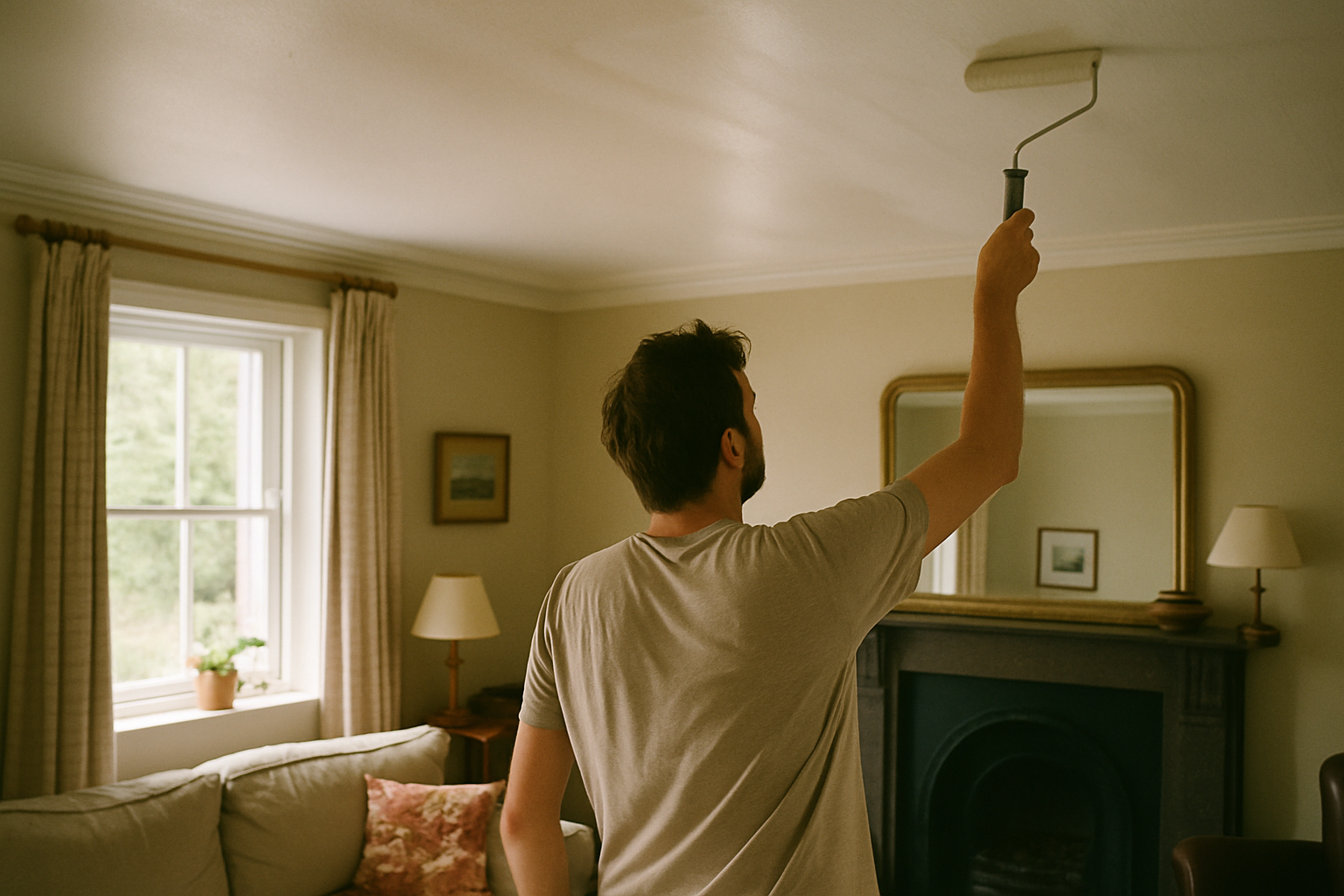
A roller doesn’t lay paint flat. It leaves micro-ridges. Depending on your nap, those ridges run between 1 and 2mm high — invisible under normal overhead light, but under raking conditions they cast actual shadows you can see from across the room.
Nap size is the piece of this nobody talks about loudly enough. A 3/8-inch nap leaves shallower ridges than a 1/2-inch nap. The difference in ridge depth is small in absolute terms but meaningful when light is hitting at five or ten degrees off horizontal. I switched to 3/8-inch nap on every ceiling that isn’t heavily textured, and it cut the direction problem down to almost nothing before I even had to think about which way I was rolling. That one swap does more work than any direction rule.
The shadow visibility threshold is roughly 18 inches out from a single-source window at raking angles. Past that, the shadows soften as the light spreads. So your problem zone is actually a strip along the wall, not the entire ceiling. Worth knowing before you overthink the middle of a 14-foot room.
And don’t assume smooth ceilings are immune. I did. My old kitchen had fresh skim-coat, looked like glass before painting, and still showed roller tracks under the afternoon light from the west window. Flat surface doesn’t mean zero texture. It means less texture. Less is not none.
Room Types Where Direction Is Genuinely Irrelevant
Most rooms, honestly.
Recessed lighting hits the ceiling at a 90-degree downward angle. Straight down. There is no raking. The light doesn’t skim anything — it lands perpendicular to the surface, and perpendicular light does not shadow a 1mm ridge. If recessed cans are your primary source, you can roll whatever direction feels natural and the result will be the same.
Rooms with windows on two or more walls neutralize raking light because the angles compete. The shadow from the east window and the shadow from the north window cancel each other out — or at least reduce each other to the point where no single direction choice fixes anything anyway. Skylights are even more extreme. They diffuse light across more than 60 degrees of ceiling area, essentially turning your whole ceiling into an evenly lit surface regardless of time of day.
Windowless bathrooms, laundry rooms, interior hallways, walk-in closets, any room where overhead fixtures are doing all the work. None of these need a direction strategy. The hallway in my house has never once cared which way I rolled it, and I’ve painted it twice. The majority of interior rooms in American homes fall into this category. The direction debate is a non-issue for most people painting most rooms. It just doesn’t feel that way because tutorials treat the edge case like the standard case.
Wet Edge Is the Rule That Actually Prevents Lap Marks
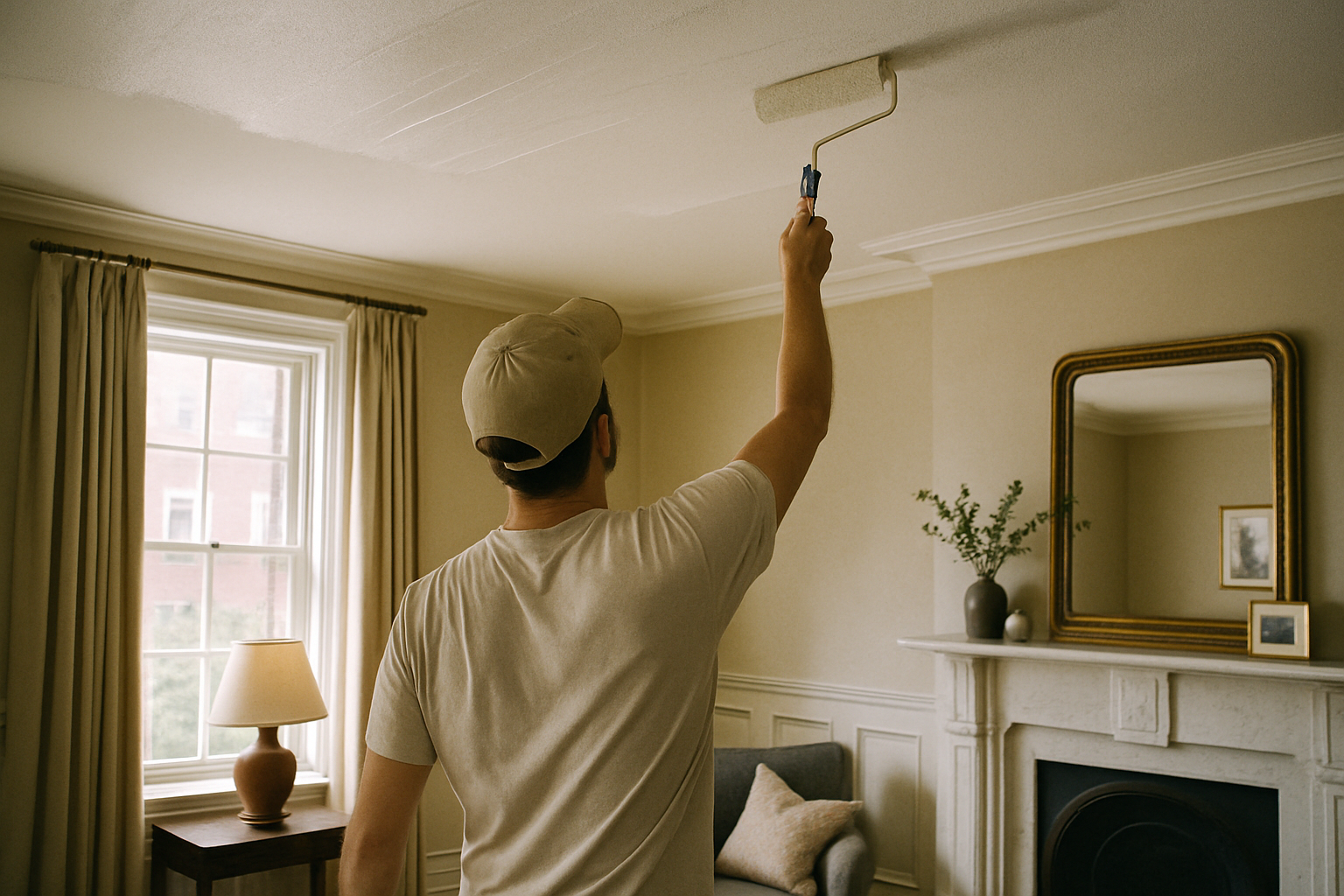
Most ceiling failures that get blamed on wrong direction are actually a timing problem.
When paint starts to skin over before you rejoin your section, you’re essentially painting over a partially dried edge. That overlap dries thicker. It catches light differently. You see a line. And because the lines sometimes run in the direction you were rolling, people assume direction caused them. It didn’t. You just took too long.
The section width that matters is 24 inches. That’s your maximum before you need to come back and rejoin a wet edge. Not 4 feet. Not a whole ceiling quadrant. Twenty-four inches, then back. In a room under 200 square feet, you shouldn’t be working in big open sections anyway — you’re too close to your own wet paint and the temptation to overroll is real.
Recoat window matters here too. Most ceiling paints allow about an hour at 70°F and 50% humidity before the surface is too dry to rejoin cleanly. Sherwin-Williams Ceiling Bright White dries faster in low humidity — I’ve had it skin in 45 minutes on a dry winter day with the heat running. Benjamin Moore Waterborne Ceiling Paint runs a bit more forgiving, closer to the full hour in the same conditions. Neither of those windows is long. If you’re cutting in and then rolling, cut a smaller section than you think you need.
Lap marks are a timing problem. Fix your timing, and direction becomes even less relevant than it already was.
The Single-Window Room: How to Actually Decide Your Direction
Okay. You have one window. It’s not huge. The room is big enough that the light rakes across the ceiling at a low angle. Direction matters here. So what do you actually do?
Stand in the room at midday. Look at the sharpest shadow line on your ceiling — not the light patch, the shadow edge. That shadow line is running in a specific direction. Paint parallel to it. Not toward the window. Parallel to the shadow.
Most guides say “paint toward the light source.” That advice is geometrically imprecise and it’ll give you the wrong answer in any room where the window isn’t perfectly centered on the wall. If your window is in the corner of the room, painting toward it means rolling at a diagonal. The shadow line is not diagonal. Parallel to the shadow is the correct rule, and it’s different from “toward the window” more often than people realize.
Before you commit to rolling the whole ceiling, do a test patch. 12×12 inches, let it dry for 2 hours, then check it under the actual light conditions. If you painted in the morning, come back at the same time of day the room gets its worst raking light. South-facing windows produce the most acute angles between 10am and 2pm, so that’s your test window. If the patch looks fine, you’re done deciding. If you see ridges, adjust your direction and test again.
Twenty minutes of testing beats repainting a ceiling. I know this because I did not test. I repainted. I also didn’t bother with a paint sample on the trim that same week and ended up with a finish I hated for two years — same principle, same lesson, apparently not learned.
Paint Sheen Changes the Stakes More Than Direction Does
Using wall paint on a ceiling because you already have it open is probably the single most common decision that turns a simple paint job into a direction problem.
Ceiling-specific flat paint sits at 0–2% sheen on light reflectance. Eggshell is 10–25%. That gap is enormous in terms of how much texture the surface telegraphs. Flat paint absorbs light. Eggshell bounces it. Any roller ridge that would disappear under flat paint becomes visible under eggshell, and now direction matters even in rooms where it otherwise wouldn’t.
Ceiling paint is also formulated with higher viscosity specifically to reduce drip and sagging on a vertical-to-overhead surface. Standard wall paint isn’t. You get more drips, more orange-peel, and a surface that’s working against you before the roller even touches it. Behr Ceiling Paint versus a standard eggshell wall paint on the same ceiling is not a subtle difference — the eggshell will show every flaw, and you’ll end up blaming your rolling direction when the paint formula was the actual problem.
Ceiling-specific flat paint runs $28–$35 a gallon. Eggshell wall paint runs $40–$60. The ceiling paint is cheaper and it’s the right tool. There’s no good reason to use the wrong one.
A Pre-Paint Checklist That Replaces the Direction Debate Entirely
Work through this before you pick up a roller, and the direction question either answers itself or stops mattering.
First: what’s your light source? Recessed only, or multiple windows on different walls? Stop here. Direction is irrelevant. Roll however is comfortable.
Second: if you have a single window, measure it. Under 3 feet wide in a room over 12 feet across? You’re in raking-light territory. Keep going. Wider window or smaller room? Probably irrelevant, but keep going anyway.
Third: pick your nap. Smooth to lightly textured ceiling gets 3/8-inch. Orange-peel or popcorn texture gets 1/2-inch. The 3/8-inch nap cuts ridge depth before direction ever becomes a factor.
Fourth: confirm your paint. Flat ceiling-specific paint, not wall paint, not eggshell. This alone removes most of the direction stakes.
Fifth: set your section width at 24 inches max. No wider. Time your sections against your paint’s recoat window and don’t let the edge skin over.
Sixth: if you’re still in raking-light territory after all of that — stand in the room at midday, find the shadow line, and paint parallel to it. Do your 12×12 test patch and check it before you commit.
If you’ve worked through all of that and you’re still convinced direction is your biggest variable, something else is going on. Wrong paint, bad nap, lost wet edge, previous ceiling texture showing through. Direction is almost never the culprit it’s made out to be.