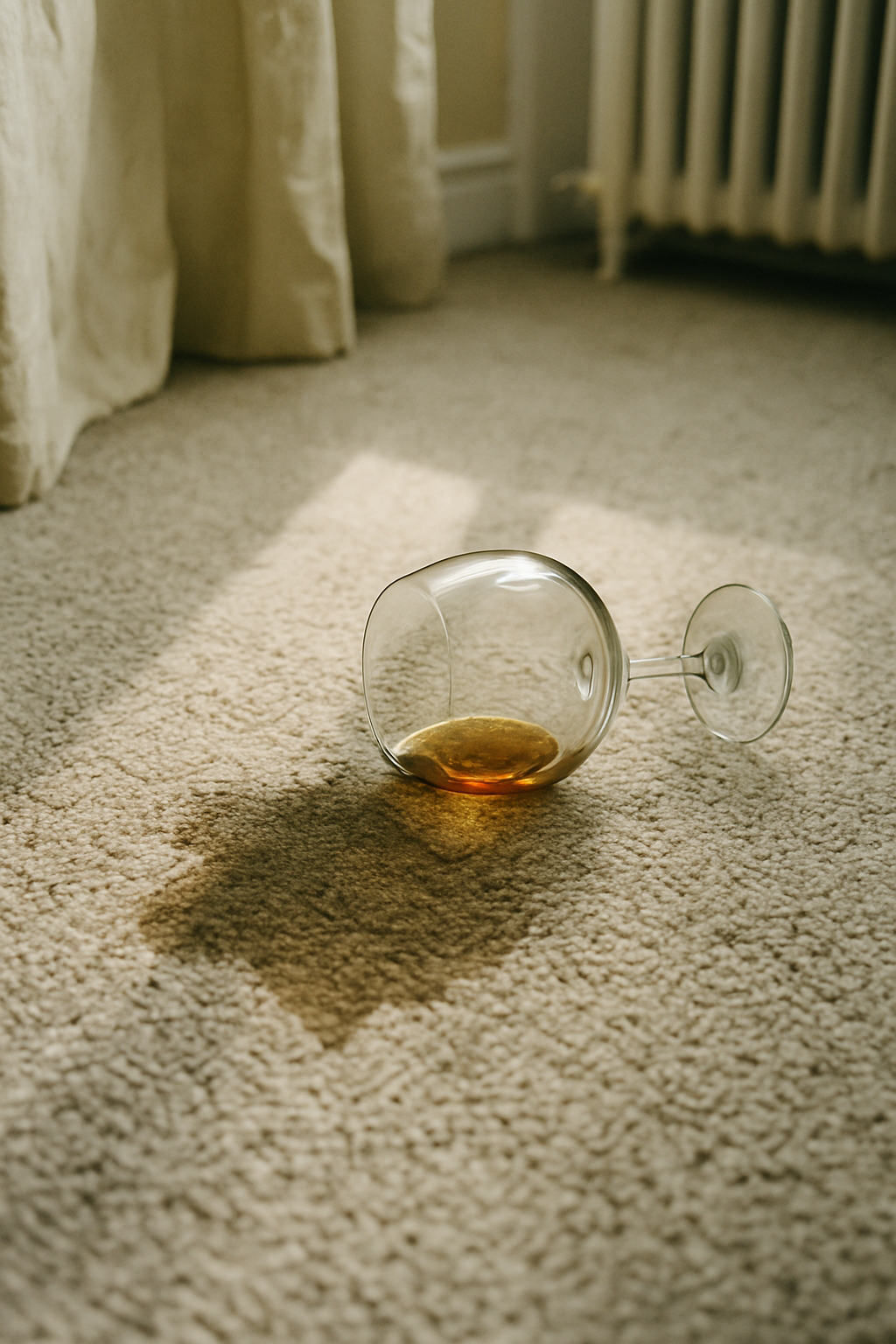
The vodka spill from Saturday night looked dry by Sunday morning. Completely dry. I actually walked across that spot a dozen times before I noticed, six weeks later, a stiff, slightly discolored patch in the middle of my living room rug. The rug I’d paid $340 for. The rug I’d been so proud of finally getting right. That’s when I learned that evaporation and clean are not the same thing. Not even close.
Yes, Alcohol Evaporates — But That’s Only Half the Answer
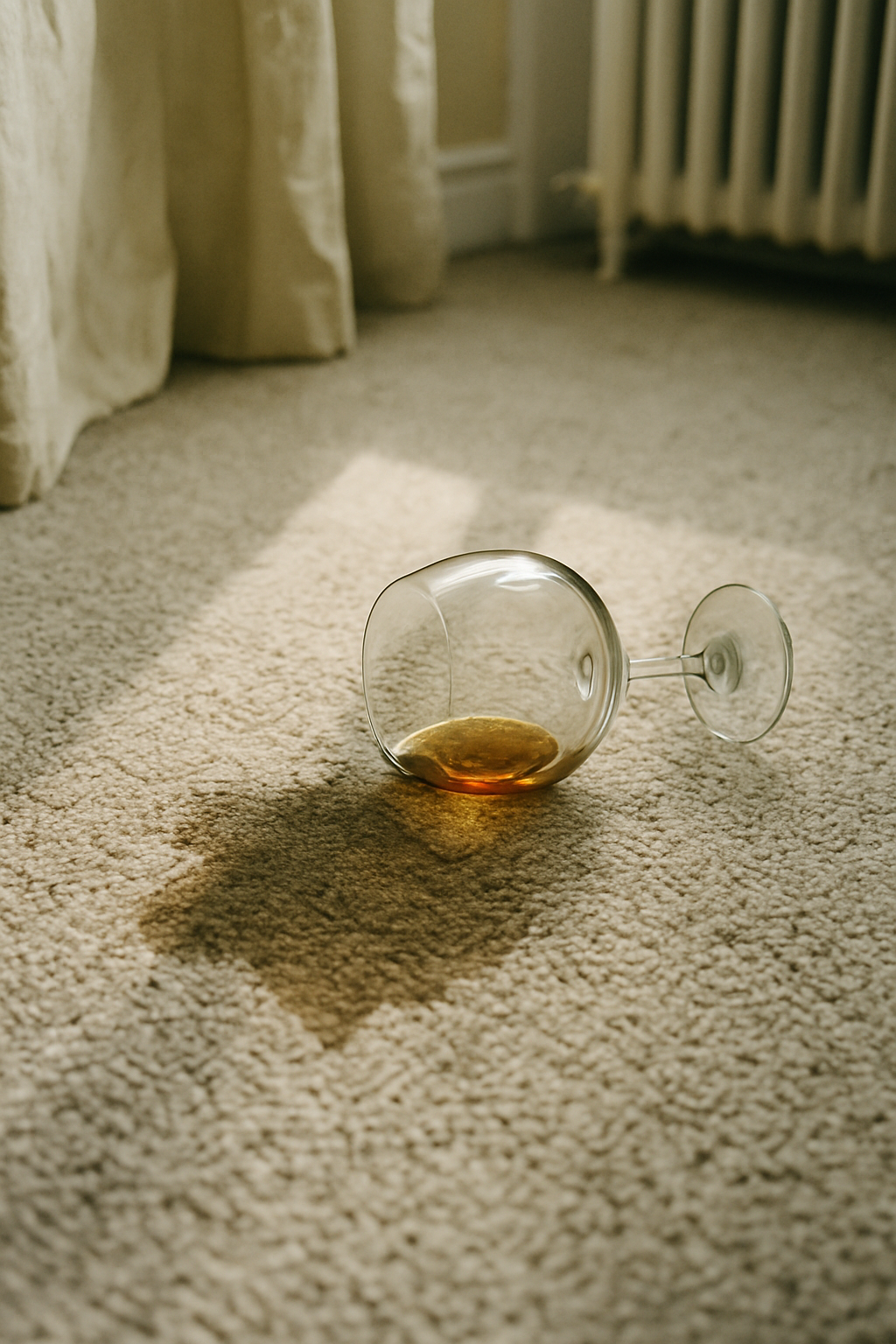
Ethanol boils at 78.4°C, but you don’t need boiling temperatures to make it disappear. At room temperature, around 20°C, it evaporates on its own through vapor pressure. Isopropyl alcohol moves even faster — roughly 30% quicker than ethanol at the same temperature. So yes, technically, alcohol will leave your carpet on its own.
Here’s where it gets expensive. A hard floor dries in an hour or two. Carpet pile that’s an inch deep extends that timeline by four to eight hours minimum, because the liquid wicks down into the fibers, gets insulated, and just sits there. And while it’s sitting there, everything that isn’t alcohol — which is most of what you spilled — is settling into the base of that pile and making itself at home.
Treating evaporation as the endpoint is, in my experience, the single most costly mistake carpet owners make. Not because the alcohol itself lingers. Because “it dried” feels like a resolution, and it isn’t. It’s just the beginning of the actual problem.
What Actually Stays in the Carpet After the Alcohol Is Gone
A standard beer is 4 to 6% alcohol by volume. Meaning the other 94 to 96% of what you poured into your carpet is not alcohol. It’s water, sugars, proteins, hop compounds, yeast byproducts, and colorants. None of those evaporate. They concentrate in the fibers as the alcohol and water slowly leave.
Red wine is worse. The anthocyanin pigments — the ones that make it red — begin oxidative bonding with carpet fibers within about two hours of contact. Two hours. You’re not even fully asleep yet and the chemistry has already started working against you.
And honestly, I used to think clear alcohol was the safe option. Completely wrong. Vodka, gin, white rum — they still carry water-soluble compounds that don’t evaporate and that attract mold, bacteria and dust. The carpet looks clean. It isn’t. Even pure isopropyl alcohol at 99% concentration leaves trace plasticizer residues from the bottle it was poured from. I didn’t know that until I ruined a rug trying to clean a rug.
The alcohol in a drink is the least damaging ingredient. You’re mostly spilling sugar water with dye, and the alcohol just distracts you from that fact by evaporating and making you think the problem left with it.
Carpet Fiber Type Determines Whether You Act or Wait
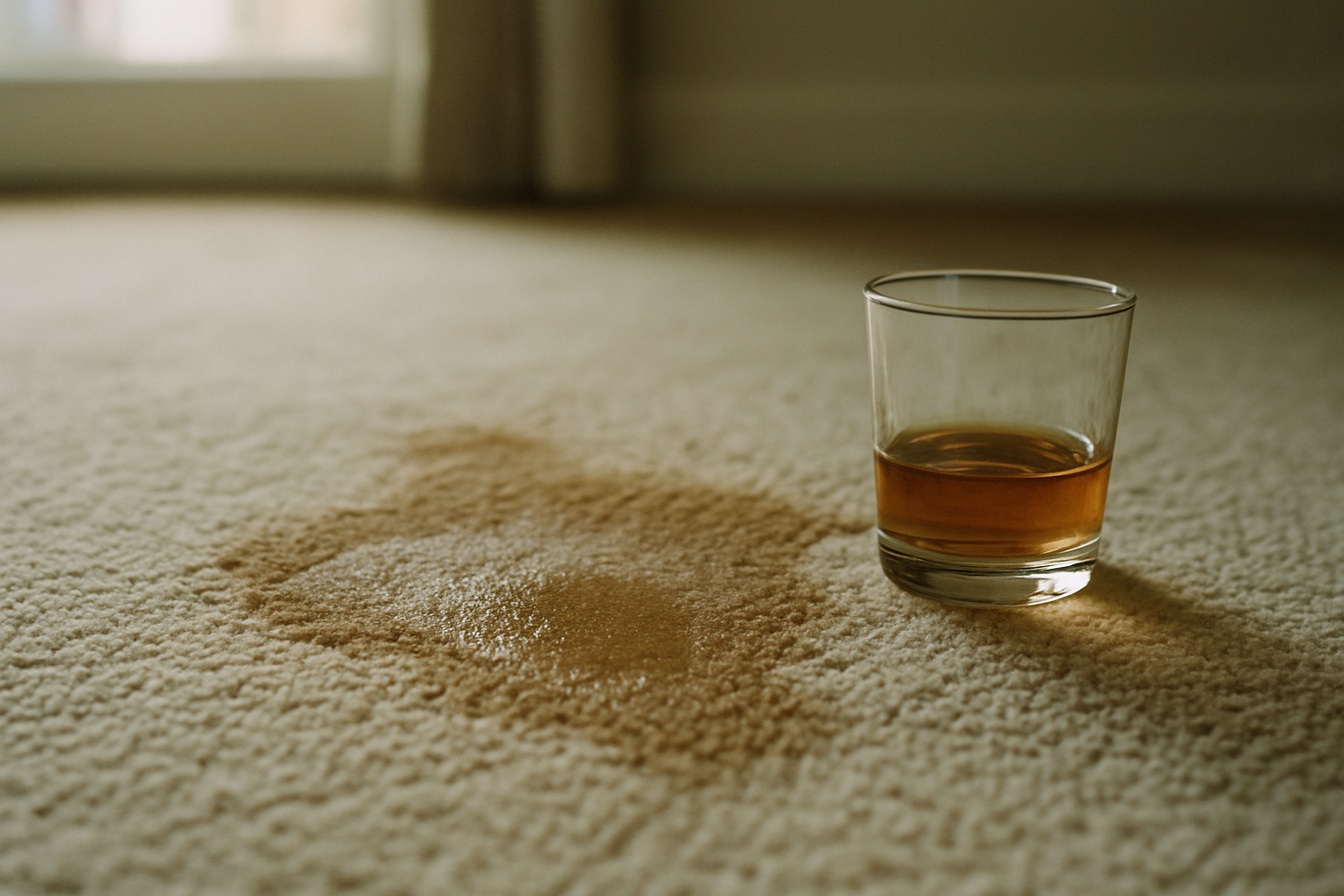
This is where I have to get specific, because the answer is completely different depending on what your carpet is made of.
Solution-dyed polyester is the most forgiving residential fiber you can own. The dye is part of the fiber itself, not applied to the surface, so alcohol can’t pull it out. Nylon is tolerant of isopropyl alcohol but — and this is important — it’s damaged by repeated applications. More than three cleanings in the same spot will weaken the fiber crimp, and you’ll end up with a flat, matted area that catches light wrong and looks terrible. I have one of these. It’s in the hallway right outside my bedroom and I look at it every single day. Tried to fix it myself three times before my contractor pointed out I’d been making it worse.
Wool is a different conversation entirely. Wool carpet dye can begin to lift with IPA concentrations above 70% after just 60 seconds of contact. Sixty seconds. And the fiber itself is protein-based, which means it responds badly to the pH of most cleaning agents too. If you own a wool or silk rug and someone spills alcohol on it, call a professional cleaner. Don’t blot it with rubbing alcohol — which is, I cannot stress this enough, a surprisingly common suggestion on the internet that compounds the damage. You’re adding a second solvent with dye-stripping potential to a fiber that’s already in trouble.
The savings from DIY on a wool rug aren’t worth it. I’ve been there. They really aren’t.
The 48-Hour Window: When Evaporation Stops Working in Your Favor
Fresh residues are still water-soluble. That’s the whole window. Within 48 hours, the sugars and colorants left behind after alcohol evaporates can still be rinsed out with cold water and a little patience. After that, oxidation and drying lock them into the fibers in ways that plain water can’t undo.
Red wine anthocyanins reach near-permanent bonding with nylon after approximately 48 to 72 hours at normal humidity. Beer sugars become tacky enough to trap particulate soil — dirt, pet dander, dust — after about 36 hours at room temperature. That sticky residue is why the patch I found six weeks after the vodka spill felt stiff. It had become a little trap for everything that walked across it.
Professional carpet cleaners charge 40 to 60% more for set-in stain removal than for fresh treatment. I’ve gotten those quotes. The math is not subtle. Acting within 48 hours isn’t just good advice — it’s the single most important variable, more important than which product you use or how many times you treat it. Timing beats chemistry. Every single time.
Odor After Evaporation: Why the Smell Returns When It Rains or Gets Humid
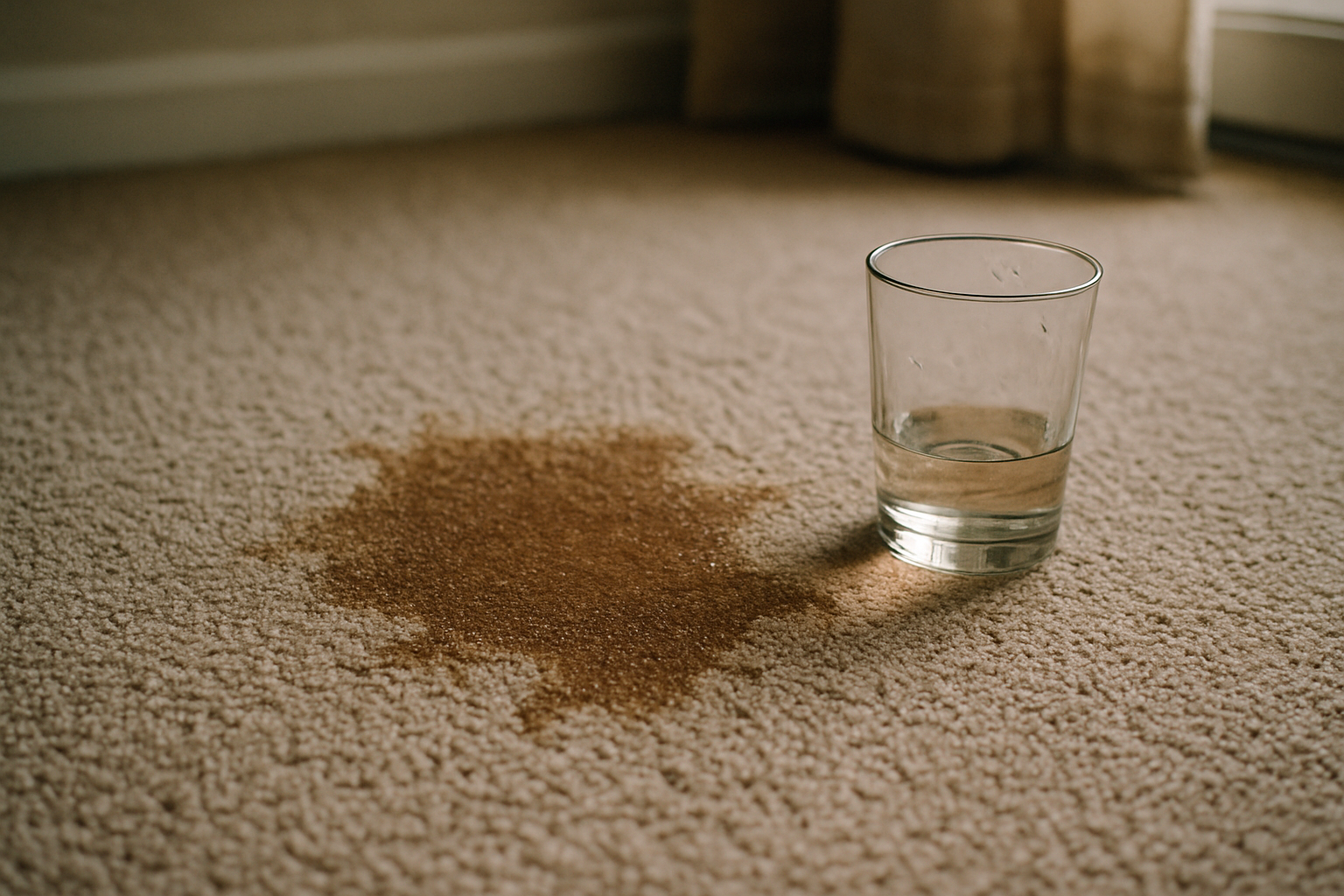
My basement carpet started smelling sour last October. Just on rainy days. The rest of the time, nothing. I’d cleaned it in August after my nephew knocked over half a beer, and I thought I’d handled it.
Turns out, dried sugar residues are hygroscopic. They pull moisture from the air. Relative humidity above 60% is enough to rehydrate them and reactivate the odor compounds. And if any bacterial fermentation got started in the pile, acetaldehyde starts building up. Acetaldehyde has an odor detection threshold of 0.067 parts per million — a trace amount most people can’t even see on a test strip, but you will absolutely smell it.
Baking soda doesn’t fix this. Air freshener doesn’t fix this. Both mask the smell temporarily and leave the source compound sitting in your carpet, waiting for the next humid day. If your carpet smells fine when dry and sour when the weather shifts, the spill wasn’t fully addressed. That’s not a ventilation problem. That’s chemistry telling you something’s still down there.
An enzymatic cleaner needs actual dwell time — 10 to 15 minutes at room temperature — to break down fermentation-based odors. The enzyme has to contact the compound long enough to do the work. Spraying and immediately blotting it up accomplishes almost nothing.
The Cleaning Methods That Actually Work (Ranked by What You Probably Have Right Now)
First thing: cold water, clean white cloth, blotting. Not scrubbing. Blotting. Scrubbing drives the spill deeper and spreads the affected area by up to three times. I watched this happen with a red wine spill on my dining room carpet while a well-meaning houseguest tried to help. Cold water, below 15°C if you can manage it, because heat sets protein and sugar compounds before you can remove them. This is also why you shouldn’t use a hairdryer to speed things up — it can lock residues in permanently, and anyone who recommends that as a neutral option hasn’t had to deal with the aftermath.
If you have a wet/dry vacuum, use it. Within five minutes of a spill, wet extraction removes 80 to 90% of the liquid. Way more effective than any product.
For the residue that blotting leaves behind, an enzymatic cleaner is what actually works. I use Rocco and Roxie, which runs about $19.97 on Amazon and is formulated for both alcohol and pet odors. Let it sit the full 10 to 15 minutes. Don’t rush it.
Club soda. I know. It’s everywhere. The carbonation does lift particulates from the surface, I’ll give it that. But plain cold water with a clean cloth outperforms it, and club soda has been repeated so many times as folk wisdom that people treat it like fact. It’s a bartender’s trick, not a carpet chemist’s recommendation. Use it if it’s all you have, just rinse the area with plain water after.
When to Stop DIY and Call a Professional — Specific Thresholds
I’ll just give you the list, because this is where vague advice costs people real money.
Any wool or silk rug with a replacement value above $500 gets a professional call on day one. No exceptions. The cost of a professional spot treatment runs $25 to $75. The cost of replacing a rug you loved is $200 to $800 minimum, before you account for the fact that you’ll probably settle for something you like less.
A stain larger than 12 inches in diameter on cut-pile carpet is past what a spray bottle and a cloth can address. That size typically needs truck-mounted hot water extraction to pull the residue all the way out of the pile and the backing. A wet/dry vac helps but it’s not the same.
If you’ve done two enzyme treatments and the odor persists when humidity rises, you’re dealing with sub-pad contamination. The liquid got through the carpet and into the padding underneath. At that point you’re not cleaning carpet anymore — you might be replacing pad, and you need someone with extraction equipment to tell you how far it spread.
Most people call a professional on day thirty, after they’ve tried four things and made the stain harder to remove each time. I have done this. The call I made on day one of the next spill cost me $45 and the carpet is fine. The call I made on day thirty after the vodka incident cost me the rug. That math stuck with me.
Fading is not removal. A stain that lightens over a few weeks still has residue in the fiber, and that residue will re-darken the next time humidity gets above 60%. Waiting to see if it fades on its own is not a strategy. It’s just postponing the decision.