My kitchen sink window was getting direct afternoon sun right in my eyes every single day. Harsh, flat, zero personality. I tried ignoring it for about eight months. Finally I spent one Saturday going down a rabbit hole of above-the-sink curtain ideas, and honestly? It changed the whole feel of the room. Further down I’ll walk you through every style I considered (and the ones I actually tried), including a no-sew DIY that cost me under $15 and a layering trick that makes a basic window look like it belongs in a magazine. Stay with me.
Classic Café Curtains: The Easy Win
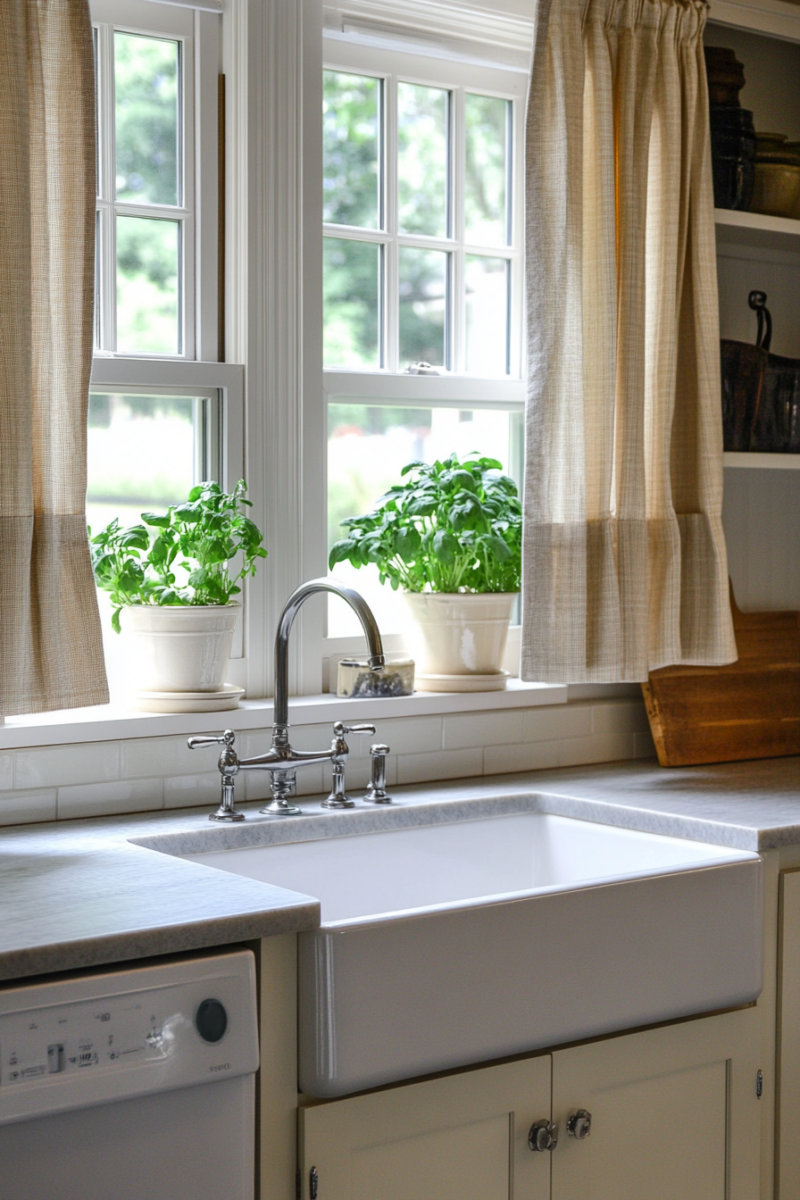
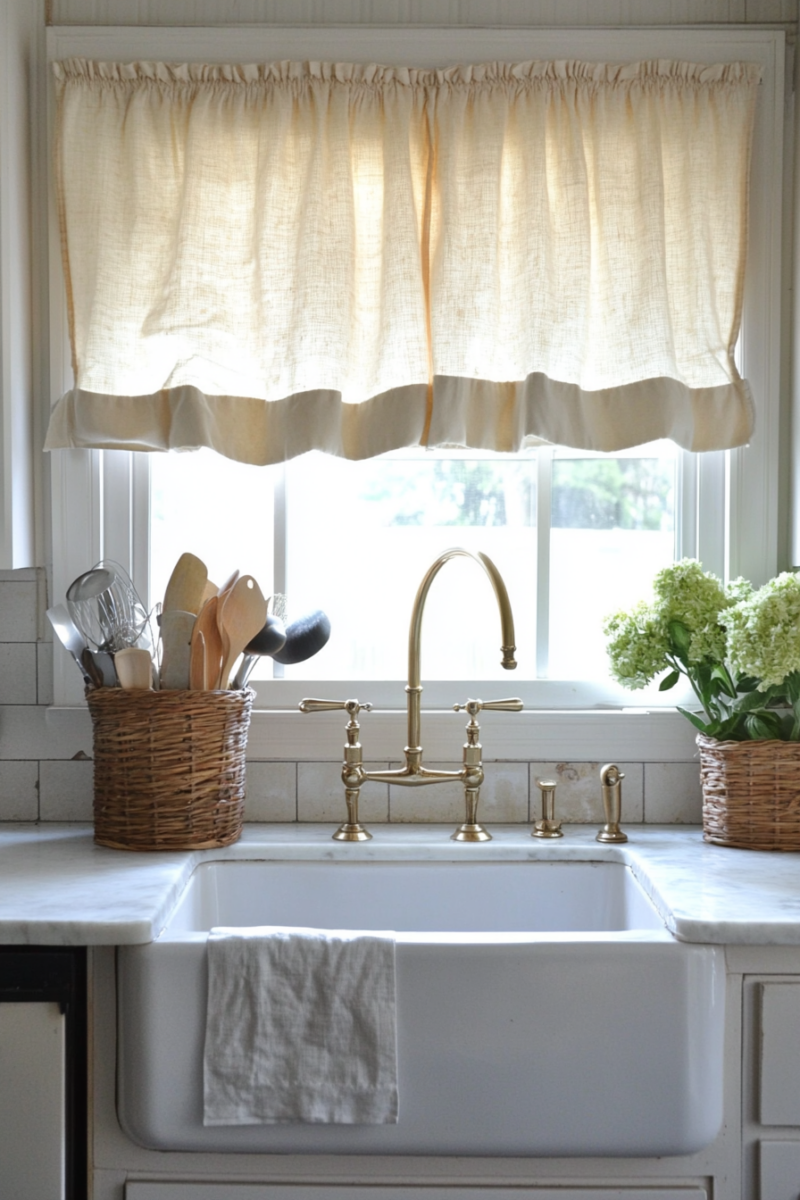
Café curtains were the first thing I tried, and I’m still not over how good they look for how little effort they take. They cover only the bottom half of the window, so you keep all that top light pouring in while still getting some privacy at counter height. That’s the sweet spot for a kitchen sink.
Fabric makes a huge difference here. Lightweight linen reads breezy and relaxed. Patterned cotton adds personality without trying too hard. For a farmhouse kitchen, gingham or a soft ticking stripe is the move. For something more modern, a solid sage green or warm cream in a matte cotton works beautifully.
Installation is genuinely simple. A tension rod (around $8 at any home store) fits right inside the window frame, zero drilling required. I used clip rings so I could slide mine open and closed easily, and swapping them out for a different season takes about four minutes.
One thing I’d push back on: people say café curtains only work in farmhouse kitchens. That’s not true. I have a mix of vintage and modern stuff going on, and they fit right in.
Quick sizing note: measure from where your rod sits to just past the sill, then subtract about half the window height. You want coverage, not a full blackout. Most standard above-the-sink windows are around 24–36 inches wide, so you’re usually looking for panels in the 24-inch length range.
Sheer Voile Curtains: Soft Light, Zero Fuss
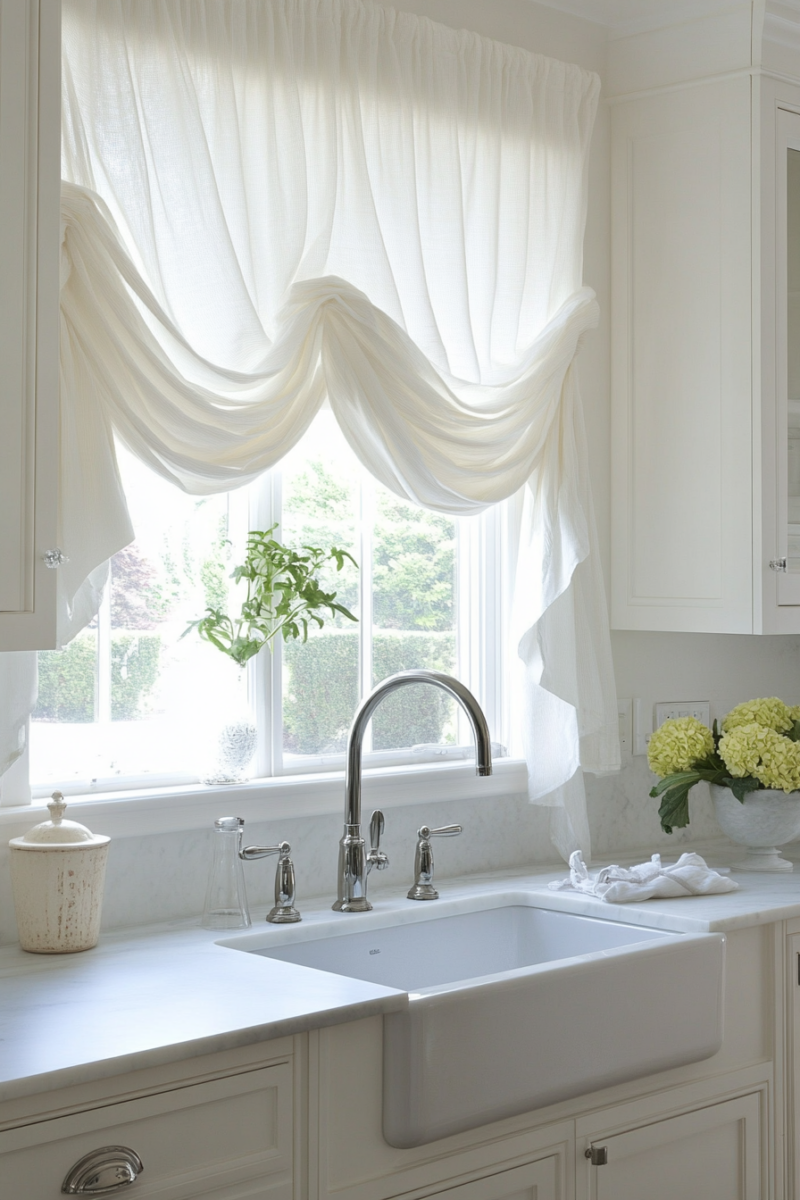
If you get good light in your kitchen and don’t want to lose a single bit of it, voile sheers are the answer. They’re translucent enough that morning light still glows right through, but they soften the glare so it’s not blasting you in the face while you do dishes. I have a west-facing window and that 3pm sun used to be brutal. Sheers fixed it.
White and cream are the classic choices, and for good reason. They disappear against a bright window in the best possible way. That said, a pale dusty blue or blush can add a subtle wash of color to the whole room depending on how the light hits.
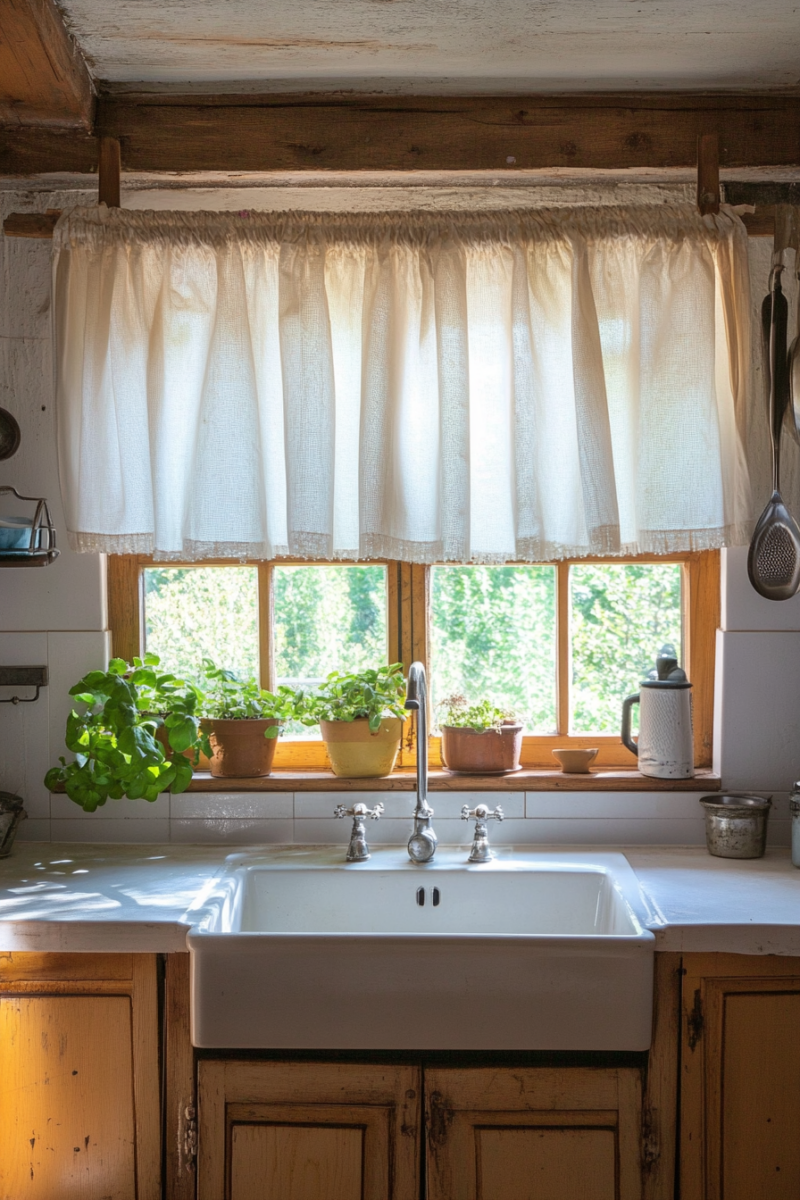
For hanging, a slim brushed nickel rod (I got mine for $12 from a big box store) keeps things understated. You want the curtains to be the feature, not the hardware. Tie them back loosely with a ribbon or a piece of jute twine during the day for that gathered, slightly romantic look.
Voile sheers also layer really well over roller shades or bamboo blinds if you want more light control at night. That combo gives you the soft daytime glow AND the ability to actually have privacy after dark.
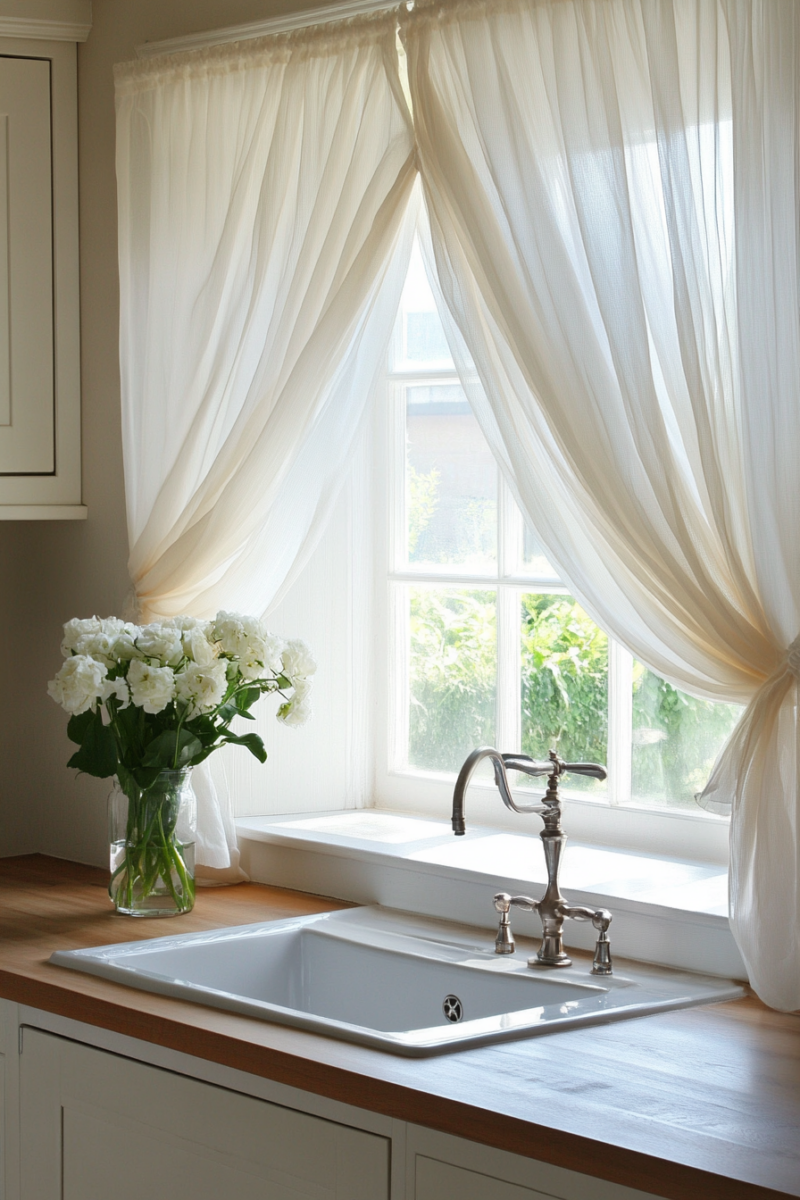
Fair warning: they do show water spots if they’re too close to the sink. Give them a few inches of clearance and you’ll be fine.
Roman Shades: Clean, Tailored, Actually Functional
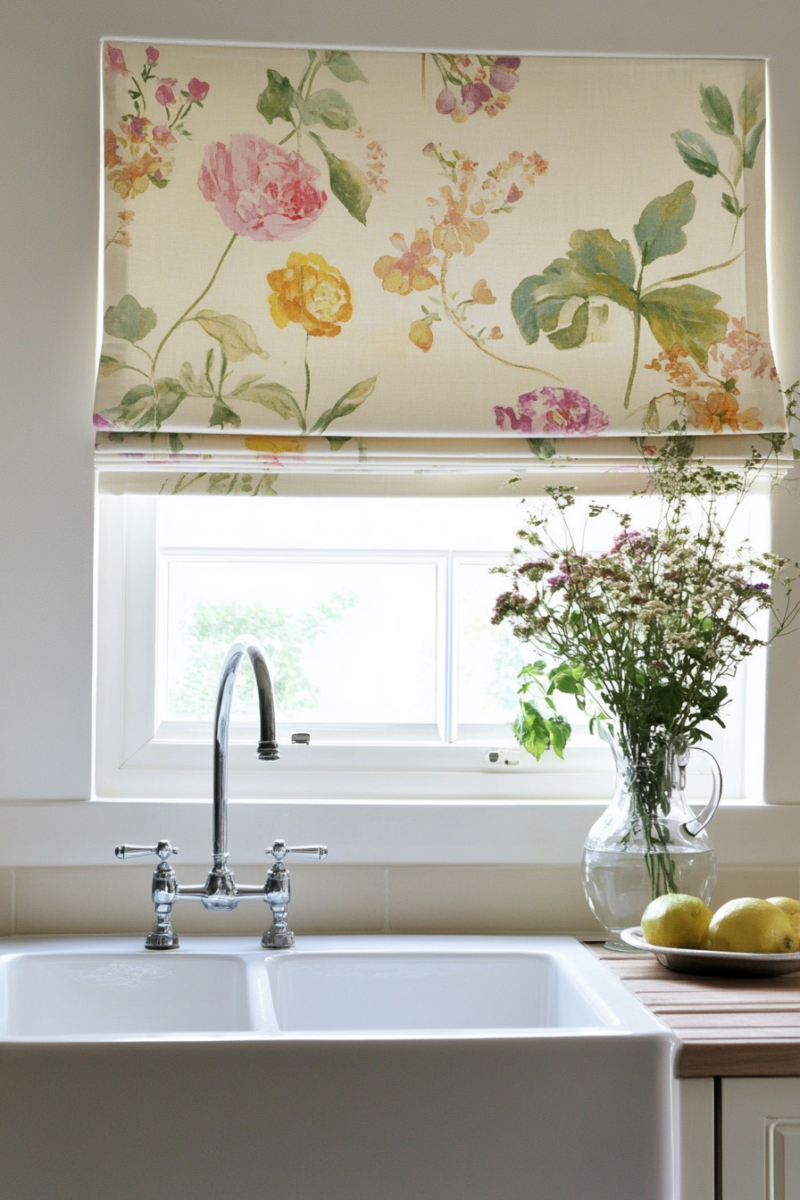
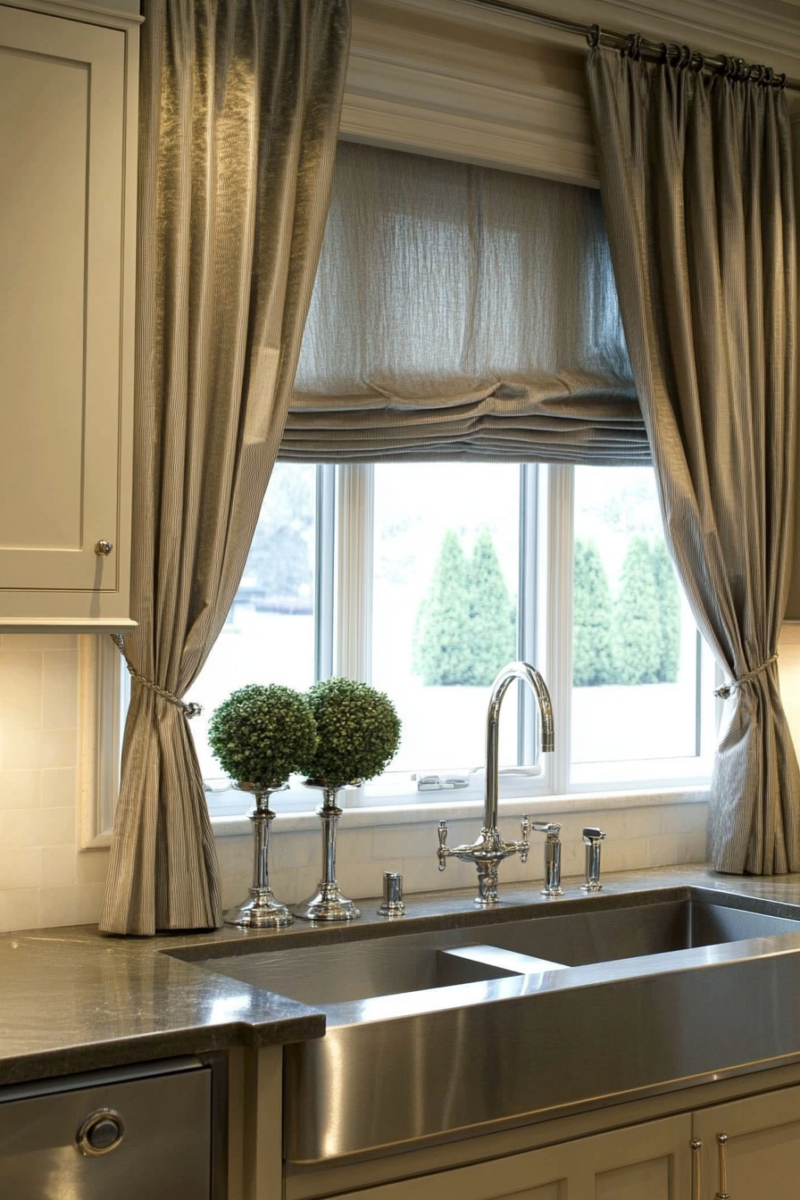
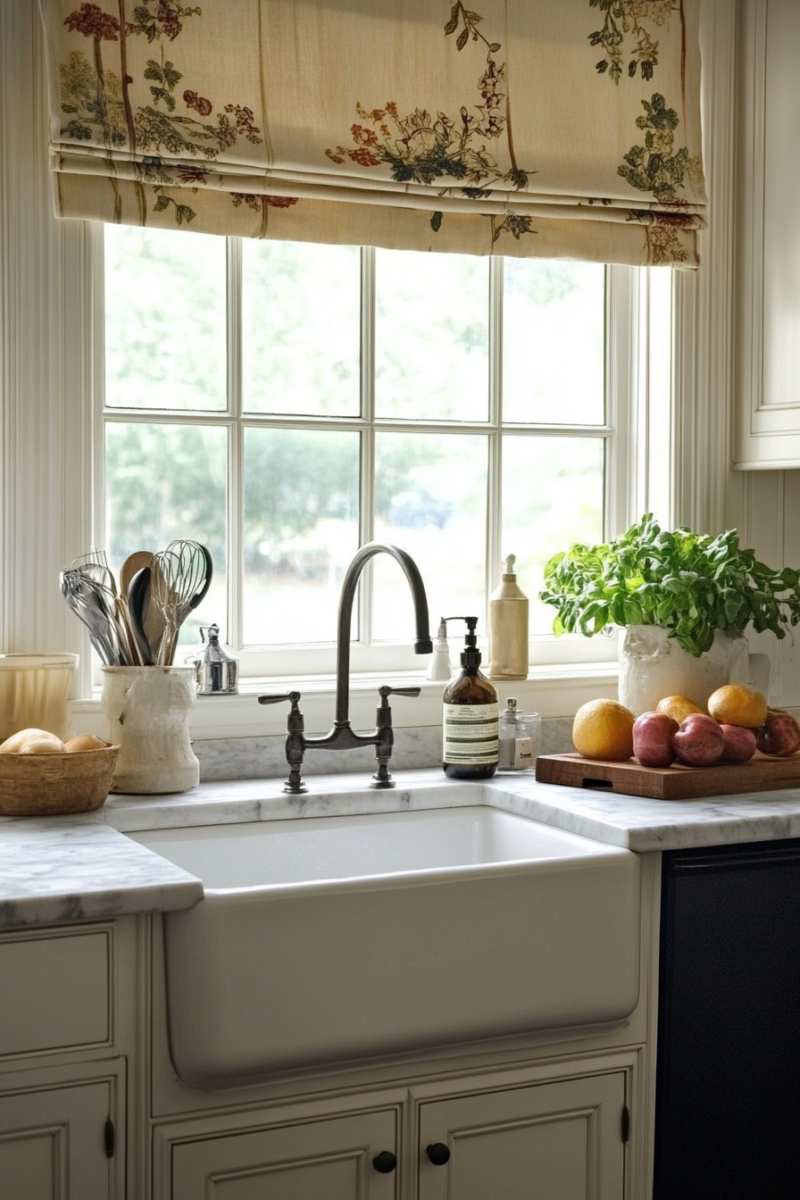
Roman shades are what I’d call the “grown-up” option. They fold up into neat horizontal pleats when raised, and when lowered they lay flat and smooth. No billowing, no bulk. For a small window above the sink where space feels tight, that clean profile is really appealing.
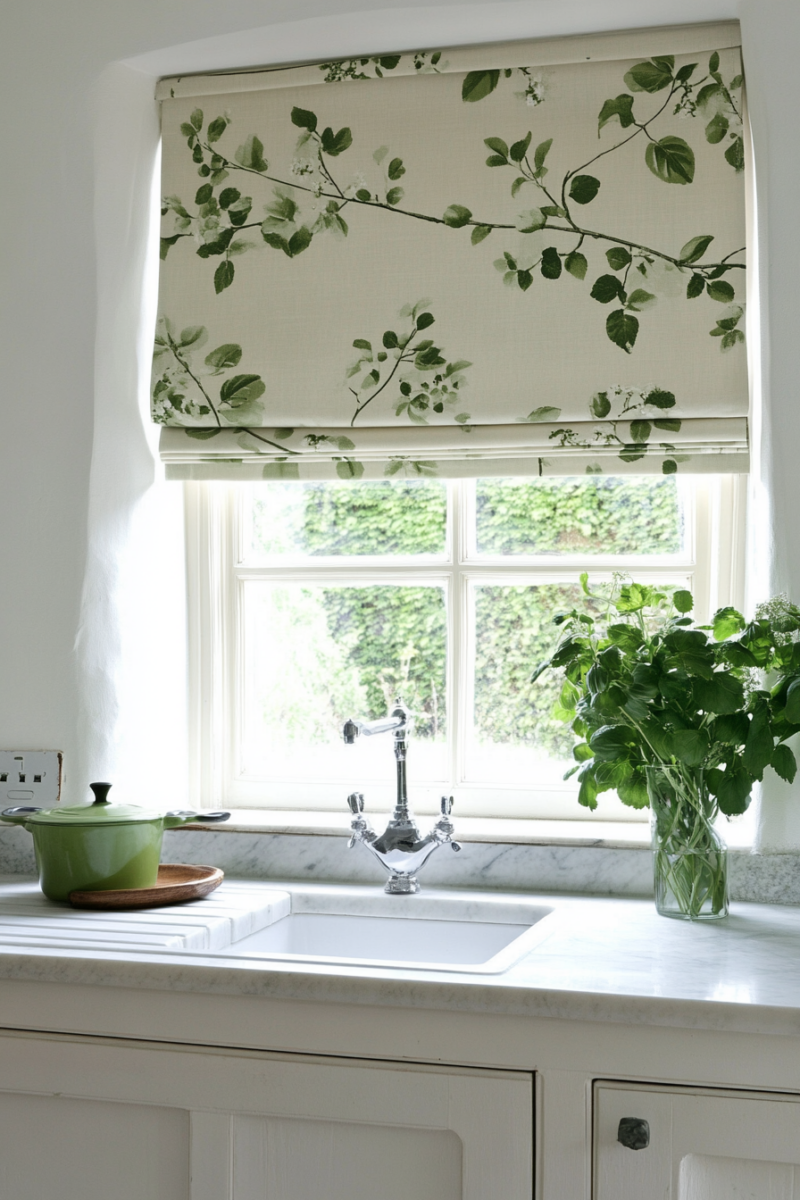
The fabric range is genuinely wide. A linen-cotton blend in a warm neutral is probably the most versatile choice. If your kitchen has one color you love (for me it’s the sage green I painted my lower cabinets), find a Roman shade that picks that up and it’ll tie the whole room together.
Inside mount vs. outside mount: inside mount (hung within the window frame) looks more precise and architectural. Outside mount (hung above the frame) makes your window look bigger. If your window is on the small side, go outside mount every time.
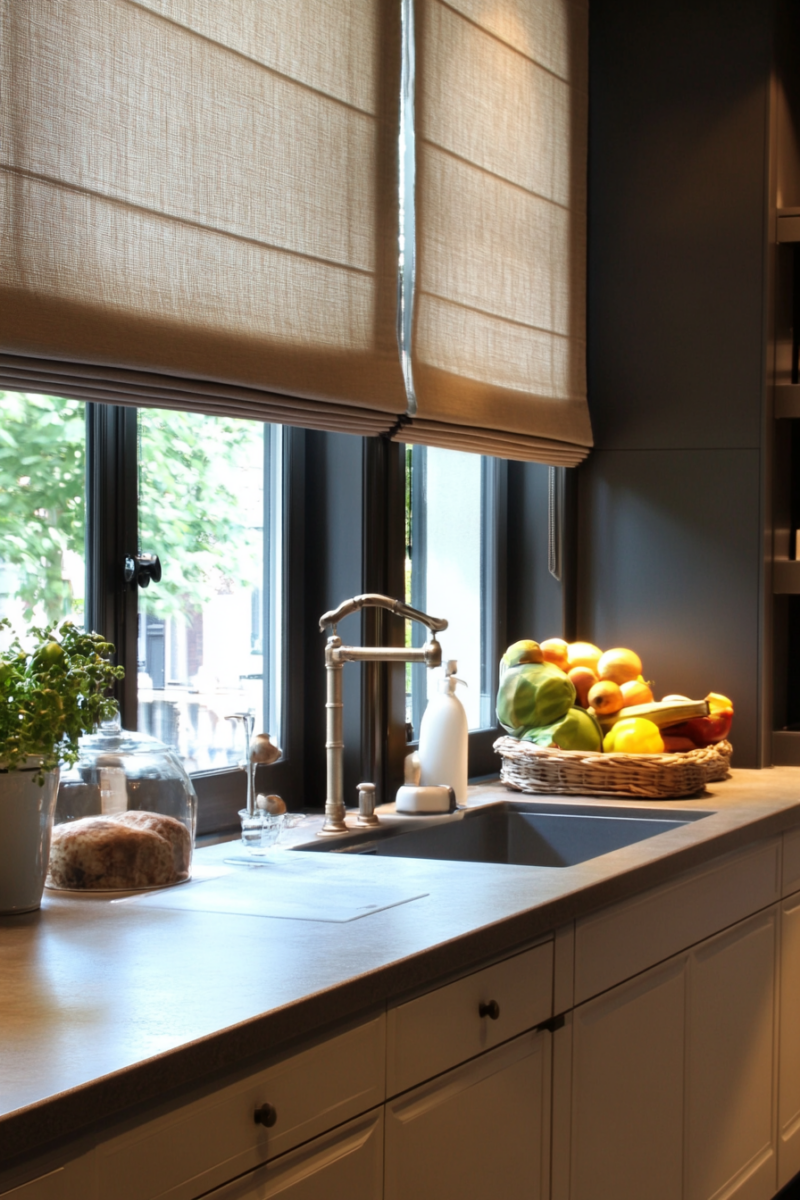
Cordless options are worth the extra $10-20. Cords near a sink get wet, get gross, eventually get gross-er. Cordless just makes daily life easier.
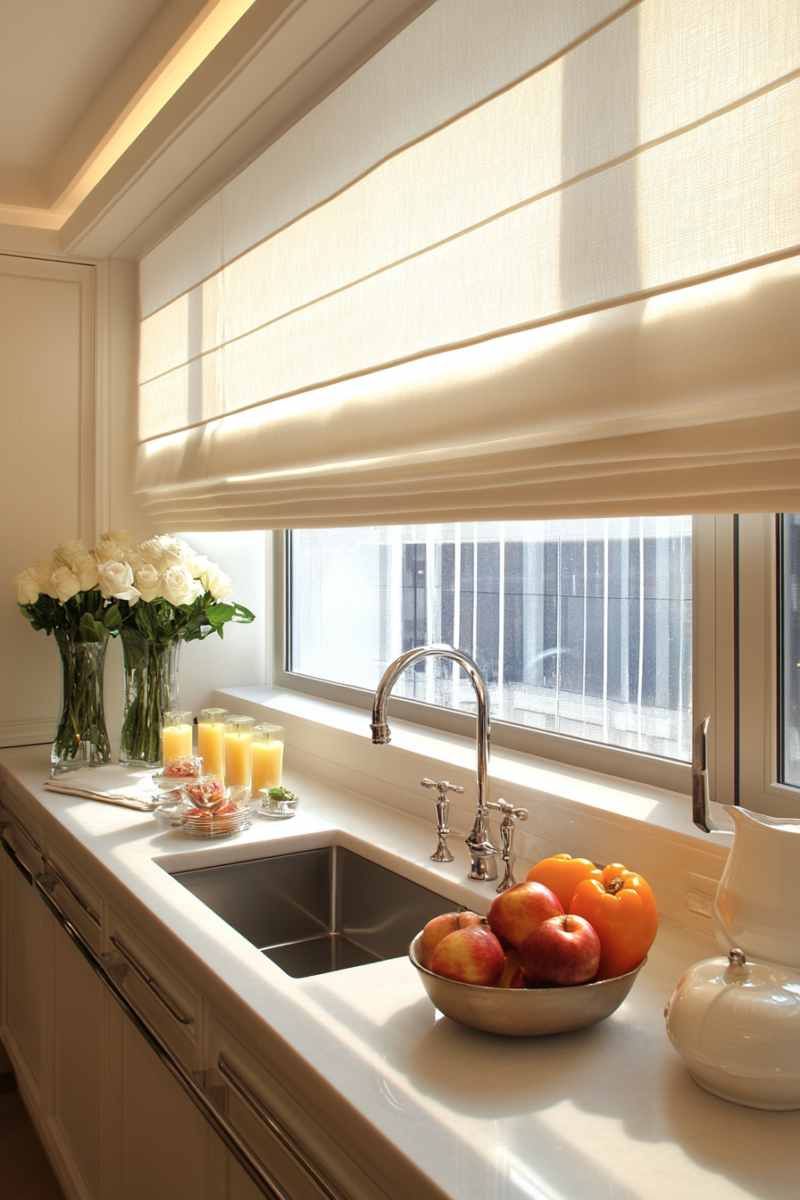
Roman shades aren’t the cheapest option. A decent one runs $40-80 depending on size and fabric. But they last for years and they look legitimately expensive, so I think the math works out.
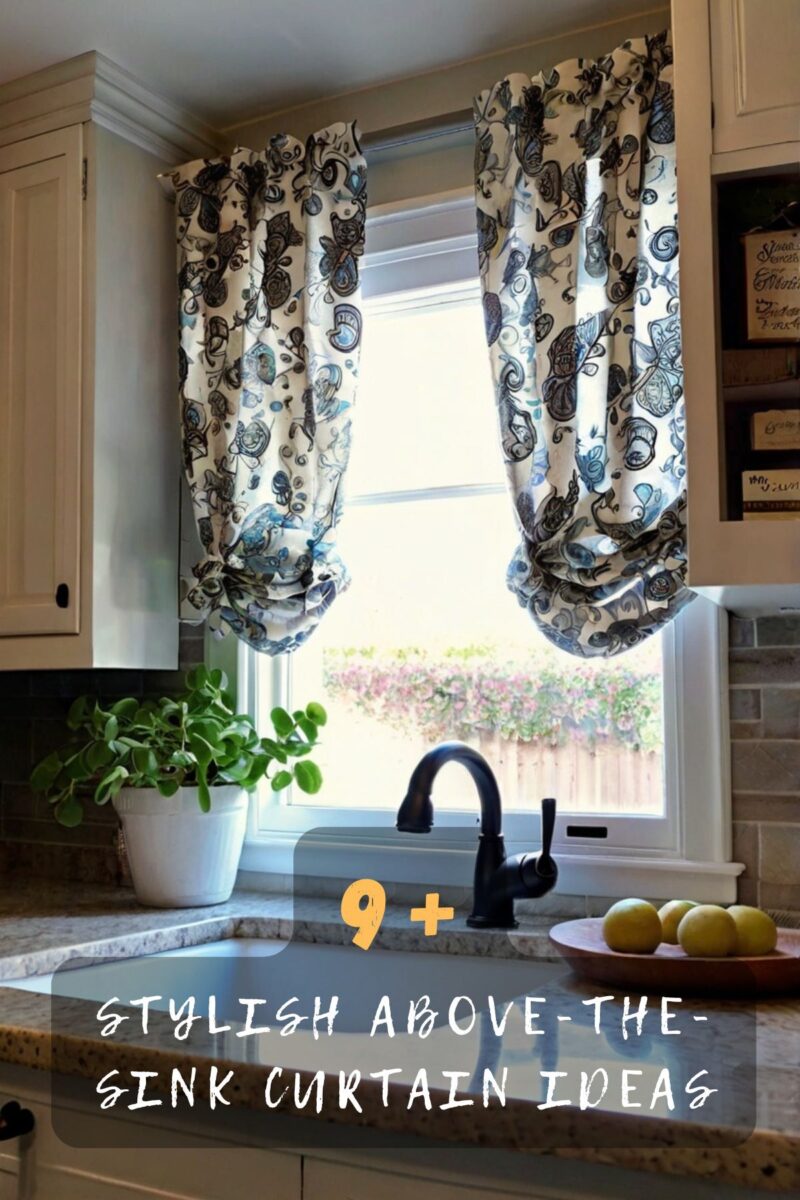
Bold Patterned Curtains: Make a Statement
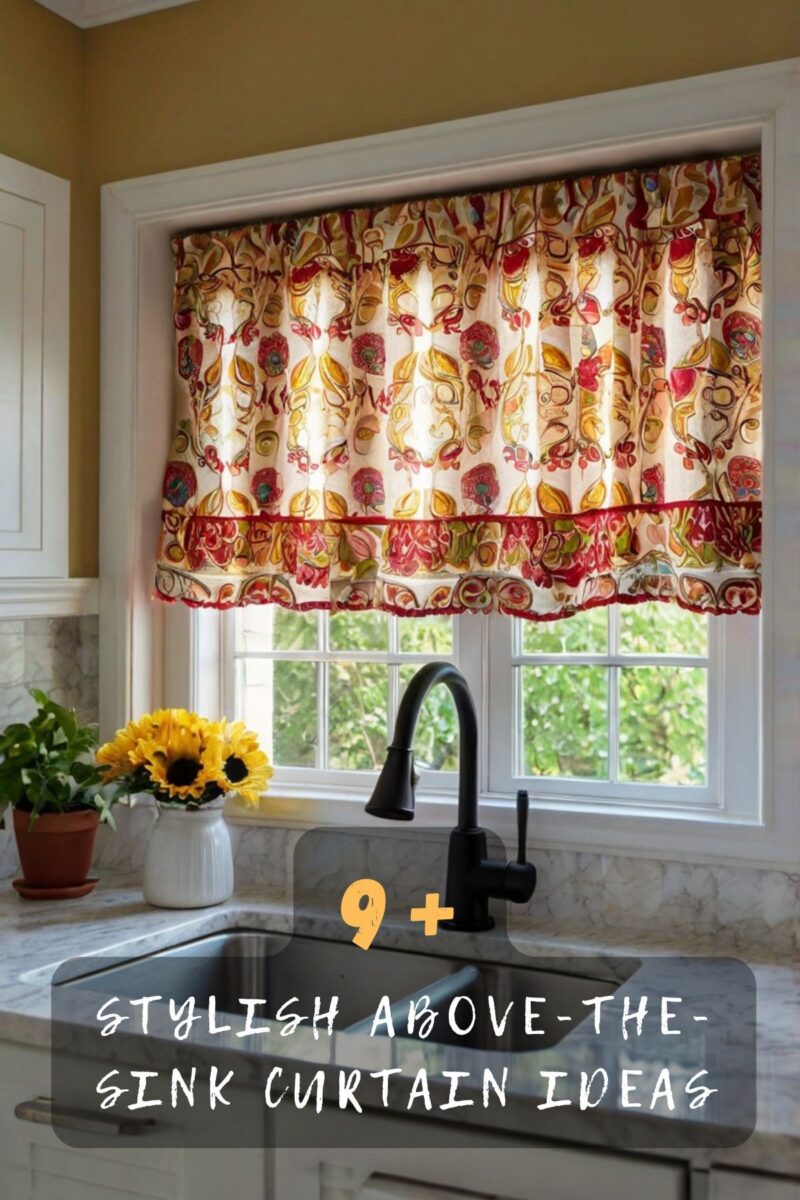
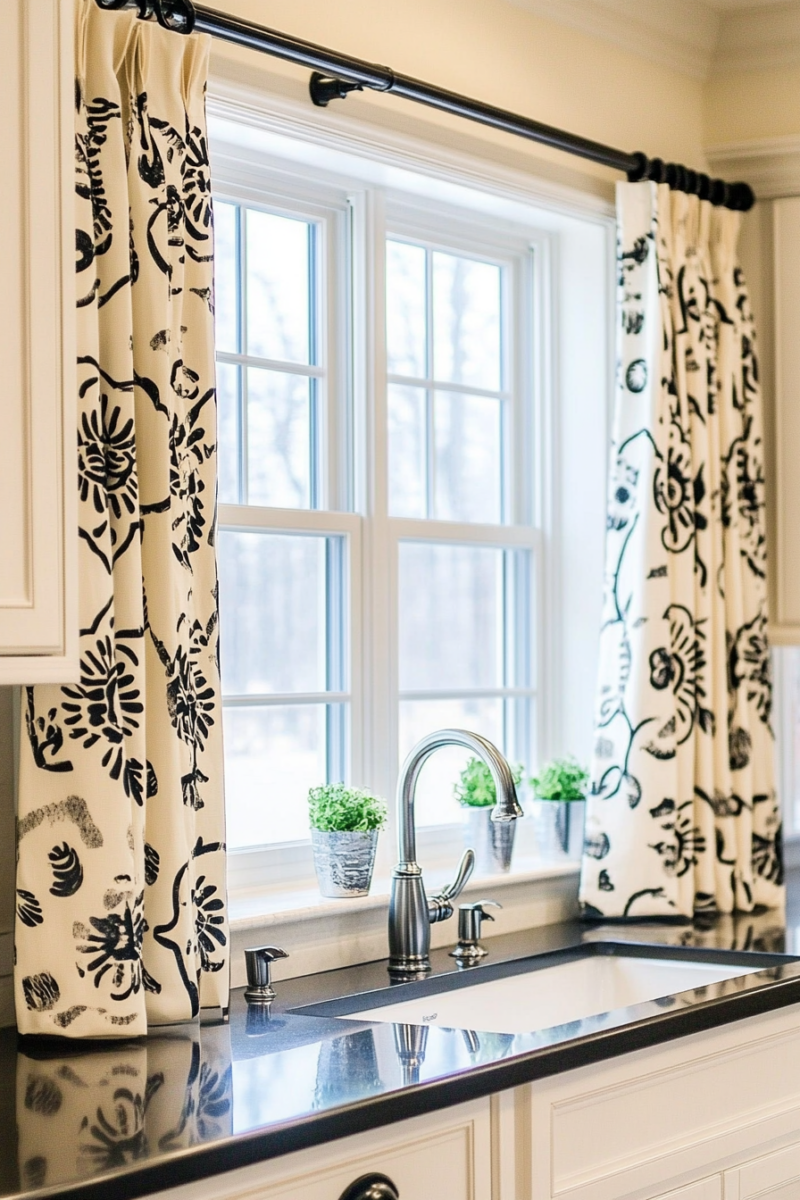
My kitchen walls are white. My counters are white. My appliances are white. At some point a person needs to commit to a little chaos, and patterned curtains are a low-risk way to do it.
The trick is pulling a color that’s already somewhere in your kitchen. I have a small collection of vintage blue pottery on a shelf, so when I finally tried a curtain with a blue and white print, the whole room suddenly looked intentional. Like I’d planned it all along. (I had not.)
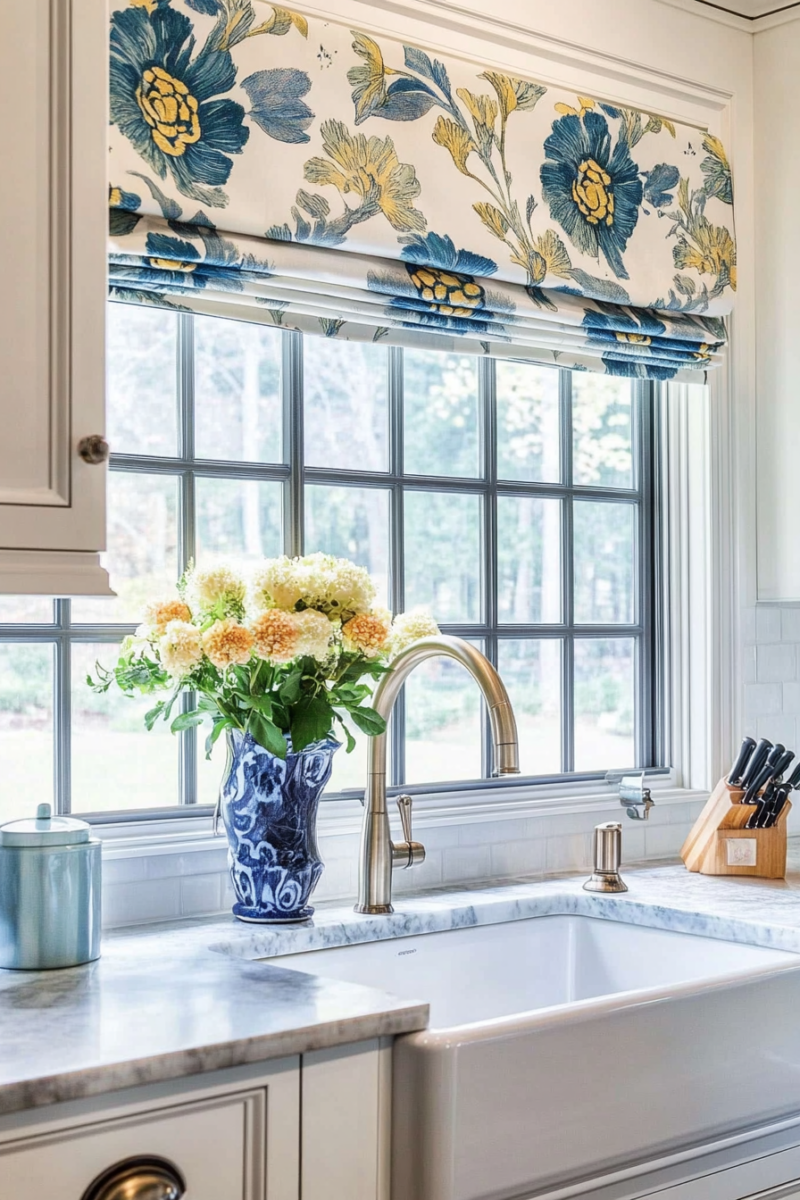
Florals, stripes, abstract blocks, geometric prints — all work. The one thing I’d avoid is a very busy pattern on a very small window. It can feel overwhelming. If your window is under 24 inches wide, keep the scale of the pattern small or go for a looser, more open print.
Keep your rod and hardware simple when the curtain is the star. A plain matte black or antique brass rod won’t compete. Let the fabric do the talking.
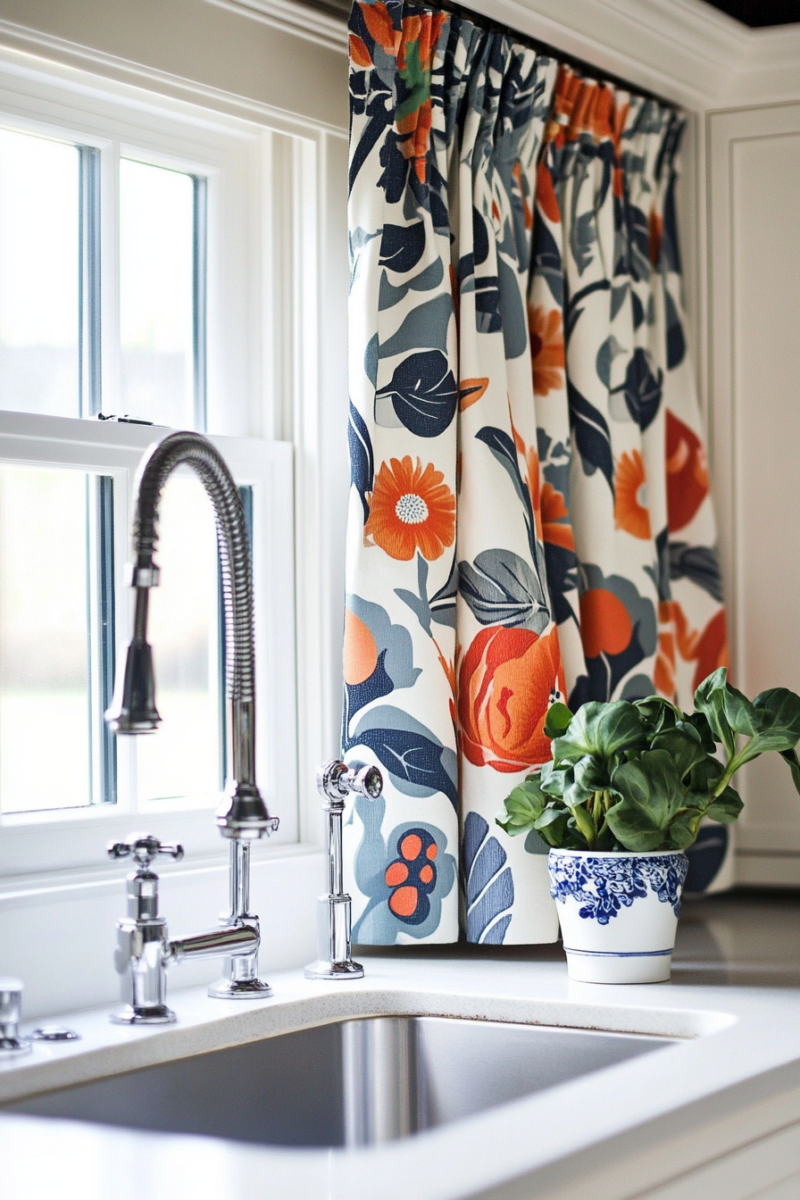
One practical addition: if that window gets a lot of direct sun, look for patterned curtains with a light lining. It protects the fabric from fading and keeps the print looking sharp longer.
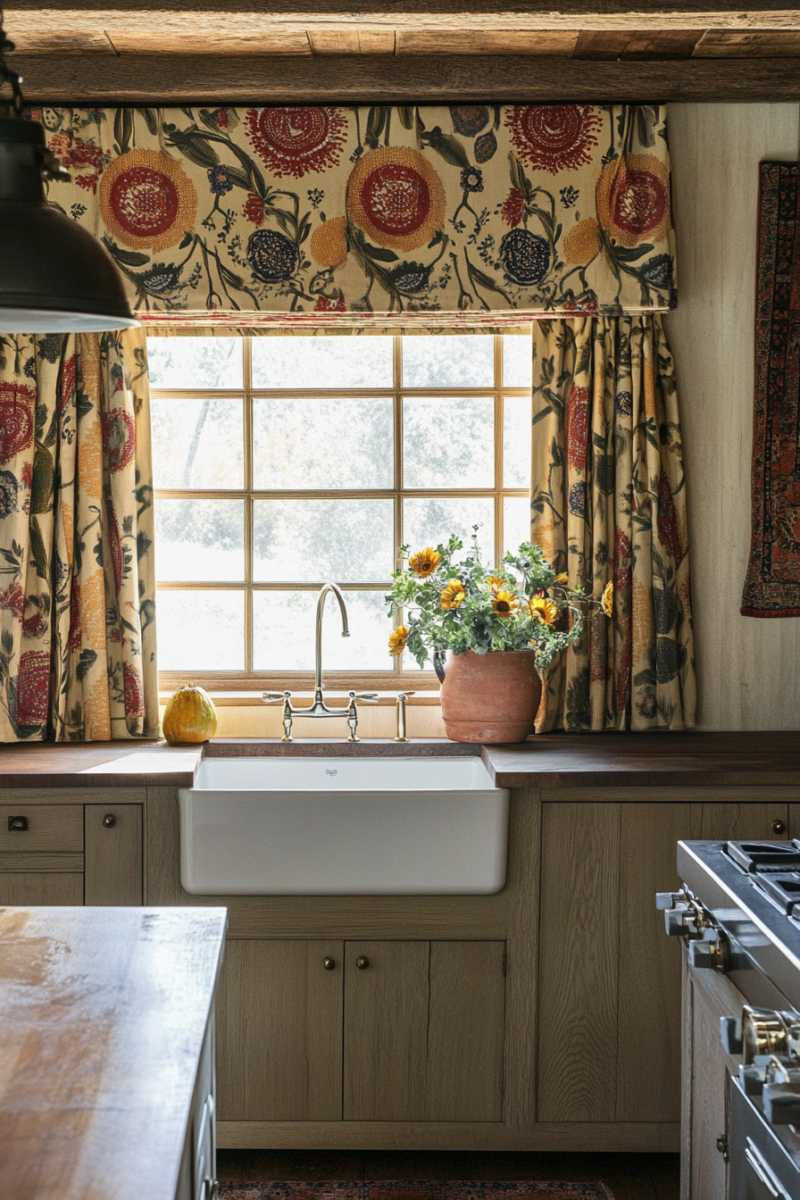
Bold patterns are not for everyone. If you second-guess yourself easily, start with a valance in the pattern you love before committing to full panels. Lower stakes, easier to swap.
Burlap Curtains: Rustic, Cheap, and Better Than You’d Think
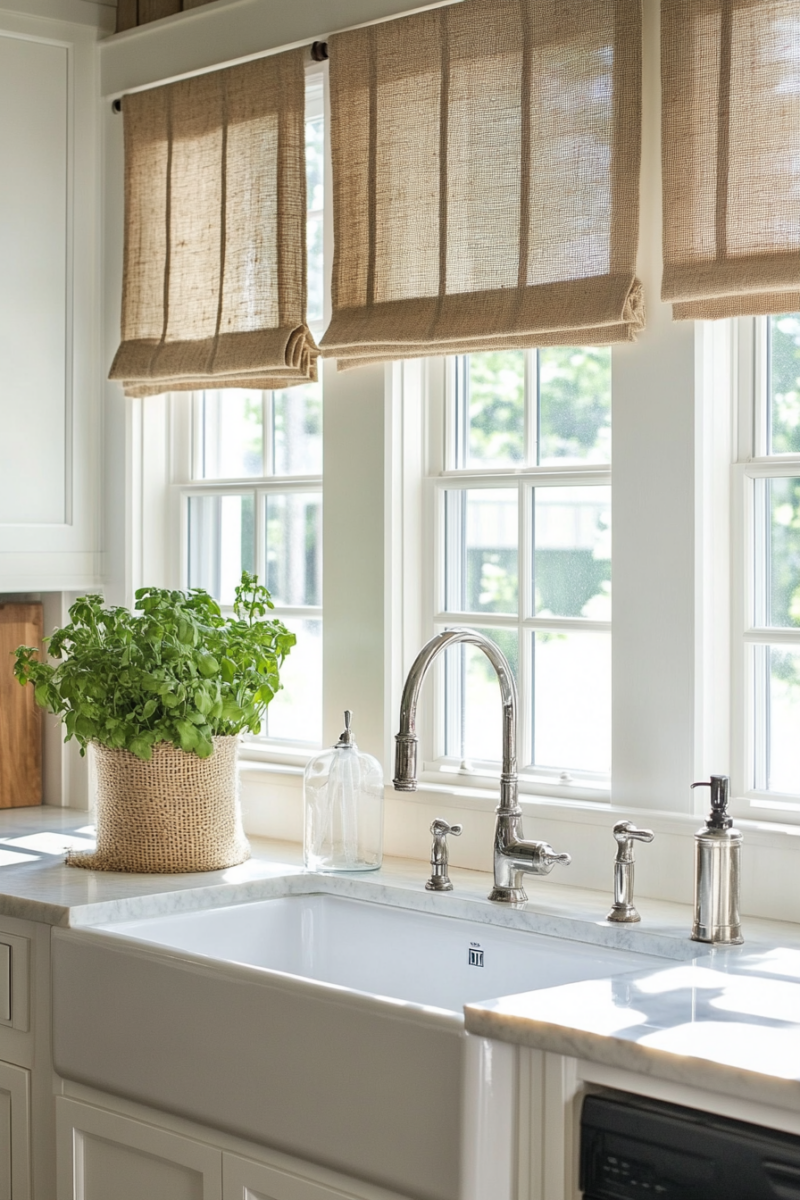
I was skeptical about burlap. It sounds scratchy and utilitarian. But honestly, in the right kitchen it looks really warm and grounded in a way that fancier fabrics don’t.
The natural weave lets light filter through softly, almost like it’s glowing. And the earthy tan color plays beautifully against wood tones, terra cotta pots, and anything with a worn or aged look. If you have open shelves with wooden boards or vintage crockery, burlap at the window will feel like it belongs there.
To keep it from looking unfinished, add a small detail. A strip of white lace sewn (or iron-on hemmed) along the bottom edge is such a simple touch, but it pulls the whole thing together. A stenciled pattern in white paint is another option if you’re feeling crafty.
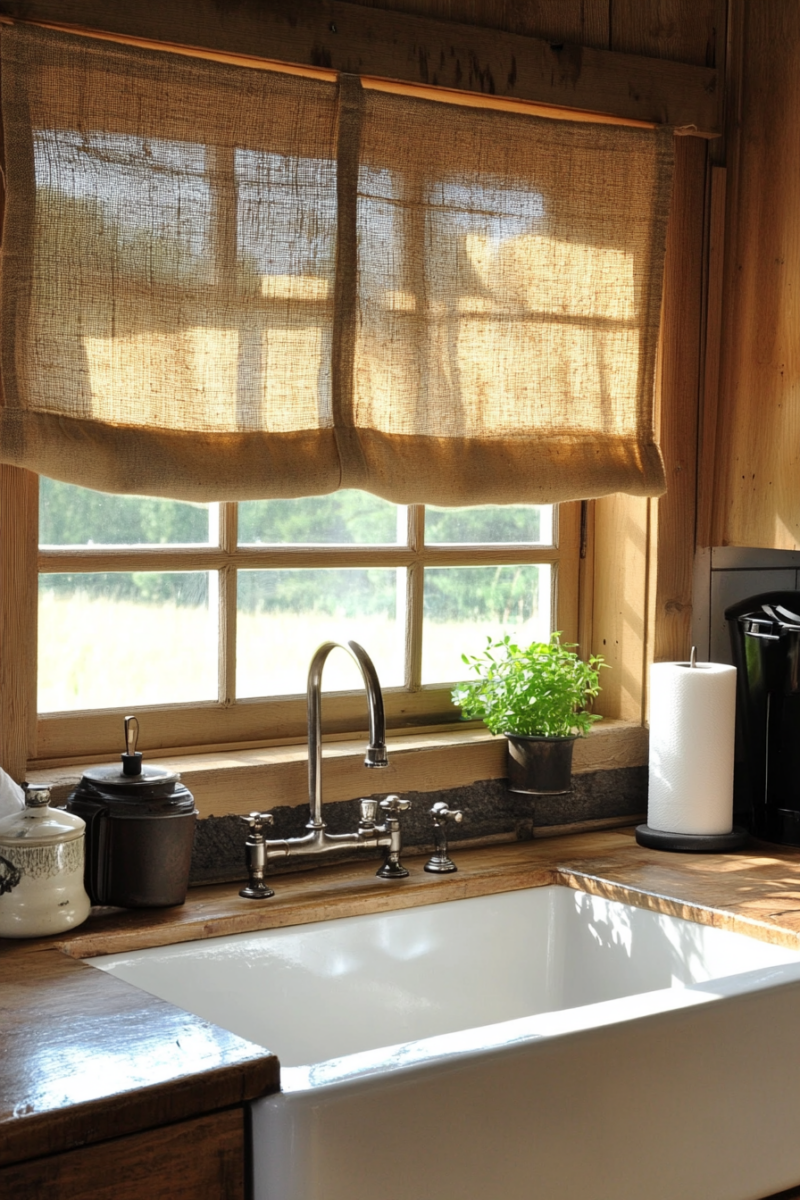
Rod options: a wooden dowel from the hardware store (honestly under $5) looks completely at home here. Or a dark bronze curtain rod if you want something a little more polished. Skip the shiny chrome — it fights the texture.
A burlap valance instead of full panels is worth considering if you want just a hint of the texture without covering the window. About 12-14 inches of drop is usually enough to read as intentional without blocking your view.
Burlap curtains are also genuinely inexpensive. You can buy burlap by the yard at a craft store for $3-5 per yard and make your own with iron-on hem tape. No sewing required.
Tie-Up Curtains: Casual, Adjustable, Easy to Love
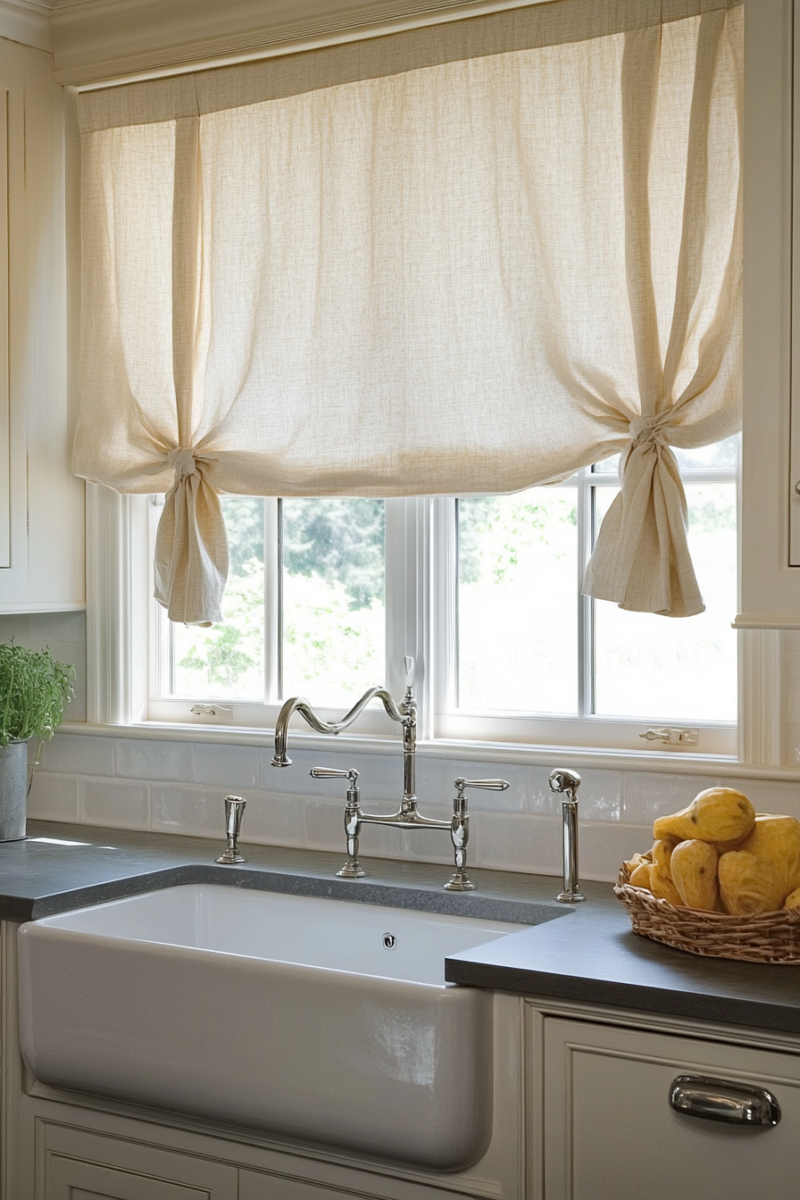
Tie-up curtains are basically a fabric panel that you scrunch up to whatever height you want and secure with fabric ties. It’s a laid-back look that works especially well for above-the-sink windows because you can adjust how much light you’re letting in depending on the time of day.
Morning coffee when the light is soft? Let them all the way down. Afternoon when the sun is coming in sideways? Tie them halfway up. It takes about ten seconds.
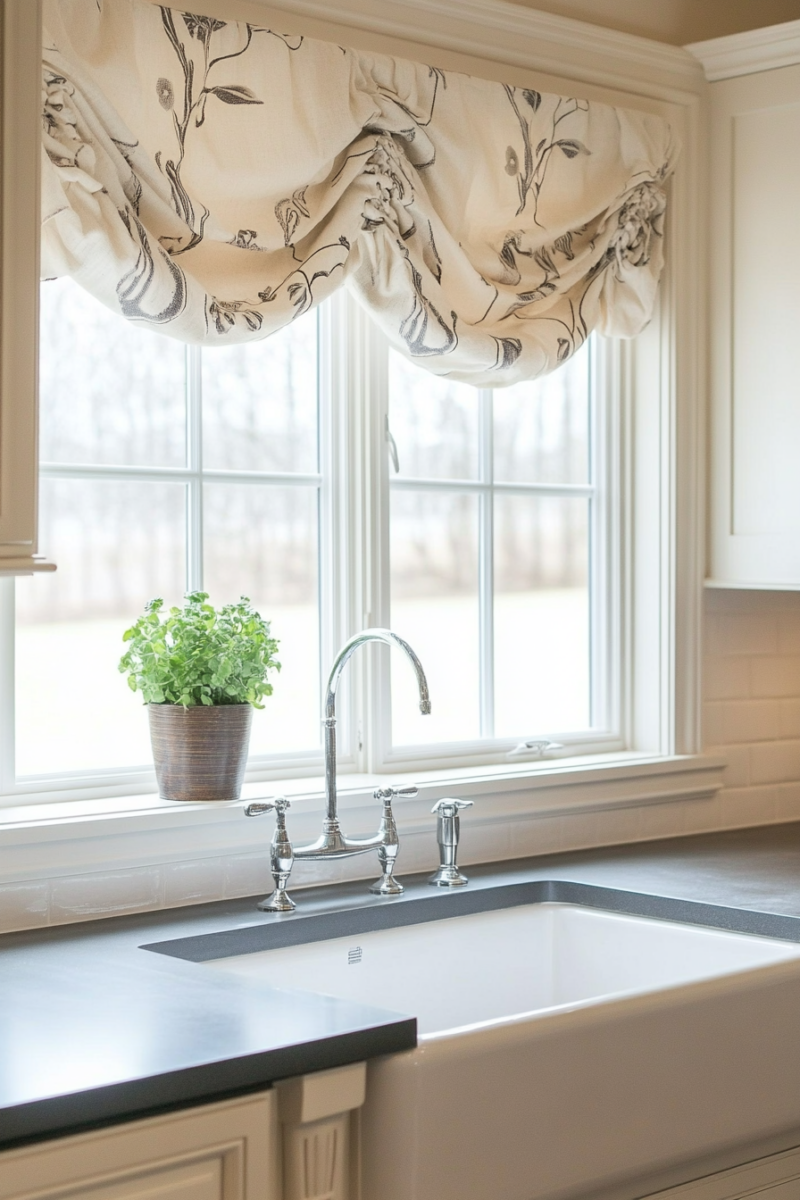
Fabric choice shapes the whole feel. Lightweight cotton or linen in a soft color reads romantic and a little cottagecore. A thick buffalo check or stripe reads more casual and country. Either way, the tied-up silhouette is inherently charming — there’s something a little unpretentious about it that I really like.
How you tie them changes the look too. A loose, casual knot is relaxed and effortless. A neat bow is slightly more put-together. Both are fine; just pick one and commit.
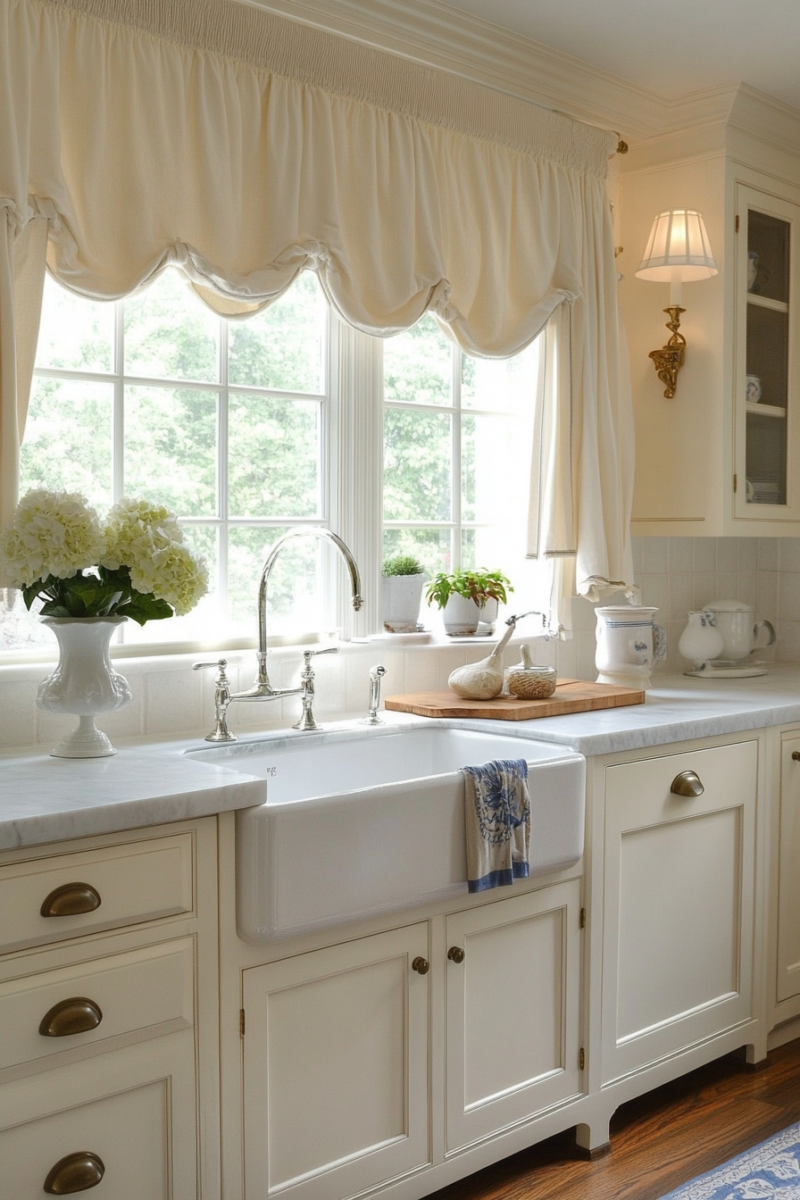
They’re also extremely easy to wash, which matters a lot above a sink. Take them off the rod (clip rings make this a 30-second job), toss them in the machine, rehang. Done.
Roller Shades: Minimal, Clean, No Nonsense
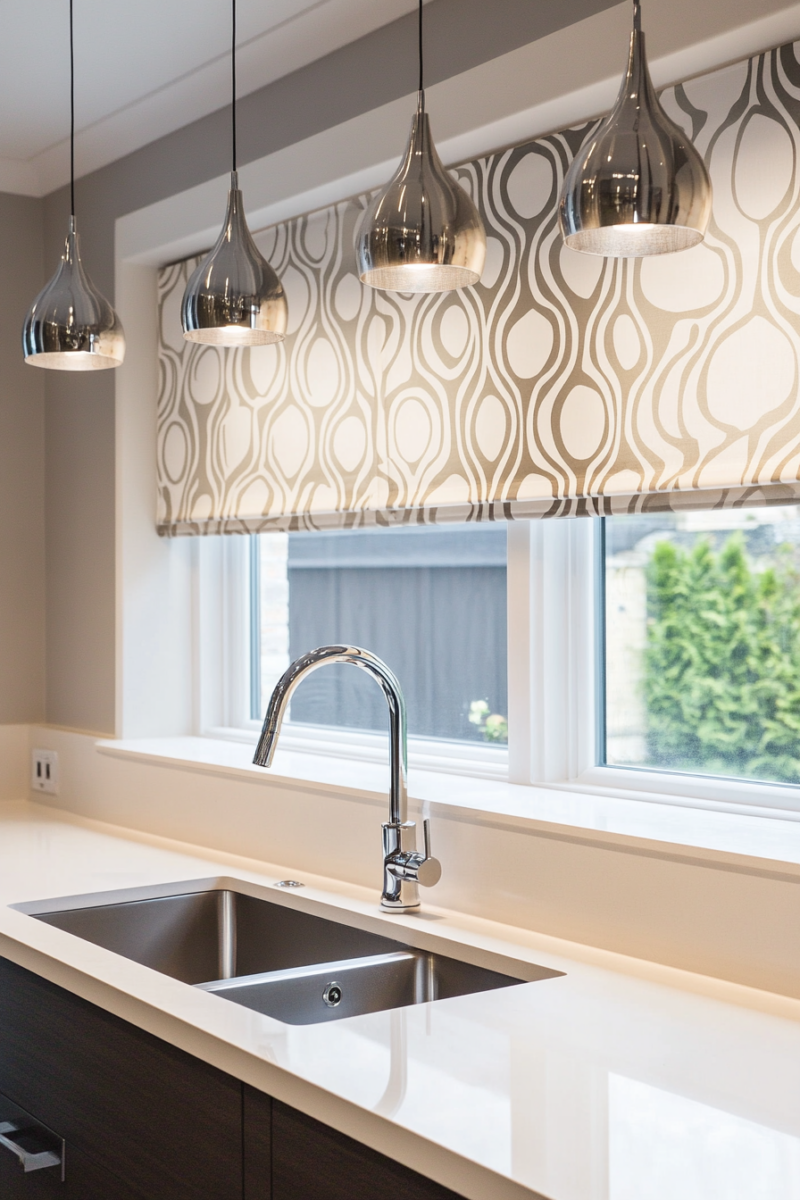
If curtains feel fussy to you, roller shades are the antidote. They roll up almost completely out of sight when you don’t need them, and they pull down smooth and flat when you do. No fabric moving around in the breeze, no ties to redo. Very clean.
For a modern or industrial kitchen, a roller shade in a warm linen texture or a solid muted color (think warm gray, soft white, dusty olive) looks intentional without trying too hard. Textured materials add more visual warmth than a flat synthetic fabric.
Light-filtering vs. blackout: for a kitchen, I’d go light-filtering almost every time. You still want some daylight coming in while you’re working at the sink. Save the blackout fabric for bedrooms.
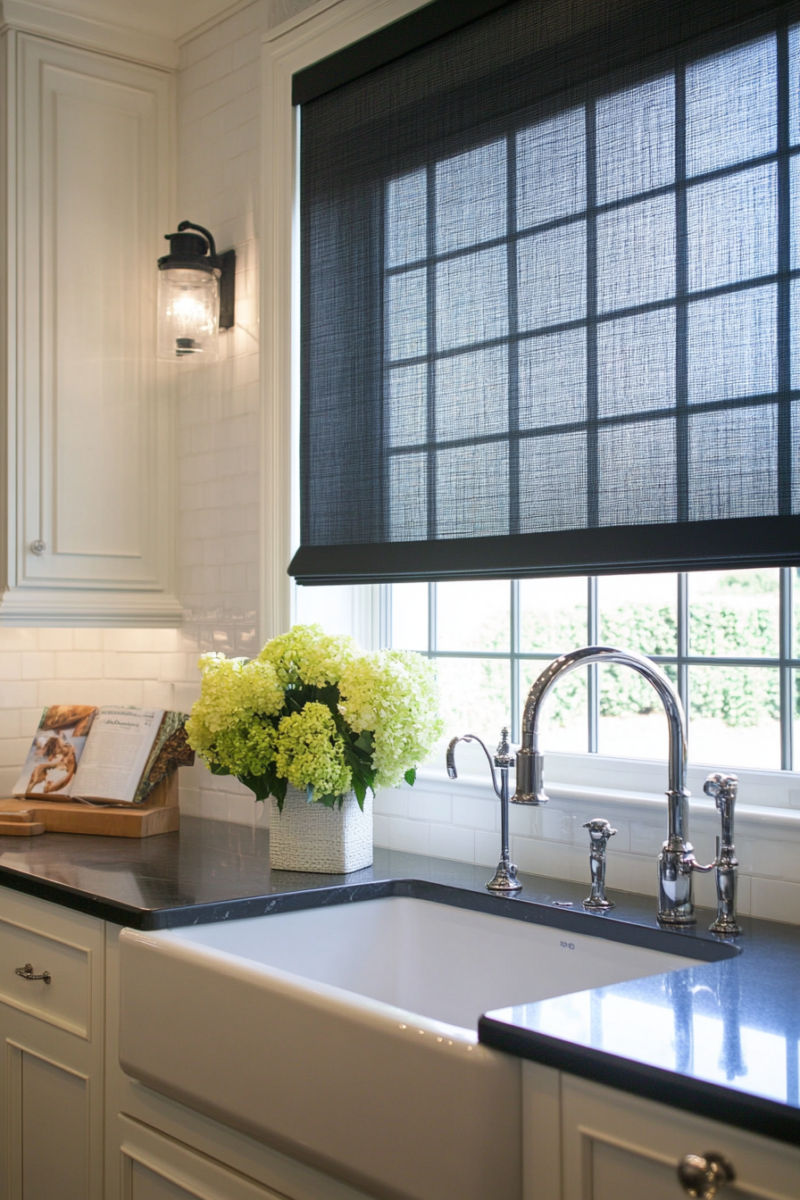
Above a sink, easy-clean matters. Most roller shade fabrics can just be wiped down with a damp cloth if they catch a splash. That’s a real practical win.
Motorized options exist if you have a hard-to-reach window, but honestly a basic pull cord is fine for a standard kitchen window. The motorized versions start around $80-100 and go up fast. Unless you genuinely can’t reach it, I’d skip it.
Valances: The Lightest Touch (And Easier Than You Think)
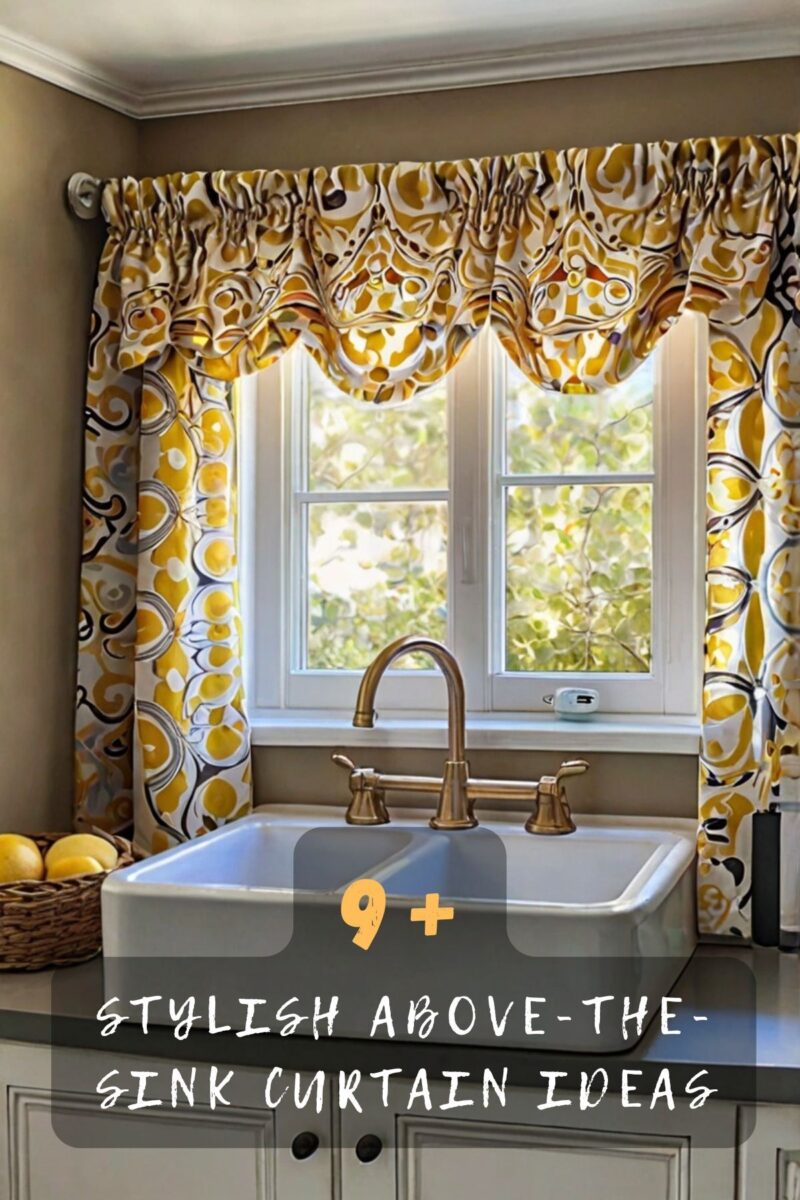
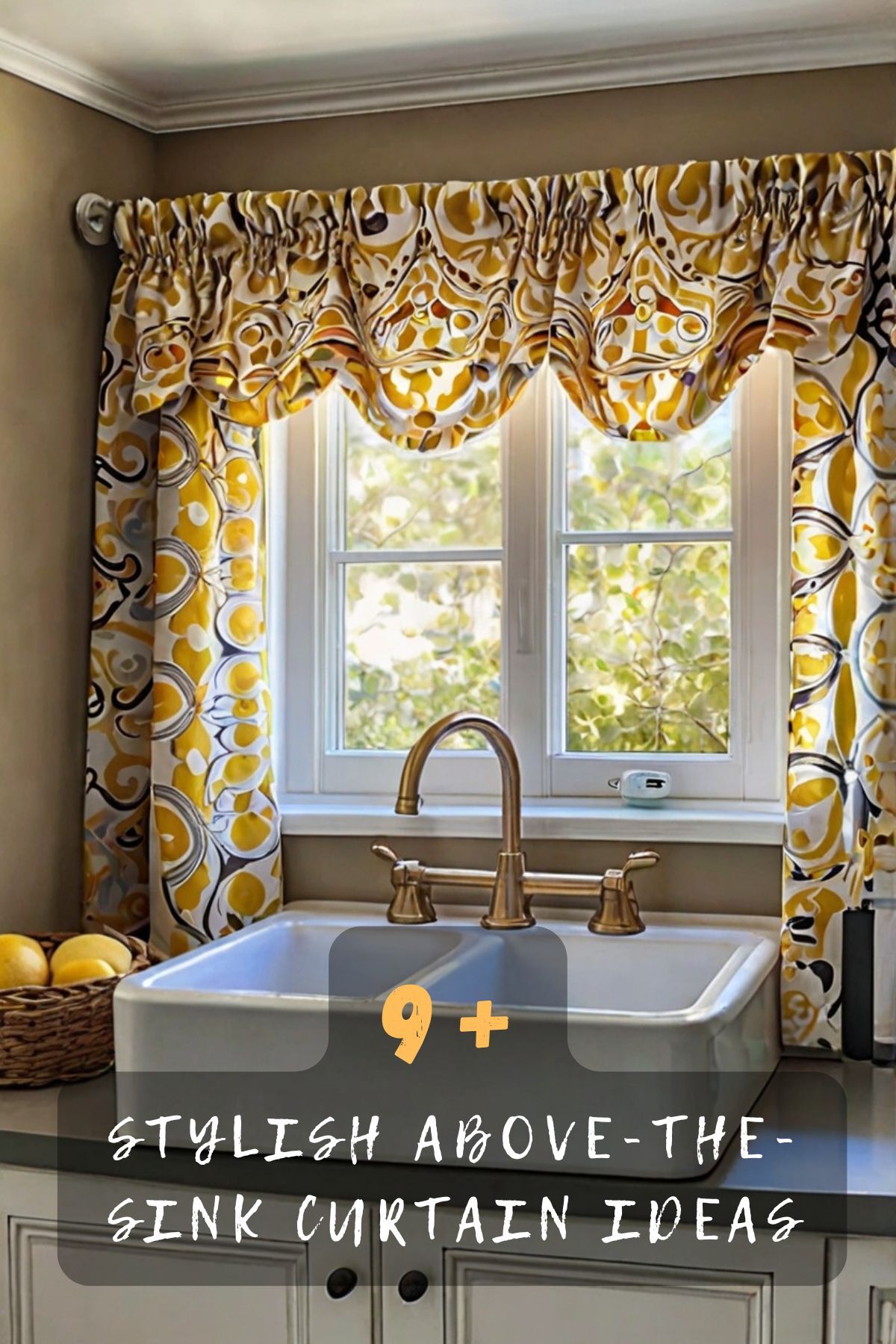
A valance is just a short fabric header across the top of the window. It adds something decorative without blocking light, which is why it’s such a smart choice for kitchens that already get good sun. You’re dressing the window without actually covering it.
Standard valance drop is around 12-18 inches. Too short and it looks like an afterthought. Too long and it starts to look like a curtain that ran out of fabric. I’ve found 14-16 inches tends to be the sweet spot for most above-the-sink windows.
Style options run the full range. Straight and tailored for a modern kitchen. Scalloped edge for something more romantic. Ruffled for cottage or shabby-chic. Box-pleated for traditional. Each silhouette reads completely differently even in the same fabric.
Valances are also the easiest thing to swap out seasonally without committing to a whole new look. I keep a floral linen one for spring and summer, a warm plaid for fall. The rest of my kitchen stays exactly the same but it somehow feels different.
Layering a valance over a roller shade or bamboo blind is a combination that genuinely looks designed. The shade handles function; the valance handles personality.
DIY No-Sew Curtains: Under $15 and Completely Yours
I made my first no-sew curtain out of a vintage tablecloth I found at a thrift store for $4. Cut it down, used iron-on hem tape on the edges, clipped it to a tension rod. Took maybe 45 minutes including the trip to get the hem tape. People ask about it constantly.
Here’s the basic process, as simple as I can make it:
- Measure your window width and desired length (add 1 inch on each side for the hem)
- Cut your fabric to size — thrift store tablecloths, linen dish towels, fabric remnants, even tea towels for a small window all work
- Fold edges under about half an inch and press with an iron
- Apply iron-on hem tape (under $5 at any craft store) along the fold and press again to bond it — hold for about 10 seconds per section
- Let it cool completely before handling
- Attach clip-on curtain rings (a pack of 10-12 runs about $6-8) and hang on your rod
That’s genuinely it. No machine, no hand stitching, no special skills.
The fun part is the fabric sourcing. Vintage scarves layered together look amazing and wildly unique. A remnant of bold printed cotton from a fabric store can cost $3-6 total for a small window. Fabric glue works too if you don’t have an iron, though hem tape gives a cleaner result.
Add pom-pom trim or fringe along the bottom with fabric glue if you want something with more personality. That extra step takes ten minutes and makes it look like something you’d pay $60 for at a boutique shop. (I learned this trick after buying $60 curtains at a boutique shop and then immediately recognizing the plain fabric underneath all the trim.)
Bamboo Shades: Natural Texture That Works in Almost Any Kitchen
Bamboo shades are one of those things that photograph beautifully and also look great in real life, which isn’t always true. The woven texture catches light differently at different times of day and there’s a warmth to it that flat fabric just can’t replicate.
They work in boho kitchens obviously. But also coastal, farmhouse, modern organic, and transitional styles. I’d say the one aesthetic they don’t quite fit is very sleek ultra-modern — the organic texture can feel out of place next to a lot of stainless steel and high-gloss surfaces.
Light filters through the weave in a soft, dappled way that I find really appealing, especially in the morning. You get light without harsh direct sun. For full privacy (like if you face a busy sidewalk), look for bamboo shades with a fabric liner option.
Cleaning: a vacuum brush attachment along the slats takes care of regular dust. Wipe individual slats with a barely damp cloth for anything more stubborn. Bamboo is surprisingly resilient near a sink as long as it’s not soaking wet repeatedly.
A bamboo shade paired with a loose linen valance on top is one of my favorite combinations. The shade handles the light. The valance adds a soft fabric element that makes the window feel dressed without being heavy. It’s a layering approach that looks expensive and costs very little to pull off.
Layered Curtains: The Designer Trick That’s Not Actually Complicated
Layering window treatments sounds intimidating but it’s basically just: put two things on the same window. A sheer panel plus a Roman shade. A bamboo blind plus a valance. A roller shade plus café curtains. Each combo gives you something different.
The most useful combo for a kitchen sink window is a light-filtering shade (roller or bamboo) as the base layer plus a sheer or café curtain on top. During the day, you raise the shade and let the sheer filter the light softly. At night, lower the shade for full privacy. Two modes. Both look intentional.
For the layered look to feel pulled together rather than accidental, either match colors closely between the two layers, or go deliberately different (like a warm natural bamboo shade with a crisp white café curtain). The mistake is ending up in the middle — two different neutrals that are almost-but-not-quite the same. That just looks like you couldn’t decide.
Hardware: a double curtain rod makes layering easy. They’re two rods on a single bracket, one close to the window and one further out. You can find them for around $15-25. Worth having if you layer often.
Your neighbors’ house is eight feet away and you face each other directly? This is genuinely the best solution. Sheer open during the day, heavier layer down at night. You keep all the daylight and all your privacy.
Vintage Lace Curtains: Delicate and Kind of Magical
Lace curtains get dismissed as old-fashioned and I think that’s unfair. In the right kitchen, a White or cream lace panel above the sink does something really lovely with the light. It creates a soft dappled pattern across the counter and walls that changes as the sun moves. It’s subtle but genuinely pretty.
They’re at home in cottagecore, shabby-chic, French country, or any kitchen that leans toward the romantic and lived-in. They don’t belong in a sleek modern kitchen. But then again, neither do I.
Because lace is lightweight, you don’t need a heavy rod. A simple tension rod or a thin brass rod does the job. Clip rings work great since lace can be delicate and you don’t want to fight with rod pockets.
Most lace curtains are machine washable on a gentle cycle, which is a bigger deal than it sounds for a window right above the sink. Cold water, air dry. They hold up really well.
Layer lace over a simple white roller shade if you want both the romantic look and actual light control. The shade disappears behind the lace during the day; you just pull it down at night.
Metal Blinds: Industrial Edge, Easy to Clean
Metal blinds are not the most glamorous option on this list. But they’re practical in a way that earns them a spot here, especially for kitchens that get a lot of grease and moisture near the window.
They wipe clean completely. Like, completely. A damp cloth and 90 seconds and they look new again. No fabric to spot-treat, no panels to take down and wash. For a kitchen sink window specifically, that’s actually a meaningful advantage.
Finish options matter a lot here. Classic silver aluminum is fine but feels a little office-building. Matte black is much more interesting and plays well with black hardware or dark grout. Brushed gold adds warmth and looks genuinely nice against white subway tile.
For an industrial kitchen with exposed brick or stainless appliances, metal blinds are the natural fit. But they can also work in softer spaces if you balance the metal with warm tones elsewhere — wood cutting boards, wicker baskets, linen dish towels nearby.
Go cordless if you can. Cords above a sink get wet and gross faster than you’d expect. Cordless versions are a few dollars more and completely worth it.