Okay, real talk: my sliding glass door sat bare for almost four months after I moved in. Not because I forgot. Because every time I tried to figure out what to put on it, I got completely overwhelmed and closed seventeen browser tabs. It’s a big opening, it moves, it’s also technically a door, and whatever you hang on it has to look intentional. No pressure.
Here’s what I’ve learned after way too much trial and error: there are really only a few decisions that matter — how much light you want, how much privacy you need at night, and whether you actually use that door regularly (because that changes everything about what’s practical). Get those three things straight and the rest is just shopping, which honestly is the fun part.
Further down I’ll break down all fourteen options I’ve tested or styled — including what they actually cost, specific fabric and sizing tips, and a few honest “skip it” warnings I wish someone had given me sooner. Sheers, silhouette shades, roller shades, bamboo, panel tracks, shutters, the works. Stick around because the cellular shades section alone might save you real money on your energy bill.

First: The Three Questions That Actually Drive Your Decision
Before you fall down a Pinterest rabbit hole, answer these. They’ll cut your options in half immediately.
1. Do you use the door daily? If yes, skip anything that requires unclipping, untying, or fighting with hardware every single time. You want smooth-sliding track systems or curtain rods with rings that glide easily. Trust me on this one — I hung a beautiful pair of linen drapes on cheap rings and by week two I was shoving them out of the way instead of actually sliding them open. Annoying every single morning.
2. Night privacy vs. daytime light: which one hurts more right now? If you feel exposed at night, you need something opaque or at least room-darkening. If you hate losing your backyard view during the day, solar shades or loose-weave bamboo are your friends. Pick your bigger pain point first.
3. What’s your realistic budget? For a standard 6-foot sliding door you’re looking at roughly $30-$80 for basic roller shades or off-the-shelf sheers, $150-$400 for quality cellular or silhouette shades, and $500+ for custom shutters or motorized anything. Know your number before you start falling in love with things.
Okay. Now let’s get into the actual options.
Sheer Curtains

Sheer curtains are my starting point recommendation for almost anyone who isn’t sure what they want yet. Low commitment, low cost, and they make every room feel softer and more pulled-together instantly.
Here’s the thing about sheers on a sliding door specifically: the width matters more than most people realize. A standard 6-foot door opening needs curtain panels that together span at least 144 inches when closed — more if you want that full, gathered look. I’d honestly go 180 inches total (three 60-inch panels, or four 45-inch panels). Skimpy sheers on a wide door look sad. Like a tiny hat on a large head.
Mount the rod as high as you can — I put mine about 4 inches below the ceiling — and let the fabric brush the floor. That simple choice makes a regular 8-foot room feel taller. It costs nothing extra and makes such a difference.
The honest limitation: sheers do nothing for you after dark. The minute your interior lights come on, you are on full display to anyone outside. So if you face a street or a neighbor’s window, you’ll want to pair them with a second layer — roller shades behind, or blinds, something with real opacity. The layered look honestly looks more intentional anyway.
Price check: IKEA’s LILL sheers are around $9 for a pair and they’re perfectly fine for a casual space. If you want something with more texture and drape, look for linen-blend sheers in the $25-$45 per panel range. And yes, most machine-wash on cold. Biscuit has walked through mine multiple times trailing muddy paw prints, and they’ve survived every time.
For sliding doors, use curtain rings with clips on a thick rod (at least 1-inch diameter so it doesn’t bow). Thin rods flex under the weight of wide panels and start to look droopy within a few months. (I learned this the obvious way.)
Silhouette Shades

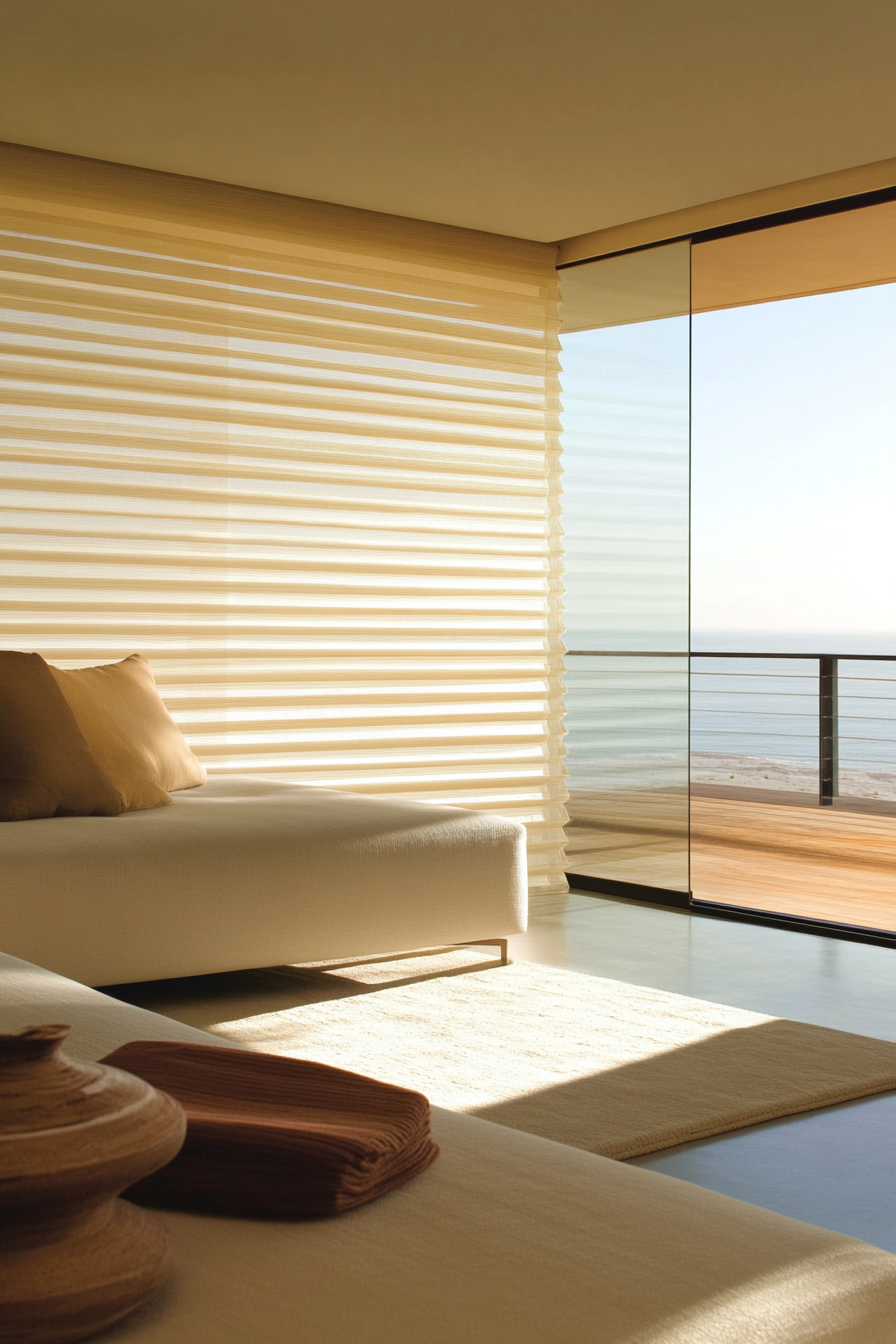
Silhouette shades are genuinely one of the most beautiful window treatments I’ve ever seen in person. They have these soft fabric vanes suspended between two sheer panels — it’s hard to describe, but they catch light in this gorgeous, layered way that makes a room feel expensive without being fussy about it.
What makes them work so well on sliding doors is the light control. During the day with the vanes open, you get this warm, diffused glow — not harsh, not dark, just right. Tilt the vanes closed and you get real privacy while still keeping the room bright. After dark, fully closed, they block views in from outside effectively.
The track-mounted versions designed for sliding doors are worth the extra cost. They glide along with the door movement and don’t bunch or catch. If you’re pricing them out, Hunter Douglas makes the most well-known version (the Silhouette line) and you’re looking at $300-$600+ for a custom-fitted sliding door application. That’s real money. But the quality holds up and they don’t look dated after a few years the way some trendy treatments do.
One practical note: because they’re fabric, keep them away from a sliding door that opens onto a pool deck or anywhere with regular moisture or splashing. I wouldn’t put these in a room where the door is constantly propped open in humid weather. They’re best in a living room or a main floor bedroom where conditions are controlled.
Cleaning is mostly a gentle vacuum with a brush attachment. Don’t wet-clean them unless the manufacturer specifically says you can — that’s a mistake you make once.
Roman Shades

Roman shades are one of those treatments that photograph beautifully, and for a good reason — those horizontal folds when the shade is raised look genuinely elegant. They come in flat (no folds visible when down), hobbled (folds even when fully lowered), and relaxed (soft curved hem). For sliding doors, flat Romans are the most practical because the face stays smooth and doesn’t interfere with the door frame when raised.
The customization options here are enormous. You can do a linen blend in natural flax for a calm, organic look, or go with a graphic geometric print if you want the door to be an actual design moment in the room. I’ve seen a deep navy Roman shade on a sliding door in a small condo that made the whole space feel intentional and sophisticated. It was the first thing you noticed when you walked in. Good way.
For a standard 72-inch wide sliding door, you’d typically hang two Roman shades side-by-side rather than one enormous single shade, which would be impractical to raise. Each shade gets its own mounting board above the door frame. Mount them on a board that extends 4-6 inches on each side beyond the door frame so they cover any light gaps when closed.
Motorized Romans are absolutely worth it for a large sliding door. Soma and Budget Blinds both offer motorized options in the $200-$500 range depending on size and fabric. You’ll use them way more if you’re not wrestling with a cord across a wide opening every morning.
Spot clean most fabric Romans with a damp microfiber cloth. For dusty ones, a handheld vacuum with a brush attachment once a month keeps them fresh. If Biscuit makes contact with them (and he will), act fast — dried dog nose prints on linen are not a vibe.
Layered Curtains

This is honestly my favorite approach for a living room sliding door because it gives you the most flexibility and the most visual richness. You’re not locked into one mood. Morning light with sheers? Done. Movie night privacy with blackout panels? Also done. It’s the same wall, completely different feel.
The setup: a double curtain rod (or a double track) holds two layers independently. Sheer panels sit closest to the glass. Heavier drapes hang in front. Each layer slides on its own so you can mix and match throughout the day without thinking too hard about it.
Practical sizing for a 6-foot sliding door: sheers at 180 inches total width minimum, outer drapes at 144-180 inches total. For the outer panels I’d do floor length — measure from the rod to the floor, then add 1 inch for a clean break, or add 4-6 inches if you want a gentle pool on the floor (which looks really romantic in a living room). Just know that pooling fabric and dogs with long fur are a complicated relationship.
Color pairing ideas that actually work:
- White linen sheers plus warm mushroom or taupe velvet drapes — classic, calming, works in almost any room
- Ivory sheers plus deep forest green curtain panels — moody, botanical, feels expensive
- Blush sheers plus warm charcoal blackout panels — soft daytime, serious nighttime privacy
For the hardware, a double curtain rod with smooth ball-bearing rings is non-negotiable if you’re using the door regularly. The Amazon basics double rods are fine for lighter fabrics. For heavier velvet or lined panels, go for something with a 1.5-inch diameter rod — the extra stability prevents the mid-span sag that makes rods look cheap after a few months.
Budget-wise, you can layer IKEA sheers ($15-$30) with thrift-store velvet panels (I’ve found gorgeous ones for $8-$12 a pair) and the whole setup can come in under $60. Or you can spend $400 on custom linen from a specialty shop. The layered look works at every price point because the texture and dimension does the heavy lifting, not the price tag.
Cellular Shades

These are the unsung heroes of sliding door window treatments, and I mean that. They’re not the most dramatic looking option, but if your sliding door faces west and turns your living room into a sauna every afternoon (raises hand), or if you’re paying too much to heat a room with a big drafty glass door all winter, cellular shades will genuinely change your life in a quiet, practical way.
The honeycomb cell structure traps a pocket of air inside — that’s the insulation doing its job. Single-cell shades provide good insulation. Double-cell shades are better for rooms with extreme temperature swings. Triple-cell is the premium tier, worth it if the door faces north or is in a drafty older house. That corner in my dining room that gets brutal 3pm sun in summer? Single-cell cellular shade, and the difference in room temperature was noticeable within a week. My energy bill noticed too.
For a sliding door, the track-style mounting matters. Look specifically for cellular shades rated for patio doors or sliding doors — they’re designed with a bottom rail that glides in a floor track so the shade moves with the door rather than swinging free or catching on the frame. This is a detail that cheaper versions skip and then you’re annoyed every single time you open the door. Don’t skip it.
Top-down/bottom-up operation is genuinely useful here. You can lower from the top to let in sky light while keeping the bottom half of the door covered — great for ground-floor rooms where you want daylight without giving a full view into the room from outside.
Colors and opacity: most major brands (Bali, Levolor, SelectBlinds) carry cellular shades in light-filtering and blackout versions. The light-filtering ones in warm white or soft cream look really nice — they glow softly when backlit by sun and don’t feel institutional. Blackout cellular shades for a bedroom sliding door are genuinely one of the best investments you can make if you’re a light sleeper.
Price range: $80-$180 for a standard sliding door in a mid-range brand. Custom sizing from places like SelectBlinds or Blinds.com runs $120-$300 but the fit is so much better on odd-sized doors. Worth the extra $40 to not have light gaps down the sides.
Café-Style Curtains
I know, I know — café curtains feel like something you’d see in a 1987 kitchen. But hear me out, because on the right sliding door in the right space, they are genuinely charming and underrated. They work best when you have a sliding door in a kitchen or breakfast area where you want light flooding the top half of the room all day, but you also want some privacy at seated height.
The concept: you hang curtains on a rod positioned roughly halfway down the door — usually between 36 and 48 inches from the floor. The top half of the door stays completely open to natural light. The bottom half has fabric coverage. It’s basically the same logic as a frosted-glass privacy film, but with much more personality.
For the rod placement: measure to where a seated person’s eye level would be from outside, and put the rod a few inches above that. Usually 42-48 inches from the floor is about right. Use a tension rod if you don’t want to drill into the door frame — for lightweight cotton or linen panels it holds just fine.
Fabric choices that work well here: lightweight cotton in a stripe, a small check, or even a simple solid. Gingham in navy or sage green looks especially good on a kitchen sliding door. Linen in a natural undyed color is beautiful and casual. Avoid heavy or stiff fabrics — they don’t move well on a short rod and they look out of proportion on just the lower half.
One honest limitation I’ll tell you upfront: the minute your lights come on at night, anyone outside can see straight in through the uncovered top half. So if you have neighbors close by or you face a street, you’ll want a secondary shade behind the café curtains for evening. A simple roller shade in white that disappears into the top of the frame during the day works perfectly. Best of both worlds.
Cost: this is genuinely one of the cheapest options. Two panels of decent cotton from IKEA or HomeGoods runs $20-$40 total. A tension rod is $8. You can do this whole look for under $50 and it looks intentional and sweet.
Roller and Solar Shades

Roller shades are the workhorse of sliding door treatments. They’re clean, they’re predictable, they’re easy to live with, and when they’re chosen well they look genuinely sharp. If you want nothing to compete with your backyard view or your furniture, a good roller shade is your answer — it basically disappears when it’s rolled up.
The distinction worth knowing: roller shades vs. solar shades are not the same thing, even though people use the terms interchangeably.
Roller shades are made from solid, opaque (or semi-opaque) fabric. They provide clear privacy, block light to varying degrees depending on the opacity percentage, and come in a wide range of colors and textures including woven fabric, faux linen, even some really nice textured options that feel almost like a natural material.
Solar shades are made from a mesh-like fabric specifically engineered to block UV rays and glare while preserving your outward view. The openness factor (the percentage of “open” weave) matters here: a 3% openness gives more privacy and more UV blocking. A 10% openness gives you a more open feel but less privacy. During daylight hours, solar shades let you see out clearly while blocking the worst of the glare — but at night, with interior lights on, they don’t give you much privacy at all. Worth knowing before you buy.
For sliding doors specifically: measure inside the frame carefully. Most sliding doors have a recessed track area where the shade can mount cleanly inside the frame — this is called an inside mount and it gives the cleanest look. If your door frame is too shallow for an inside mount (less than about 2.5 inches of depth), go outside mount and cover 2-3 inches on each side of the frame to eliminate light gaps.
Motorized roller shades on a sliding door are legitimately one of my favorite home upgrades. IKEA’s FYRTUR cordless blackout roller shade is around $100-$130 depending on size and works with their smart home system. Lutron Serena shades start around $200 and integrate with most smart home platforms. For a wide sliding door, the convenience of a button (or a voice command if you’re into that) is genuinely worth the extra cost because you’ll actually use it instead of leaving the shade half-down at a weird angle for three days.
Cleaning: most roller and solar shade fabrics wipe clean with a damp microfiber cloth. They don’t collect dust the way fabric curtains do. If you have pets, this alone might be the deciding factor. (Every curtain in my house currently has a layer of Biscuit on the bottom two feet. Roller shades: not a problem.)
Sectional Drapes


Sectional drapes are what you choose when you want the sliding door to be a moment — not just a covered opening, but an actual design feature of the room. These are multi-panel drape systems where each panel moves independently on a multi-track rail. It’s a more architectural approach to window treatment and it looks incredible in a larger room with high ceilings.
The way it works: you have three, four, sometimes five separate panels hanging on individual tracks. You can draw them all to one side to fully reveal the door. Pull two center panels closed and leave outer ones open for a framed look. Stack them in alternating positions for a layered, asymmetrical effect. The flexibility is genuinely not matched by any other treatment.
Fabric is where you make or break this look. For a dramatic, formal living room: floor-length velvet in a deep color (emerald, navy, burgundy) pooling slightly on the floor makes a room feel like a real room. For a lighter, more casual family space: linen or cotton-linen blend in natural, warm white, or soft sage gives you the layered panel look without heaviness. Avoid stiff or synthetic fabrics that don’t drape — the whole appeal of this treatment is the fabric movement and fall.
Length matters more here than in any other treatment. For a truly dramatic effect, measure from ceiling to floor and add 1-2 inches of pooling at the bottom. For a cleaner, tailored look, measure exactly to the floor with a half-inch clearance. Do not hang sectional drapes that stop awkwardly in the middle of the window opening — they’ll look like they ran out of fabric.
The multi-track hardware system is usually custom or semi-custom. IKEA’s KVARTAL track system is a surprisingly affordable starting point for a DIY version — you can build out a 3-4 panel sectional look for $100-$200 in hardware alone, plus the cost of panels. Professional custom versions from a window treatment specialist start around $600-$1200 for a full sliding door installation with good quality fabric. Worth it for a living room you spend a lot of time in. Probably overkill for a spare bedroom.
Maintenance: depends entirely on fabric. Linen panels can usually be machine-washed on a gentle cycle, hung to dry immediately to prevent wrinkles. Velvet needs professional dry cleaning, full stop. Don’t try to machine-wash velvet drapes. I’ve heard stories. They don’t end well.
Austrian Shades

Austrian shades are genuinely the most theatrical option on this list, and I say that as a compliment. Those scalloped, gathered poufs of fabric when the shade is raised look like something out of a period drama — opulent, romantic, completely unapologetic about being decorative.
They’re not for everyone. But in the right room — a formal dining room, a master bedroom with high ceilings, a sitting room that takes itself a little seriously — Austrian shades on a sliding door look absolutely stunning. They’re one of those choices that makes guests stop and actually comment on the windows, which almost never happens with standard blinds.
The fabric choice shifts the whole personality of the shade. Silk or dupioni gives you that rich, formal ballroom feel — beautiful in a deep ivory, a dusty rose, or a champagne gold. Linen or cotton gauze gives you a softer, more romantic cottage feel — think French country or vintage-inspired interiors. Velvet is the drama dial turned all the way up. Only attempt this if you’re fully committed to the opulent life.
Functionally, Austrian shades work on a cord or ring system that gathers the fabric upward into those signature folds. When fully lowered, they cover the door completely and the fabric has a soft, rippled look that filters light beautifully. When raised, they become purely decorative — like a fabric valance with personality. Motorized versions exist and I would strongly recommend them for a wide sliding door since the cord system on a large shade requires some effort to operate.
One real honest caveat: Austrian shades are high-maintenance. The gathers collect dust. Delicate fabrics like silk may require professional cleaning. They’re not a set-it-and-forget-it treatment, and they’re genuinely not appropriate for a room with a lot of moisture, kids, or pets who view fabric as a chew toy. But if your space is a more formal room and you’re willing to care for them, the visual payoff is extraordinary.
Custom Austrian shades are a specialty order — expect to work with a local workroom or window treatment specialist rather than finding them off-the-shelf. Budget accordingly: $400-$800+ for a custom sliding door application is not unusual.
Bamboo Shades

Bamboo shades are having a long moment and honestly they deserve it. There’s something about woven natural material on a window that makes a room feel grounded and warm in a way that synthetic materials just can’t replicate. They bring texture, they bring warmth, and they photograph beautifully — but more importantly, they look good in person every single day.
The weave tightness determines everything. A tight, fine weave (like the classic flat bamboo shades) offers more privacy but filters light more heavily, giving the room a warm, amber-toned glow when the sun is behind them. A looser, more open weave (like a chunky jute or natural reed shade) lets in significantly more light and is more casual but offers very little privacy. Know which you need before you order — they look similar in product photos but they’re very different in a real room.
For a sliding door, bamboo shades can be mounted in a track system similar to cellular or roller shades so they glide with the door. This is important — a bamboo shade that just hangs stationary in front of a door you use daily will get pushed aside, knocked around, and start looking beat up within months. Make sure the track system is designed for the weight of woven wood material, which is heavier than fabric shades.
Liner options: most woven wood and bamboo shades can be ordered with a fabric liner bonded to the back. A light-filtering liner keeps the natural look while adding privacy. A blackout liner makes them suitable for a bedroom. I’d almost always recommend at least the light-filtering liner — unlined bamboo shades look a little unfinished to me, and the liner helps them hang straighter too.
The style range here is wider than people realize. Super tight, fine-weave bamboo in a pale natural tone reads very clean and modern — great in a neutral living room alongside linen furniture. Chunky, dark-stained woven shades feel more bohemian or tropical. Medium weave in a warm honey tone is the most versatile and works in the most different room styles without looking forced.
Pairs beautifully with: linen drapes on the sides for a layered look (this combo is everywhere in interior design right now and for good reason), simple white Roman shades if you need blackout behind, or nothing at all if the room has enough privacy naturally.
Price check: Selectblinds and Smith+Noble carry good quality woven wood/bamboo shades for sliding doors. Expect $80-$200 for a standard 72-inch sliding door, more with a liner. Worth every penny for the texture they add.
Shutters

Shutters are the long game. They’re the treatment you choose when you’re done experimenting and you want something that’s going to look good, function perfectly, and never need to be replaced. They’re also the most expensive option on this list, and I want to be upfront about that so nobody has a heart attack when they get a quote.
For sliding glass doors, plantation-style shutters are the most common approach. The louvers (the horizontal slats you tilt to control light) come in three standard widths: 2.5 inches, 3.5 inches, and 4.5 inches. Bigger louvers let in more light when open and give a more contemporary look. Smaller louvers are more traditional and give you finer control. I lean toward 3.5-inch as the most versatile middle ground.
The panel configuration matters for a door you actually use. Bifold shutter panels stack neatly to the side when you open the door. Bypass shutters slide on a track similar to the door itself. Hinged panels swing outward. For daily use, bypass or bifold are most practical — you don’t want to be wrestling with hinged panels every time you want to step outside.
A few things worth knowing before you buy:
- Measure at three different heights across the door opening because floors and frames are rarely perfectly level or plumb — custom shutters will need exact measurements at each point
- Composite (faux wood) shutters are better than real wood for doors that face outside or get condensation — real wood can warp over time near glass
- Full-height shutters with a center rail give you the top-half/bottom-half control option that’s really useful for privacy during the day
- Aluminum shutters exist for very wet or coastal environments and are nearly indestructible
Budget: custom composite plantation shutters for a standard 6-foot sliding door run $400-$900 installed. Premium materials or larger doors push it higher. Yes, that’s a lot. But shutters last 15-20+ years and they add real perceived value to a home. They’re also the one window treatment that buyers consistently respond positively to during a home sale. So there’s an argument that they pay back eventually.
Professional installation is genuinely worth it here. Poorly fitted shutters that don’t close completely flush or that catch on the door frame are miserable to live with. Pay the extra $100-$200 for someone who’s done it a hundred times.
Panel Track Blinds

Panel track blinds are sort of the grown-up version of vertical blinds — same sliding-panel concept, completely different look and feel. Instead of narrow individual slats, you get wide fabric panels (usually 12-20 inches wide per panel) that slide on an overhead track system. The result is much more like a soft, architectural room divider than a traditional blind.
This is one of the best treatments for very wide sliding doors or for sliding doors that lead to a larger outdoor space where you want the treatment to feel substantial when it’s drawn. Four wide fabric panels sliding across a 6-foot door look intentional and modern. They also stack neatly to one side when open, completely clearing the door opening.
Fabric selection changes everything with panel tracks. Sheer fabric panels glow beautifully in natural light and give a contemporary, airy feel. Room-darkening fabric panels are great for a bedroom or a media room. Textured weaves like a slubby linen or a grasscloth-inspired fabric add warmth and visual interest. You can even mix panel fabrics — alternating a sheer with a semi-opaque in the same color family gives a layered, dimensional look.
How to size them correctly: for a standard 72-inch wide door, four panels at 18 inches each is a common configuration. When stacked to one side, they take up about 18-22 inches of wall space, so make sure you have wall clearance on the side where the panels will stack. If you don’t have much wall space on either side, choose narrower panels or plan to stack them off-center.
Track quality matters. Cheap plastic tracks bind, squeak, and warp over time — especially in rooms with temperature changes near a glass door. Look for aluminum track systems with smooth glide carriers. IKEA’s KVARTAL system is a decent budget option for lighter fabric panels. For heavier panels or more demanding use, brands like Graber or Hunter Douglas offer panel track systems that operate more smoothly for years longer.
Keeping the tracks clean is genuinely important — dust and pet hair in the track channels causes the panels to drag and stick. A quick vacuum of the track with a crevice attachment once a month keeps everything sliding smoothly. This is the kind of maintenance that sounds annoying but takes about 45 seconds.
Vertical Blinds


I’m going to be honest with you: vertical blinds are not my first choice aesthetically. They have a bit of an office building reputation, and for a reason. The clacking, the slight institutional feel, the way cheap slats curl at the bottom after a year — it’s not exactly the warm, layered look I love. That said. They work. They work really well for certain situations, and I’d rather give you the real picture than pretend they don’t exist.
Where vertical blinds genuinely shine: a rental where you can’t do anything permanent, a bedroom sliding door where purely functional is fine, a home office where the light control outweighs the aesthetics, or a very budget-tight situation where you just need something that works. For those scenarios, vertical blinds are a smart, affordable, low-drama solution.
The slat options have improved dramatically from the old school vinyl strips. PVC slats are the most durable and wipe clean easily. Fabric-wrapped slats look significantly softer and more intentional — almost like a panel track at a fraction of the cost. Fabric slats in a neutral linen color actually read as quite nice in person, especially if the room has other soft elements. Aluminum slats are sleek and modern but feel a little cold in a residential setting.
Practical tips that actually matter:
- Slat width: 3.5-inch slats are the standard. They provide decent privacy when closed and don’t look as heavy as wider options on a standard door
- Make sure the track extends at least 2 inches past the door frame on each side so slats can stack completely clear of the opening when you’re using the door
- The bottom chain or spacer that connects the slats is usually the first thing that breaks — look for a brand that offers replacement chains separately so you’re not replacing the whole set when one link breaks
- Vacuum slats vertically (up and down, not side to side) to avoid bending the attachment clips at the top
Cost: genuinely affordable. A complete vertical blind set for a 72-inch sliding door runs $40-$100 at most home improvement stores. Add another $30-$50 for fabric-wrapped slats if you want the softer look. Installation is straightforward and honestly one of the more DIY-friendly treatments on this list.
And that’s the full picture. Fourteen options, ranging from a $40 practical fix to a $900 lifetime investment — and genuinely, every one of them can look great on the right door in the right room. The ones I come back to most in my own spaces are layered curtains (for living rooms where I want atmosphere), cellular shades (for energy efficiency and a clean look), and bamboo with linen panels layered behind (for that warm, earthy feel I’m obsessed with right now). But your priorities are probably different from mine, and that’s the whole point of having