I painted my front door a deep forest green on a Tuesday and by Wednesday three neighbors had knocked to ask about it. That one $40 can of exterior paint did more for my curb appeal than anything else I’d tried. Your outdoor entryway is doing a lot of work before a single guest walks through the door — and most people seriously underestimate it.
So I put together all the ideas I’ve actually researched, tried, or obsessed over for my own older house. Further down I’ll show you the lighting trick that costs almost nothing but looks like you hired a designer, the pathway material I almost made a very expensive mistake with, and a water feature option so simple it’s almost embarrassing. Let’s get into it.
Start With Lush Greenery — It Does the Heavy Lifting
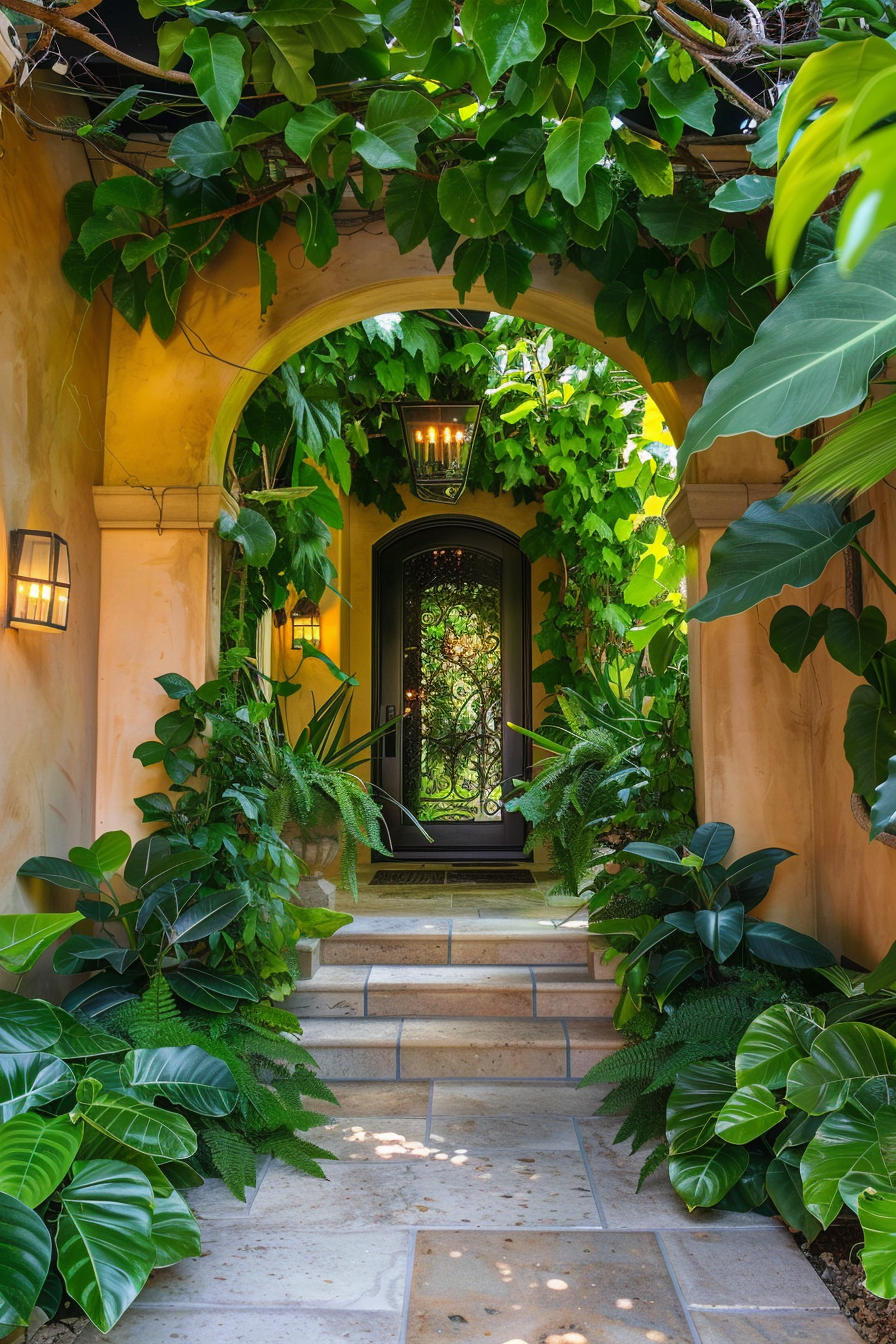
Honestly, plants might be the single most forgiving entryway upgrade there is. They cover a multitude of sins. Ugly concrete foundation? Awkward porch proportions? A front door you haven’t gotten around to painting yet? Greenery softens all of it.
The trick is to mix leaf shapes and sizes rather than planting one single thing in a row. I made that mistake my first summer here — I bought twelve identical boxwoods and planted them along my front walk and it looked like a hedge maze, not a home. What actually works is layering: something tall in the back or corners (a Japanese maple, a columnar evergreen), something medium and mounding in the middle (hydrangeas, knockout roses, ornamental grasses), and something low and trailing at the edges or in containers.
Evergreen shrubs are worth the investment because they give you something green and alive even in January when everything else looks sad. Pair them with a few seasonal bloomers — hydrangeas in summer, ornamental kale in fall — so the entry stays interesting all year.
A few placement ideas that work really well:
- Flank the front walkway with matching beds of layered plantings so guests feel guided toward the door
- Place tall potted plants (think 18-inch terra cotta urns with a small tree or big fern) on either side of the door itself
- Train a climbing vine — jasmine, clematis, even a rose — up a trellis beside the door for vertical drama
- Line the path with small matching pots if you don’t have ground beds
Pro tip: Group plants with similar water needs together. I killed an embarrassing number of plants before I learned this. If your entry gets harsh afternoon sun (mine gets brutal 3pm west light), stick to drought-tolerant things like lavender, sedum, or ornamental sage in those spots.
For a real focal point, one larger statement plant — a standard-form hydrangea, a weeping cherry, even a big sculptural agave if you’re in a warm climate — placed just off-center creates that “designed” feeling without requiring a landscape architect.
The goal is that when guests pull up, they see something alive and cared-for. That communicates everything about the kind of home they’re walking into.
The Statement Front Door: Don’t Play It Safe
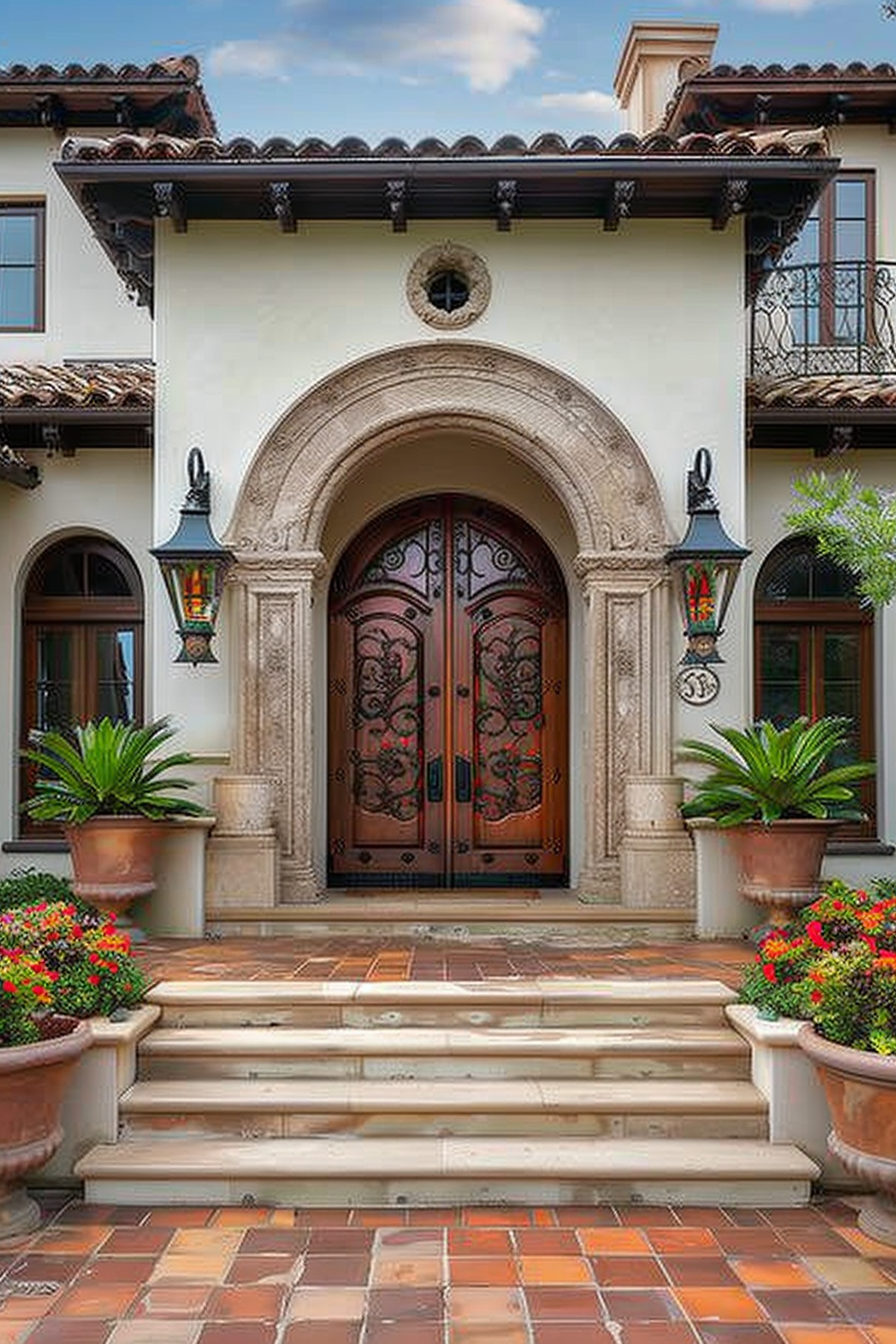
I will go to my grave believing that a bold front door is one of the best returns on investment in all of home decor. We’re talking $40 to $80 in paint for most doors. The transformation is genuinely shocking.
Most people default to black or brown because it feels “safe.” And black does look sharp, I won’t argue that. But a deep teal, a warm terracotta, a glossy cobalt blue, a rich burgundy — these are the doors that stop people in their tracks. My neighbor has a saturated mustard yellow door and I think about it every single time I walk past.
When you’re picking a color, hold the swatch against your home’s actual exterior in daylight. Colors read totally differently against warm brick versus cool gray siding versus white stucco. What looks perfect at the hardware store can look completely wrong on the house (I learned this the not-inexpensive way with a shade that turned a weird orange in direct sun).
Beyond color, consider the door’s actual form. A few options that make a real impact:
- Doors with sidelights (the narrow windows on either side) feel more grand and let in more light
- Transom windows above the door add architectural interest without requiring a full door replacement
- Carved or paneled wood doors have texture and depth that paint colors alone can’t replicate
- A vintage or antique door — properly weatherstripped and sealed — adds character you simply can’t buy new
Pro tip: Hardware matters more than people think. New door hardware costs $30 to $150 and takes twenty minutes to swap out. Matte black, aged brass, unlacquered bronze — pick one finish and use it consistently on the knob, the knocker, and the house numbers. The cohesion reads as intentional and polished even on an older house.
Light the door too. A pair of sconces flanking the door (more on lighting below) or even a single pendant lantern above it makes the whole thing glow at night. The door becomes the star.
Don’t overthink it. Pick the color that makes you happy when you pull into the driveway. You live there. It should feel like yours.
Grand Entry Columns and Pillars: Borrow the Drama
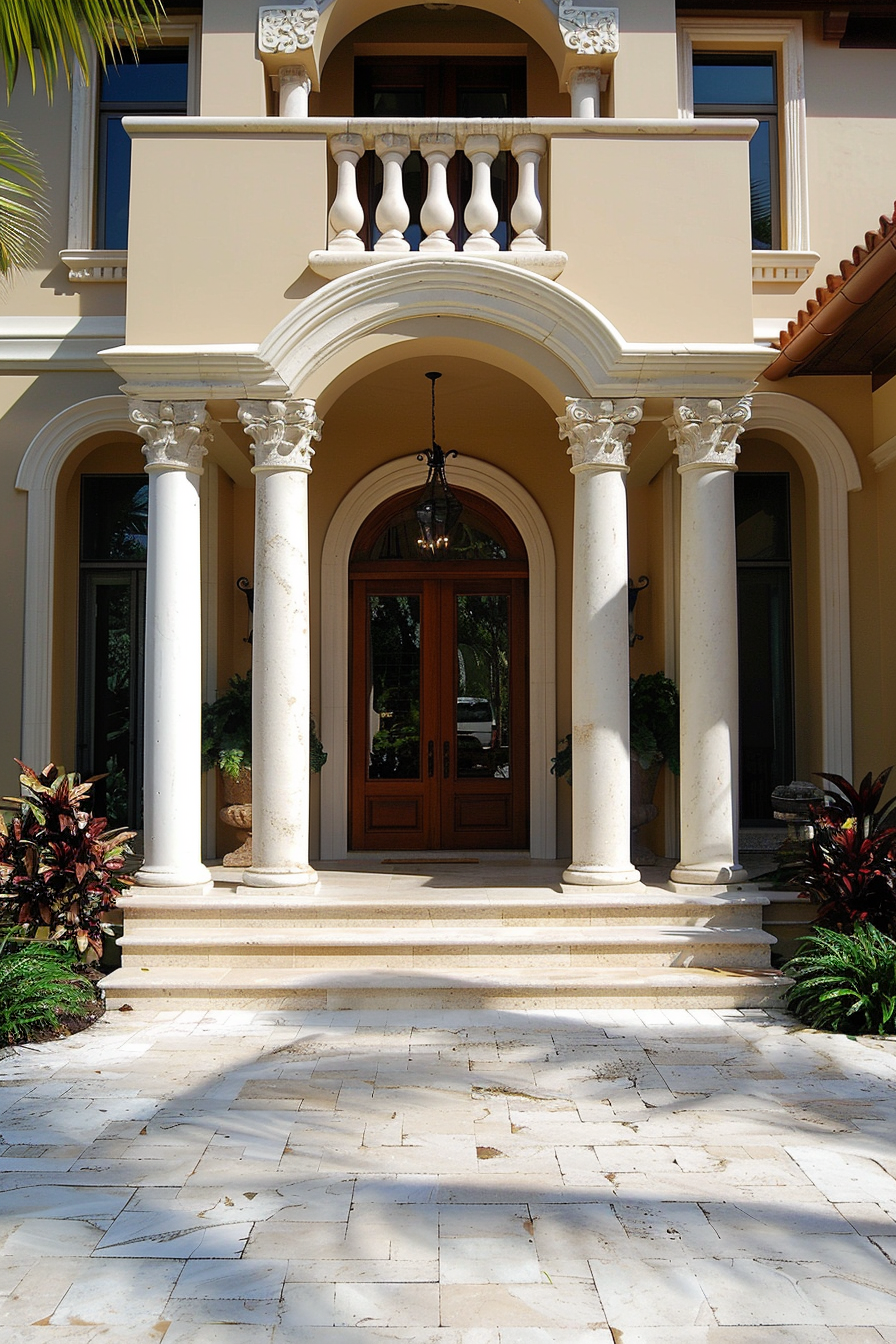
Columns get a reputation for being formal or old-fashioned, but done right they just create structure. They define where the entry begins and ends. They give the eye somewhere to land. And they make the whole space feel more intentional.
If your home already has columns — even basic square porch posts — you have more to work with than you might realize. A coat of fresh paint and some updated hardware at the base and cap goes a long way. Training a climbing vine up one or both columns softens the formality and adds life.
For homes that don’t have them, adding columns is a bigger project but not always as expensive as people assume. Prefab column wraps (basically a hollow shell that fits over an existing post) are available at most home improvement stores for around $60 to $200 each. They look significantly more substantial than the skinny posts underneath.
Material choice matters a lot for style matching:
- Stone or brick columns: traditional, heavy, grounded — great for craftsman or colonial styles
- White painted wood columns: classic, works with almost everything, especially farmhouse and cottage
- Stucco-wrapped columns: clean and Mediterranean, lovely with warm exterior colors
- Slim metal posts: modern and minimal, best left unadorned with simple plantings nearby
Pro tip: The column cap (the top detail) does a surprising amount of visual work. A simple flat cap reads casual. An elaborate Corinthian-style capital reads formal. Match the complexity of the cap to how dressed-up you want the entry to feel.
Anchor columns visually by adding something at the base — a decorative plinth, a cluster of low plantings, or a potted plant. This keeps them from looking like they’re just floating there. And if you want to add seating between columns on a wider porch, even a small bench or a pair of chairs creates a complete little room feeling.
The vertical lines columns create draw the eye upward, which makes the whole entry feel taller and more welcoming. It’s one of those architectural tricks that works every single time.
Statement Lighting: This Is the One Nobody Does Well Enough
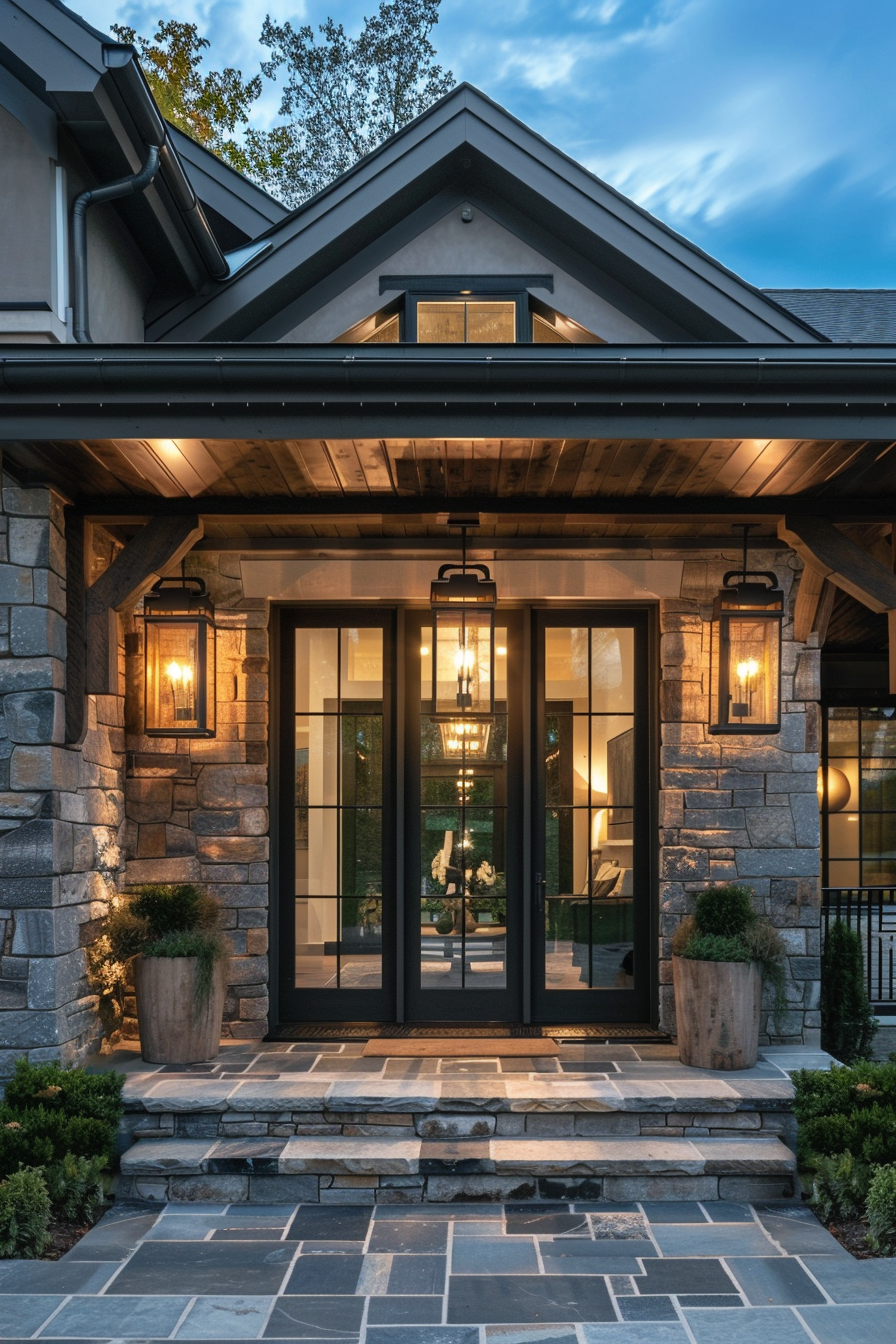
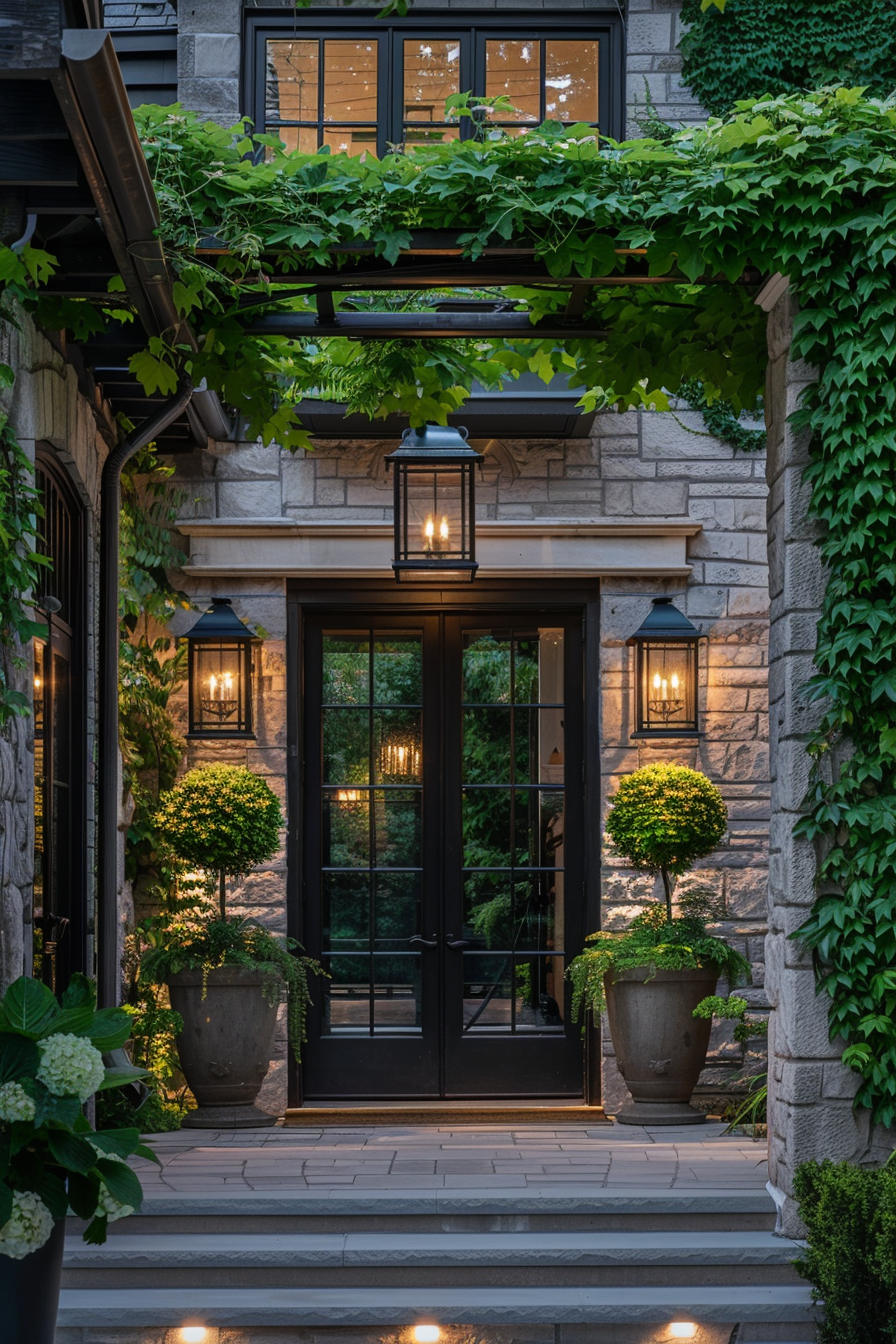
Okay, I have strong feelings here. Outdoor entryway lighting is almost universally bad. One overhead fixture bolted above the door, casting harsh downward light, making everyone look vaguely suspicious. That’s the standard. And the standard is wrong.
Good entryway lighting uses multiple sources at different heights. Think about it like how you’d light a room inside — you wouldn’t use one overhead fluorescent and call it done. Outside is the same principle.
Here’s how I think about it in three layers:
Ambient Lighting: Soft, Warm, Welcoming
Wall sconces flanking the door are the workhorse here. Two sconces at roughly eye level cast even, flattering light on anyone standing at the door. Choose warm-toned bulbs (2700K to 3000K color temperature) — this makes such a difference. Cold white light at an entry feels clinical and a little unwelcoming. Warm light feels like someone’s home and happy you’re there.
Hanging lanterns work beautifully above a porch or covered entry. Rattan, aged brass, black iron — pick what suits your house. The fixture itself becomes a decorative element in daylight too.
Accent Lighting: Drama and Depth
This is the layer people skip and it’s the one that makes the biggest difference at night. Small uplights aimed at trees or architectural features create those gorgeous pools of light and shadow that make a house look like it belongs in a magazine. You can buy solar-powered landscape uplights for around $8 to $15 each (I have a set of six I paid $40 for total and they look great).
Spotlighting the front door itself — a small fixture aimed directly at the door from above or the side — makes it a focal point even after dark.
Pathway Lighting: Safety and Magic
Path lights along the front walkway serve a real practical purpose but they also create a beckoning, warm effect that guides guests right to you. Low-profile path stakes look cleaner than tall bollard-style fixtures in most residential settings. Space them 6 to 8 feet apart rather than cramming them close together — more space between lights reads as more confident and less like a landing strip.
Pro tip: Tuck string lights or fairy lights into the branches of a tree or large shrub flanking the entry. The effect is completely different from Christmas lights — it looks organic and warm and a little magical, not festive. This is genuinely one of the cheapest things you can do that looks expensive.
Smart bulbs are worth the few extra dollars if you want to be able to dim down to a warm glow for evenings when guests arrive. Harsh bright light isn’t cozy. It’s a crime. (I have opinions.)
Stylish Outdoor Furniture: Make the Space Feel Livable
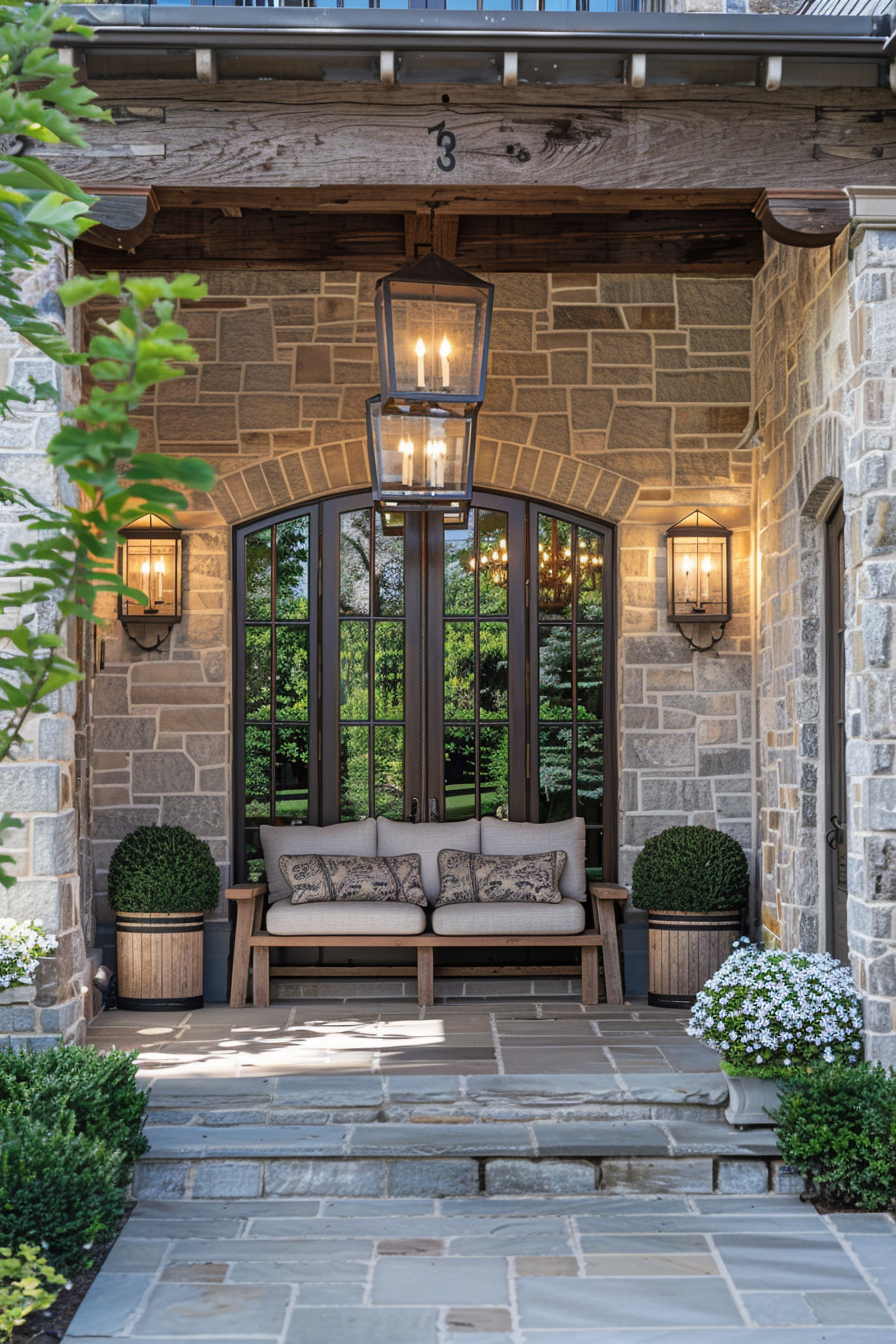
A bench or a pair of chairs at the entry does something psychological that’s hard to explain until you experience it. It says: people sit here. This is a home, not just a facade. Come in and stay a while.
It’s also genuinely practical. Guests can sit down to take off muddy boots. Delivery packages have a spot. You have somewhere to set your coffee when you’re fumbling for keys (this is a real situation in my life multiple times a week).
For small porches or stoops, a narrow bench — the kind that’s maybe 42 to 48 inches wide — is usually the right call. It gives you seating without blocking the path. If you have more porch square footage to work with, a bench plus one or two chairs with a small side table creates an actual sitting area that feels intentional rather than accidental.
Material considerations for outdoor furniture:
- Teak: ages beautifully to silver-gray, basically maintenance-free, expensive upfront but lasts forever
- Cedar: more affordable, smells incredible, does need periodic sealing
- Powder-coated aluminum: lightweight, rust-proof, comes in every color, very practical
- Wicker/rattan: beautiful, needs to be rated for outdoor use specifically or it disintegrates (learned this the hard way, RIP my first porch chairs)
Pro tip: Cushions and throw pillows are the fastest way to add personality and color. Outdoor fabric like Sunbrella holds up well and doesn’t fade the way regular fabric does in sun. Go for a pattern or a pop of color — this is not the moment for beige.
Thrift stores and estate sales are genuinely great sources for entryway furniture. An old wooden bench with some fresh paint and new outdoor cushions costs almost nothing and looks charming. I found a fantastic cast iron bistro set at a yard sale for $25 and it’s been on my porch for three years. Biscuit has chewed one of the cushions but otherwise it’s holding up beautifully.
Finish the look with a few small decor items nearby — a basket for shoes, a small tray on the side table, a potted plant tucked beside the bench. These details make it feel lived-in rather than staged.
Chic Planters and Potted Plants: The Easiest Win
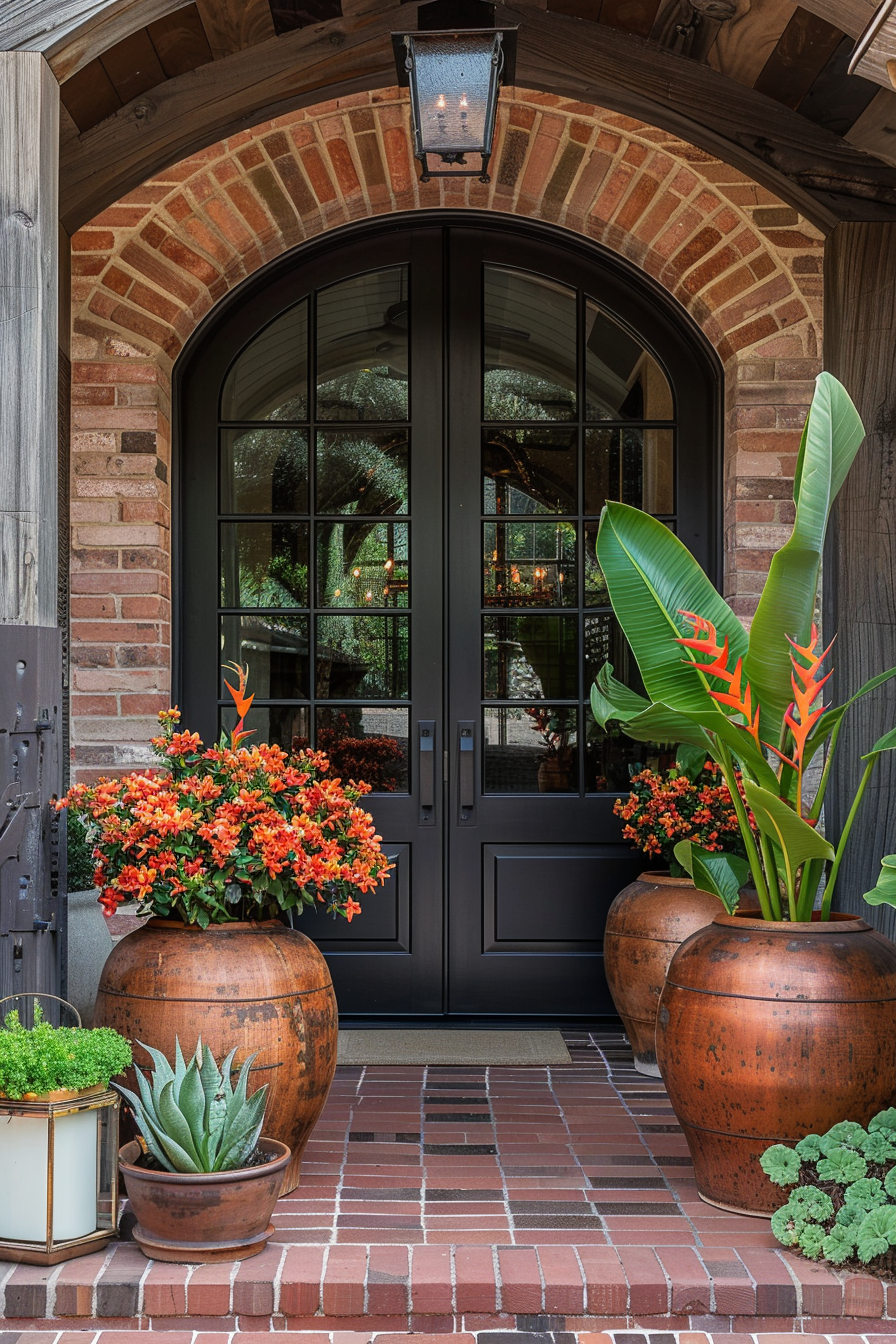
If you can only do one thing to your outdoor entry this weekend, make it this. A pair of large planters flanking the front door is the single highest-impact, lowest-effort, most affordable upgrade there is. I’m not exaggerating.
The size of the planter matters more than most people realize. Too small and it looks like an afterthought. Aim for planters at least 16 to 18 inches in diameter and 18 to 24 inches tall when placed beside a standard door. They need enough visual weight to hold their own against the architecture.
Planter materials and what they say:
- Terra cotta: warm, classic, works with everything, gets better looking as it ages, but can crack in hard freezes
- Concrete or cast stone: substantial, modern or traditional depending on the form, very durable
- Fiberglass (that looks like stone or concrete): lighter weight, easier to move, holds up in all climates, underrated
- Painted wood boxes: great for cottage or farmhouse looks, need to be lined and properly sealed
- Metal: modern and graphic, gets very hot in full sun so choose plants accordingly
For plants that actually survive entry conditions (part shade, wind, irregular watering from whoever you are as a plant parent), I’ve had luck with: upright junipers or false cypress for height, boxwood globes for classic symmetry, ornamental grasses for movement, sweet potato vine for trailing color, and geraniums for prolific blooms all summer. Succulents if your entry is dry and sunny.
Pro tip: The “thriller, filler, spiller” formula works in containers just like anywhere else. One tall dramatic plant (thriller), something mounding to fill in the middle (filler), something trailing over the edge (spiller). It takes about 10 minutes to plant and looks like you know what you’re doing.
Seasonal swaps keep things fresh. I change my porch planters four times a year — spring bulbs, summer tropicals, fall mums and ornamental kale, evergreen boughs and berries in winter. Each version costs maybe $15 to $25 in plants and it genuinely feels like a different house each season.
Charming Front Porch: The Whole Package
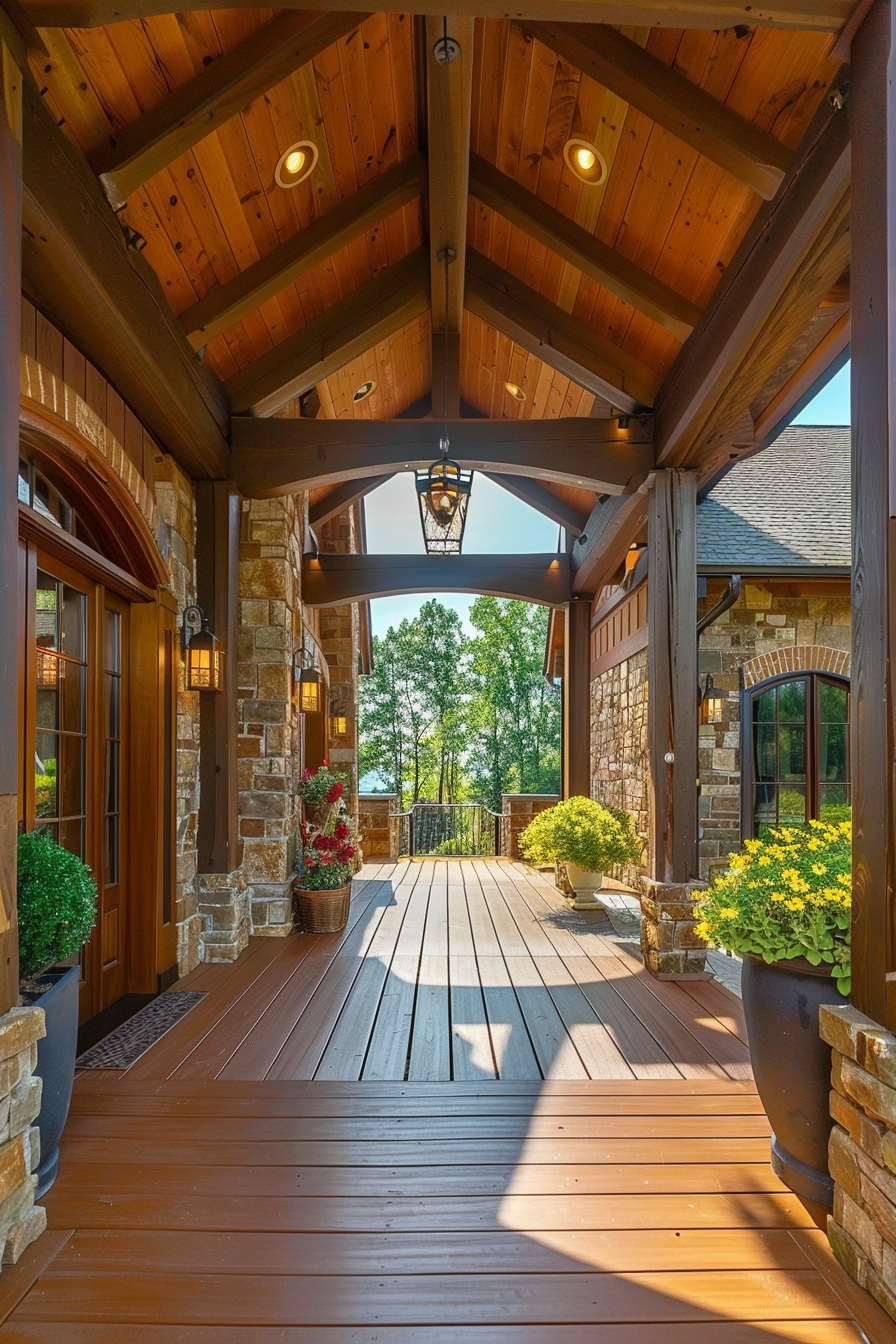
A real front porch is something I feel almost emotional about. Maybe because my house has one and I know what it’s like to pull up to a home with a porch versus one without — it’s a completely different feeling. A porch signals that people actually live here. That there’s time for sitting and talking. That you’re welcome.
If you have a porch and you’re not using it to its potential, I want to shake you gently. This is some of the most valuable real estate on your entire property for creating first impressions.
Start with the floor and ceiling if you can. A porch floor in a warm gray or soft white paint (porch-specific floor paint holds up to foot traffic) immediately looks cleaner and more intentional. A beadboard ceiling painted a soft sky blue or pale sage is a classic Southern touch that genuinely changes the whole feel of a porch. It’s also supposed to keep wasps from nesting (I can’t confirm this scientifically but my grandmother swore by it).
Porch details that make a real difference:
- A proper doormat — not a flat rubber grocery-store mat but an actual decorative coir or woven mat with enough thickness to feel substantial
- House numbers that are readable and stylish (oversized brass or black metal numbers feel modern and intentional)
- A porch swing or rocking chairs if the space allows — few things are more inviting
- A ceiling fan on larger porches for summer comfort
- Window boxes with seasonal plantings if your porch has windows or railings to attach them to
Pro tip: One pop of color saves a porch from looking like a catalog page and makes it feel like a real home. My porch has white walls, gray floor, and mostly neutral furniture — and my bright red door plus a set of coral-colored cushions pulls the whole thing together. Pick one or two accent colors and repeat them in small ways throughout the space.
For porches that are small or just a covered landing, the same principles apply at a smaller scale. A single bench, one good planter, a statement light fixture, and a great doormat. That’s actually enough.
Contemporary Covered Entry: Clean Lines, Maximum Impact
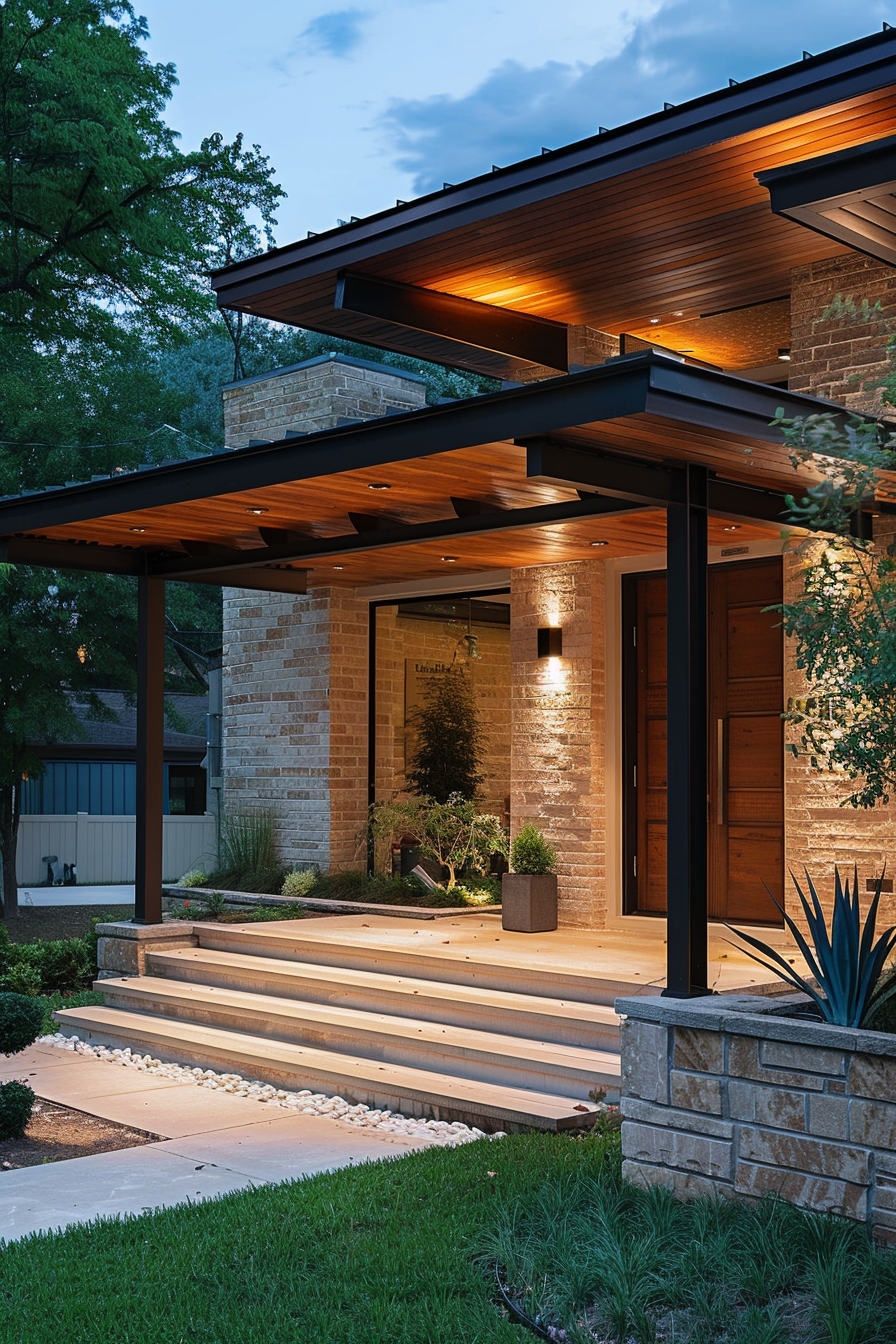
Not every house wants a porch with rocking chairs. Some houses want sharp angles and honest materials and the kind of entry that feels like it was designed yesterday. And that’s completely valid. A contemporary covered entry done well is genuinely stunning.
The principles here are almost opposite from the charming farmhouse porch: fewer elements, each one more deliberate. A contemporary entry earns its power from restraint. One good planter instead of six. One bold door instead of a dozen decorative details. Clean lines instead of ornamental trim.
Materials that work for contemporary entries:
- Ipe or cedar wood cladding on the overhang (ages beautifully, feels warm against modern materials)
- Concrete pavers — large format, minimal grout lines
- Corten steel accents (that warm rust-brown patinated metal that looks intentionally weathered)
- Board-formed concrete for walls or bases
- Black or dark gray painted surfaces for contrast
For planting, stick to architectural specimens: a single ornamental grass, a row of slim bamboo in a long planter, a sculptural succulent, or a clipped boxwood sphere. One plant chosen well beats ten plants chosen casually.
Pro tip: A black or dark navy front door with simple hardware is almost always the right move for a contemporary entry. Keep the hardware in a single finish — matte black is the most consistent choice. The contrast between a dark door and lighter exterior materials is clean and confident.
Tech integration feels natural here too. A flush-mounted video doorbell, concealed wiring, a smart lock with a clean keypad — these additions make functional sense and don’t visually compete with the architecture. The contemporary entry is one place where less really is more, and getting there takes editing rather than adding.
Rustic Wood Arbor: Old-World Charm That Actually Works
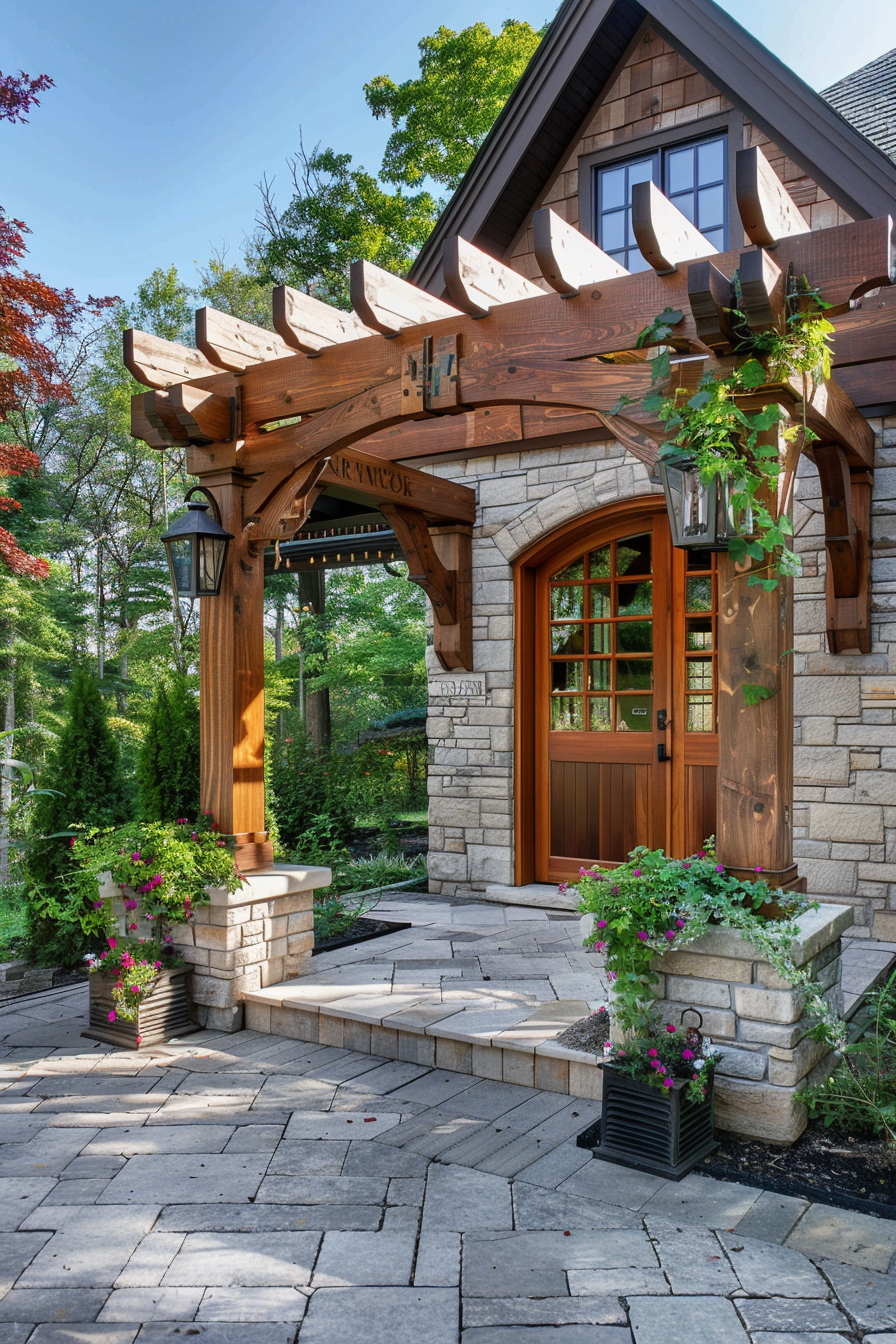
I’ve wanted an arbor over my front walk for years. Every time I see one with roses climbing up the sides and that warm, dappled light filtering through, something in my chest does a little jump. It’s one of those features that reads as completely romantic and slightly old-fashioned in the best possible way.
An arbor works in two locations: directly framing the front door, or spanning the front walkway so guests pass through it on the way to the entry. The walkway version is my personal preference because it creates a whole moment — you walk through the arbor, the plantings close in slightly around you, and then you arrive at the door. It feels like an arrival, not just an approach.
Wood choices and what they give you:
- Cedar: naturally rot-resistant, weathers to a soft silver-gray, doesn’t need finishing though it looks lovely with a light stain
- Redwood: similar to cedar, beautiful warm tone, excellent longevity
- Pine: less expensive, should be pressure-treated or sealed for outdoor use, good for a painted white arbor
- Black locust: incredibly durable, harder to source but lasts 40+ years in ground contact
Vines to grow on an arbor: climbing roses for romance and fragrance, clematis for prolific blooms in many colors, jasmine for scent, wisteria for drama (but be warned — wisteria is aggressively enthusiastic and will try to take over your house if you let it). Passionflower is gorgeous and unusual if you’re in a warm enough climate.
Pro tip: Weave string lights through an arbor and leave them up year-round. Not blinking Christmas lights — steady warm fairy lights. At dusk they create a glow that is honestly one of the most purely beautiful effects you can achieve in an outdoor space for about $15 in materials.
A simple DIY arbor from cedar boards can cost as little as $80 to $150 in lumber if you’re handy. Pre-built arbor kits are available for $200 to $500 and take an afternoon to assemble. Either way, once the plants fill in you won’t be able to imagine the entry without it.
Statement Pathway: Don’t Ignore the Walk to the Door
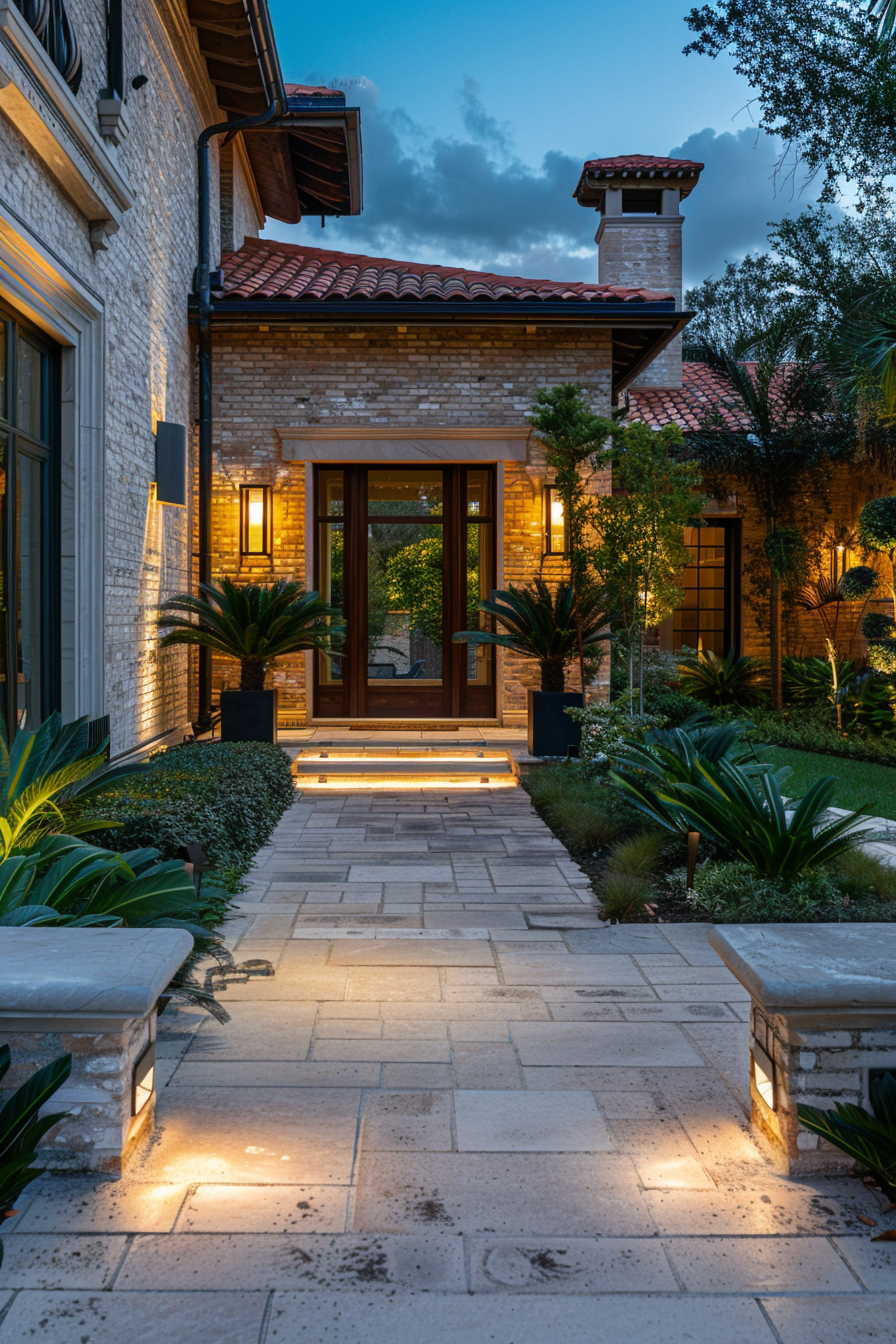
Here’s something I didn’t fully appreciate until I replaced my cracked concrete front walk: the path to your door sets up every expectation guests have before they even get to the entry itself. A crumbling sidewalk says neglected. A beautiful stone path says cared for. The door and the porch haven’t even happened yet — the path is already doing PR work for your home.
The first question is width. Most front walks are 36 inches, which is just barely enough for one person. A 48-inch path feels noticeably more generous and gracious. If you can get to 5 feet, two people can walk side by side comfortably and the whole entry reads as more welcoming. Going wider is almost never a mistake.
Material options and what they say about your house:
- Brick: classic, warm reddish tones, works with traditional and craftsman homes, needs occasional re-leveling as it settles
- Natural stone (bluestone, limestone, slate): the most beautiful option in my opinion, expensive, lasts forever, every piece is slightly different which gives it character
- Flagstone with ground cover planted in the gaps: cottage-romantic, looks amazing once the creeping thyme or Irish moss fills in
- Concrete pavers: very clean and flexible, available in countless colors and sizes, much more interesting than poured concrete
- Poured concrete: practical, affordable, completely acceptable if stamped or scored into a pattern
- Decomposed granite with edging: informal and beautiful, great for Mediterranean or desert-inspired homes
Pro tip: Border your path with low plantings — creeping plants, low ornamental grasses, clipped box hedging — to define it and make it feel intentional. The contrast between the hard paving material and soft plant edges is what makes a path look designed rather than just installed.
Lighting along the path is genuinely important, not just decorative. Path stake lights spaced every 6 to 8 feet are the standard approach and they work well. For a more architectural look, consider in-ground step lights at any grade changes, or surface-mount fixtures set into low walls or planting bed edges. The goal is to see the path clearly without the fixtures competing visually with the entry itself.
Winding paths feel secret and intimate. Straight paths feel confident and direct. The right choice depends on your property layout and the mood you want to create — neither is wrong, they’re just different stories.
Water Features: The Unexpected Detail That Changes Everything
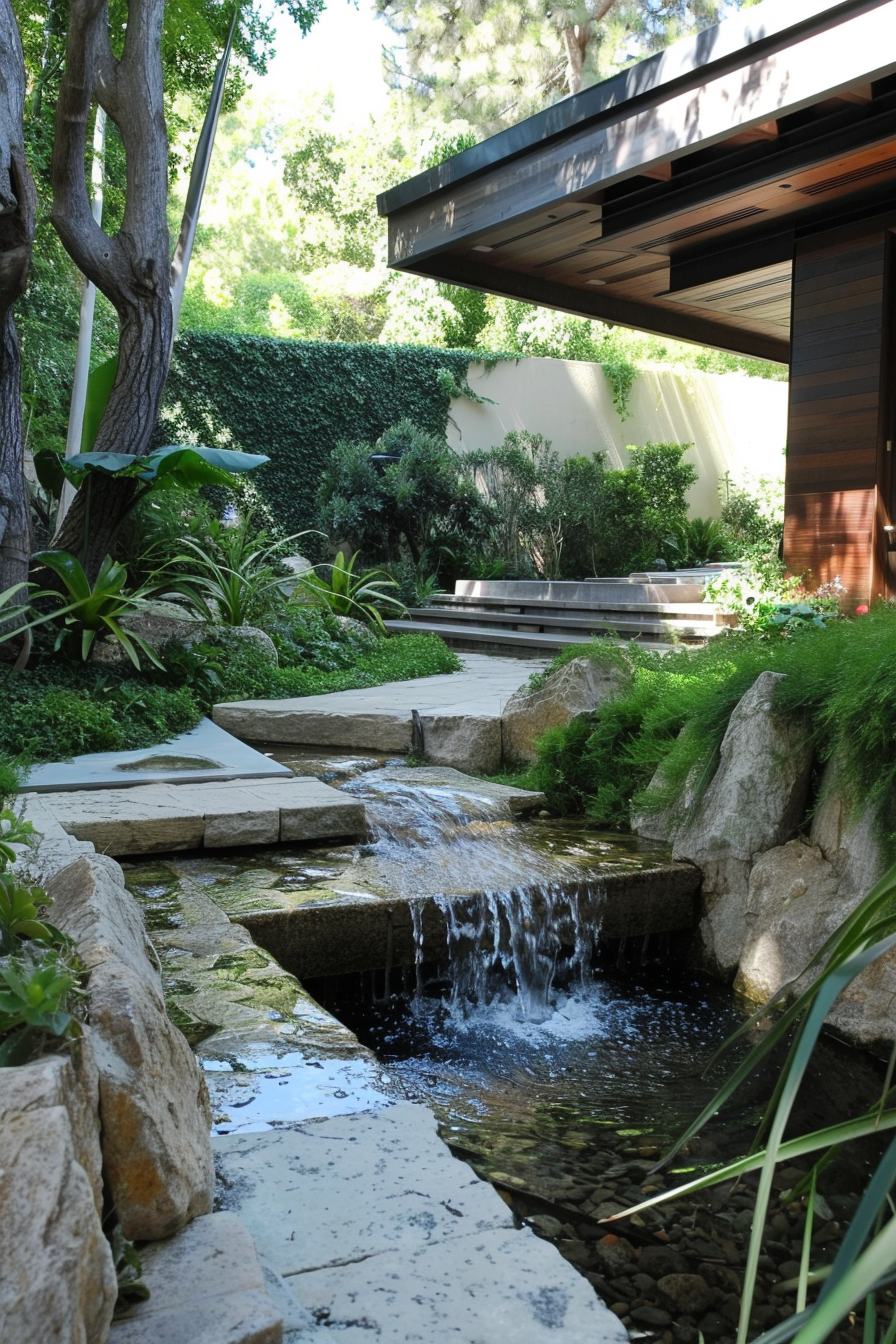
The first time I sat outside a house with a small fountain near the entry, I noticed I was more relaxed before I even went inside. Something about moving water just does that to people. It covers street noise. It draws attention in a gentle way. And it signals a kind of care and intentionality that guests feel even if they can’t name it.
The good news is you don’t need a dramatic two-tier fountain with koi to get this effect. Some of the most successful entryway water features are small and quiet.
Options across a range of scale and budget:
- Self-contained tabletop or floor fountain: $50 to $200, plugs into an outdoor outlet, can sit on a porch or in a garden bed, zero installation required — this is where I’d start if you’ve never done a water feature before
- Ceramic or stone urn fountain: $150 to $400, beautiful as a standalone piece, the water wells up and spills down the sides, feels classical and serene
- Bamboo spout into a basin: simple, slightly minimal Japanese aesthetic, the sound is incredibly peaceful, relatively easy DIY project
- Tiered cast stone fountain: $300 to $800+, more architectural presence, works as a true focal point in a larger entry garden
- Pond with a small waterfall or bubbler: significant installation, significant impact, genuinely stunning if the scale works with your property
Pro tip: Illuminate your water feature from below or from the side with a small spotlight. Water in motion catches and scatters light in a way that’s completely disproportionate to the size of the fixture. A $60 fountain with a $12 garden spotlight aimed at it looks like something from a boutique hotel at night.
Maintenance concern people always bring up: mosquitoes. Moving water is actually resistant to mosquito breeding — it’s still standing water that’s the problem. Keep your fountain running whenever possible and do a water change every week or two. Add a small amount of mosquito dunks (the kind with Bt, totally plant and pet safe) to be sure.
Pair a water feature with lush plantings nearby — ferns, hostas, or other moisture-loving plants — and the whole corner of your entry feels like a completely different microclimate. Cool, peaceful, shaded. Guests gravitate toward it before they even realize what they’re doing.
Eye-Catching Art Installations: Make Your Entry Unforgettable
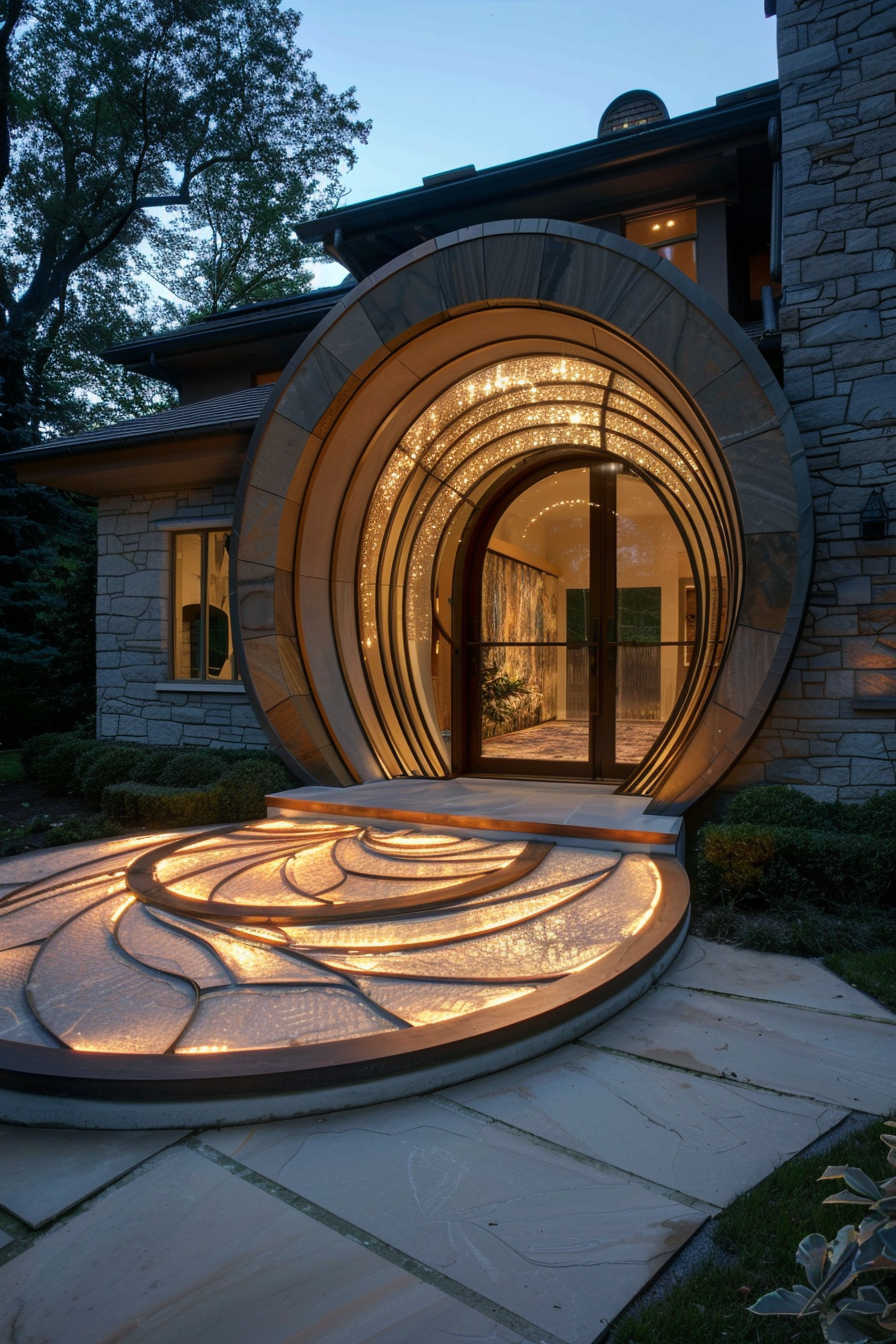
This is the one I feel like most people are too scared to try, which is a shame because it’s also the one that makes an entry genuinely memorable rather than just nice. A well-chosen piece of outdoor art makes guests say something — and something is better than nothing.
Outdoor art for an entryway falls into two main categories: freestanding pieces in the garden or landscape, and wall-mounted pieces on the facade. Both work, and you can combine them.
For garden sculpture, the most important thing is scale. A 12-inch decorative ball from a craft store gets swallowed up in a normal-sized garden and looks like you forgot to buy the real thing. Aim for pieces that are at least 18 to 24 inches in their smallest dimension — something that holds its own visually against plantings, architecture, and the open sky. Taller is usually better.
Materials that hold up outdoors:
- Corten steel: ages to a rich rust patina, zero maintenance, very architectural, looks incredible against dark green plantings
- Cast aluminum or bronze: classic, traditional figurative sculpture, patinas beautifully over time
- Concrete or cast stone: heavy but extremely durable, works for abstract or classical forms
- Glazed ceramic: beautiful color options, needs protection in hard-freeze climates
- Stainless steel: reflects light and surroundings, very modern, doesn’t rust
For wall art on the exterior facade, colorful ceramic tiles or mosaic panels are stunning against a plain stucco or brick surface. Oversized metal letters or house numbers become art when they’re done with care. A chalkboard panel in a weatherproof frame flanking the door that you change with the seasons is both personal and a great conversation starter.
Pro tip: If you’re not sure about scale, cut out a cardboard shape approximately the size of the piece you’re considering and stand it in the spot. Step back to the street and look. This is the single best thing I do before committing to any outdoor decor purchase. It saves so much money and regret.
Thrift stores, estate sales, and local artist markets are genuinely good sources for outdoor art at non-gallery prices. I found an abstract metal wall panel at an estate sale for $18 that looks like it belongs in a boutique hotel entry. Keep your eye out. The right piece will show up.
Lighting transforms outdoor art after dark in ways that are almost unfair. Even a single $15 solar-powered spotlight aimed at a sculpture makes it feel like a curated installation. The shadows and highlights shift through the night as the light source angle changes. It’s kind of magical and costs almost nothing.
Your outdoor entryway is doing real work for you every single day — welcoming people you love, making first impressions on everyone who drives past, and telling a story about what kind of home is waiting inside. The ideas here range from a $15 string of fairy lights to a full porch renovation, but all of them share the same basic goal: making the approach to your door feel warm, considered, and genuinely inviting. Start with one thing. See how it feels. I promise it’ll be hard to stop at just one.